Matanzas/The intensive care doctor Gustavo has just finished his work at the hospital, but he still has another day ahead of him. This time he will not wear a white coat nor will he have to care for seriously ill patients. He will sit at the helm of his Lada to transport some clients from Matanzas to Havana. In the front seat he has placed a thermos of coffee, essential to ward off drowsiness during the journey.
Two brand new wiper blades shine on the windshield. “They cost me 12 dollars. I got them at that price because a man who was a patient of mine sold them to me. If I look for them in the Facebook groups, they are also at 15 and 20,” he explains. In today’s Cuba, even windshield wipers can become a luxury, especially for someone who earns 7,200 pesos a month.
Gustavo inherited his father’s car and, to keep it, he has had to turn it into his second means of living. “If it depended on the hospital’s salary, this machine would already be sold or thrown away in a garage,” he says. Over the last five years he has learned mechanics, made small welds and fixed defects that he would have previously entrusted to a specialist.

/ 14ymedio
“You go into a private workshop for a small thing and they charge you any amount of money,” he laments. Added to the shortage of parts are skyrocketing prices, poor repairs, and the risk of purchasing a used part that ends up lasting less than the trip home.
With 26 years of experience as an intensivist, Gustavo applies a rule learned in the hospital to the car: stop any symptom before it worsens. “A car is like a person, if the problem is not attended to in time, it can get sick and die,” he says.
Each transfer to the airport or to an embassy in Havana can cost you $150. Not everything stays in your pocket: you have to deduct gasoline, set aside money for household needs and feed a piggy bank for future breakdowns.
/ 14ymedio
Now you need to change the gearbox. He already found one for $90 and figures he’ll be able to buy it after a couple of trips. While chatting, he confirms another service to the Varadero airport via WhatsApp. He is in no position to turn away clients, even though some races barely make a profit.
On the streets of Matanzas, maintaining a private car without putting it into production has become an extravagance. Old Soviet Ladas share the asphalt with American almendrons that have survived thanks to an endless succession of mechanical grafts.
Nelson’s 1952 Chevrolet, for example, is powered by a Ford engine and a fuel transfer pump salvaged from a dismantled Cadillac. “You have to have a greenback factory to keep these bugs rolling. With Cuban pesos you can’t even find a silicone tube for broken glass,” he protests.
The machine starts, purrs for a few seconds and turns off again. Nelson takes advantage of the slope of his street to take it out of the garage every day, walk a few blocks and leave it parked down the hill. “It’s the battery that doesn’t work anymore, but where am I going to get $600 to buy a new one,” he laments.
/ 14ymedio
Nor do the tires resist potholes indefinitely. In the informal market, one can cost 35 dollars: 140 for the four, not counting the spare. Nelson got two used rear tires for $100 each, thanks to money sent by his son.
Retired from the fishing industry, he kept the Chevrolet working as a rented taxi between Peñas Altas and the Provincial Hospital, until disagreements arose with the driver. Now he hesitates between renting it again or selling it.
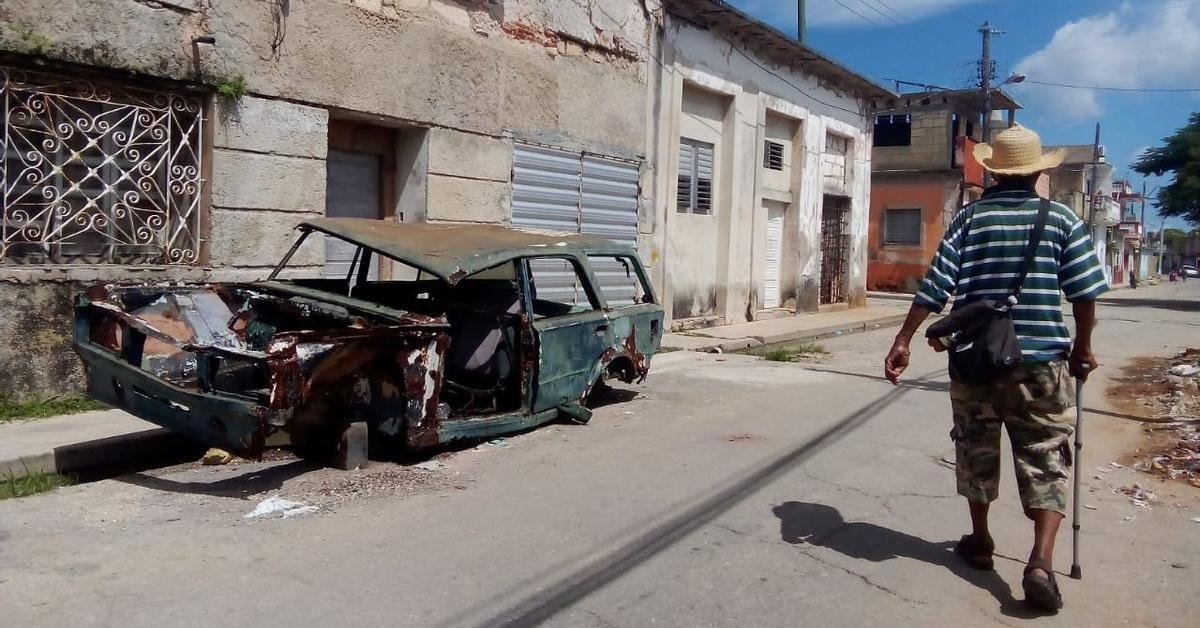
Under the Simpson neighborhood sun, the once sky-blue paint shows its decades of wear. On other streets, impeccable, newly imported cars circulate in a hurry, while a dismantled car remains next to a peeling façade, reduced to a body without wheels.
The image summarizes a threat that all owners know: all it takes is a breakdown, a defective part or an unscrupulous mechanic for the vehicle to end up as scrap metal.
“If I finally decide to sell it, at least I can get the cost,” Nelson calculates about the newly purchased tires. Gustavo, meanwhile, returns to the hospital after his trips. One tries to save his Chevrolet; the other, to keep the family Lada. They both know that, in Matanzas, having a car no longer necessarily means being able to get around.