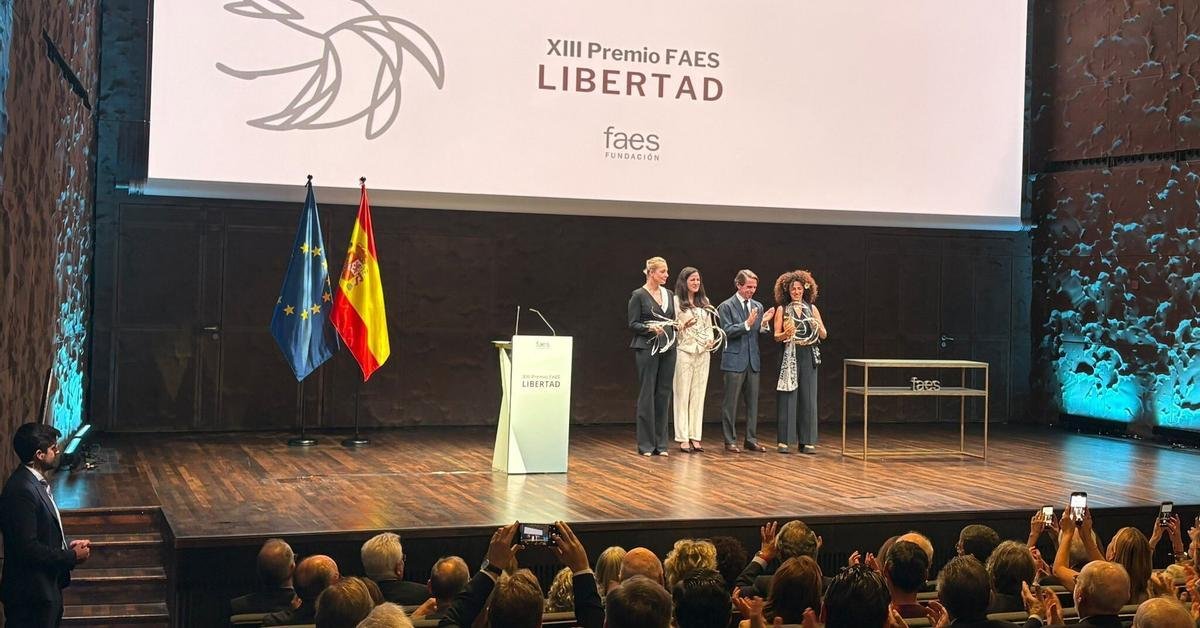
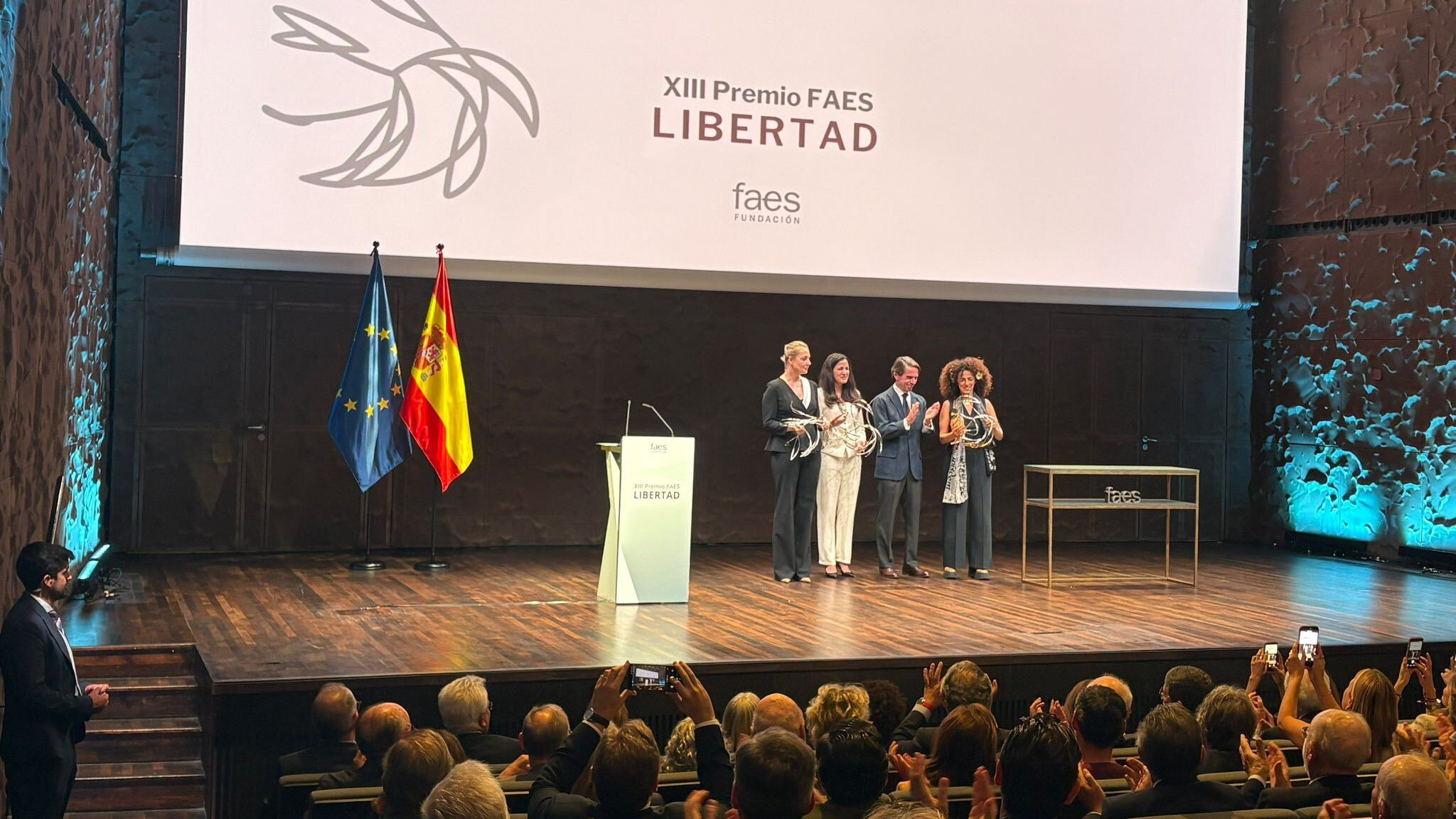
Madrid/The Cuban opposition figure Rosa María Payá received this Friday in Madrid the 13th FAES Freedom Prize, which she shares with the Russian Yulia Navalnaya, widow of the dissident Alekséi Navalni, and the Iranian journalist Masih Alinejad. The recognition was presented by the former president of the Spanish Government José María Aznar, during a ceremony held at CaixaForum Madrid, in which the three activists denounced the repression in their respective countries and demanded a greater international commitment to democracy.
“Cuba is closer to freedom than many imagine,” Payá said during his speech. The activist, who has been a member of the Inter-American Commission on Human Rights (IACHR) since January of this year, stated that the Island is “just moments away from dawn” and asked Spain to accompany the Cuban people in an eventual political transition.
“On the island and in exile we are convinced that the only way to overcome this humanitarian catastrophe is to leave the dictatorship, and we are leaving our lives to it,” declared the daughter of the deceased opposition member Oswaldo Payá.
“Eating twice a day is a luxury,” lamented Payá, who also denounced the shortage of medicines, food, electricity and drinking water.
The winner dedicated part of her speech to describing the deterioration of living conditions in Cuba. He recalled that in 2025 approximately twice as many people died as were born and pointed out that 94% of the population lives in conditions of extreme poverty, according to estimates by the Cuban Observatory of Human Rights.
“Eating twice a day is a luxury,” lamented Payá, who also denounced the shortage of medicines, food, electricity and drinking water.
The opponent took the opportunity to announce that on November 3, the equipment and capabilities developed by the signatory organizations of the Liberation Agreement, signed in March in Miami and later ratified in the Spanish capital, will be presented in Madrid. The call will coincide with the days prior to the Ibero-American Summit, scheduled for November 4 and 5.
Payá also criticized the Government of Pedro Sánchez, whom he reproached for having been “closer to the dictators than to the Cuban people,” as he told EFE after the ceremony. Before the Spanish elections in November, he called for a new relationship between both countries that prioritizes the defense of human rights.
“The Russian dictatorship killed my husband, the Cuban dictatorship murdered Rosa María Payá’s father and the Iranian dictatorship tried to kill Masih many times”
The prize, whose award It was announced at the end of Julyrecognizes the trajectory of the three activists in the defense of civil liberties. The decision was adopted unanimously by the Board of Trustees of FAES, a foundation linked to the Popular Party and chaired by Aznar.
During the ceremony, Navalnaya established a parallel between the death of her husband, who died in a Russian prison in February 2024, and that of Oswaldo Payá, which occurred in Cuba in July 2012.
“The Russian dictatorship killed my husband, the Cuban dictatorship murdered Rosa María Payá’s father, and the Iranian dictatorship tried to kill Masih many times,” declared the Russian activist. He also called on democratic movements to work together and share their experiences against the governments they fight.
One of the most striking moments of the day featured Masih Alinejad, who took the stage with a scarf covering her hair and took it off in front of the audience. He then threw it to the ground while shouting “Freedom!”, in protest against the imposition of the veil on Iranian women.
“The sympathy of a certain European right towards Putin’s regime is surprising. It seems as if they saw in it a vigorous expression of traditional virtues. Abysmal confusion. Putin is an autocrat”
The journalist, who has survived several assassination attempts attributed to the Tehran authorities, criticized Western leaders who maintain relations with authoritarian governments and pointed directly to Sánchez. “For me, Spain is more than Pedro Sánchez,” he stated when addressing Aznar.
The former Spanish president, for his part, defended the career of the three women and questioned both sectors of the left that justify the policies of the Iranian regime and certain forces on the European right that show sympathy for Vladimir Putin.
“The sympathy of a certain European right towards Putin’s regime is surprising. It seems as if they saw in it a vigorous expression of traditional virtues. Abysmal confusion. Putin is an autocrat,” said Aznar, who also accused a sector of feminism of ignoring the struggle of the three winners.
For Rosa María Payá, the award adds to a series of international recognitions received for her activism. Last May, the American organization Freedom House presented him with the Alfred Moses Liberty Award in Washington, for his work in defense of Cuban political prisoners. She has also been honored by UN Watch and the Christian Democratic Organization of America, among other institutions.
At the end of his speech, Payá once again evoked the memory of his father and those who died demanding political rights: “The best way to honor those who gave their lives for freedom is not only to remember their sacrifice, it is to finish the task they started.”