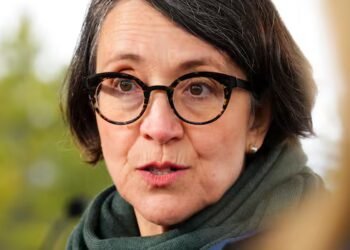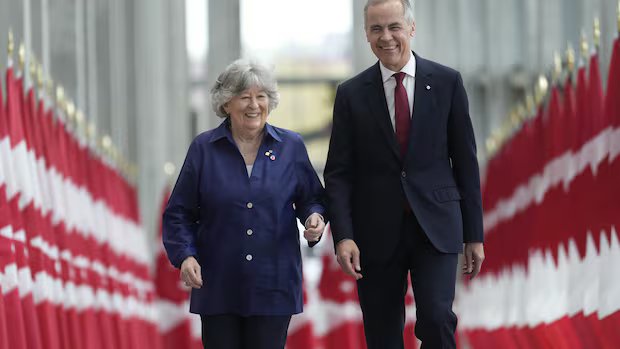
Prime Minister Mark Carney has named former Supreme Court justice Louise Arbour as Canada’s next governor general, picking a francophone with a long legal resumé which includes stints prosecuting war crimes in Rwanda and Yugoslavia and serving as the UN human rights commissioner.
Arbour will serve as the King’s representative and the commander-in-chief of Canada’s Armed Forces, replacing the retiring Mary Simon, the first Indigenous governor general, whose five-year term is due to end soon.
Arbour, 79, is one of the most celebrated jurists of her time.
She has received 42 honorary doctorates and is already a Companion of the Order of Canada — the country’s highest honour — in recognition of her pioneering legal work here and around the world.
In announcing the appointment in Ottawa on Tuesday, Carney said Arbour will be an exemplary “steward of our tradition of peace, order and good government” and the “guardian of our constitutional order.”
“Louise Arbour will represent the best of Canada to Canadians and to the world. A country that’s a bastion of security, prosperity and justice — a beacon to a world lost at sea. A Canada that is clear-eyed about the challenges we face and steadfast in the values we uphold,” he said.

Prime Minister Mark Carney announced on Tuesday that on his recommendation, King Charles has approved the appointment of Louise Arbour as Canada’s next governor general.
Arbour said she accepts the role “with a deep sense of duty.”
“The strength of this country resides in stable institutions managed with wisdom and sustained through the desire for the well-being of our country and the planet,” she said.
Asked if she considers herself a monarchist, Arbour said in French that she “doesn’t really know what that term is supposed to mean” but voiced her support for the current system and the King as head of state.
“I will be the representative of the Crown in a constitutional arrangement that has served Canada extremely well throughout our history, even more in recent decades. A system that will continue to provide continuity in our institutions and form of governance,” she said.

When asked if she is a monarchist, newly appointed governor general-designate Louise Arbour said she thinks the constitutional position ‘has served Canada extremely well.’
A long-time defender of civil liberties, Arbour’s new role follows her hard-hitting 2022 probe into sexual harassment in the military in which she condemned what she described as its “toxic” culture of misogyny and the “glorification of masculinity.”
Her work prompted a change in how the military she will now command deals with sexual misconduct. Based on Arbour’s past advice, Carney vowed to pass pending legislation that moves prosecution of these cases to civilian courts.
Despite that past criticism of the institution, Arbour said Tuesday she has “a great deal of respect for the service and professionalism of the men and women who serve.”
From Kosovo to Rwanda
Carney stressed Arbour’s legal bona fides at a time when there are serious challenges to the country’s constitutional framework, namely possible separation referendums in Alberta and Quebec.
Arbour obliquely referenced those difficulties. “It will be a privilege to be present if we face adversity,” she said in French.
“Canada is a wonderful country, shaped by its diversity of people, of perspectives and experiences, but I think shaped also mostly by a common respect for strong public institutions and for the rule of law.”
Arbour, born in Montreal and educated in Quebec, spent much of her career in Ontario, including as a justice on the province’s Court of Appeal. She then worked abroad, taking on some of the most notorious human rights abusers.
She prosecuted former Yugoslav leader Slobodan Milošević for crimes against humanity after his involvement in the ethnic cleansing of Kosovo and also led the tribunal that prosecuted high-level perpetrators of the 1994 Rwandan genocide.
“National, ethnic, racial or religious intolerance is the plague of the modern world,” she said in a statement after sentencing former Hutu leader Jean Kambanda for inciting genocide against the Tutsis.

She was later appointed the UN Special Representative for International Migration, where she helped craft a non-binding global pact on migration.
Supporters hailed that agreement as a way to bring more order to the flow of refugees but was criticized by others, including Canadian Conservatives, as a possible threat to national sovereignty.
Indeed, Arbour has expressed pro-migrant sentiments throughout her career.
In a 2016 Munk Debate with Nigel Farage, the immigration hardliner who now leads the populist Reform Party in the U.K., Arbour condemned some heated rhetoric about Muslims being an “existential threat” to Western democracy and social cohesion, saying Canada could welcome all peoples regardless of faith.
As the world was grappling with that year’s refugee crisis, Arbour said the country had a “special obligation” to offer asylum to those fleeing war-torn countries like Iraq and Syria.
“I am aware of the fear that an influx of foreigners will transform our social fabric in an undesirable way, but the reality is our social fabric is changing anyway in this interconnected world,” she said.
After investigating the mistreatment of female inmates in federal penitentiaries for a landmark report in the 1990s, Arbour also became a prisoners’ rights advocate. As a Supreme Court justice, she was part of the majority in the Sauvé vs. Canada decision that instituted voting rights for federal prisoners.
She has also advocated for 2SLGBTQ+ rights and was part of a past top court decision that blocked a B.C. school board from banning books that feature same-sex parented families on religious grounds.
Later, as UN human rights commissioner, she supported the development of the Yogyakarta Principles, which apply international human rights law to sexual orientation and gender identity issues.

While in that position, Arbour was critical of Israel’s actions against the people in Gaza during a 2008 conflict with Hamas.
She condemned what she described as the Israel Defense Forces’ “disproportionate use of force” in the Palestinian territory, including the reported killing of dozens of civilians. She also criticized the rocket attacks by Palestinian militants against Israeli civilian targets.
Those statements prompted then-Conservative public safety minister Vic Toews to call her a “disgrace” for critiquing Israel’s right to defend itself against terrorism.
Asked about possible Conservative objections to her appointment given her past progressive policy stances, Arbour said she will serve for all Canadians.
“I will reach out not only to those who agree with me,” she said.
“I will reach out to anybody. I will listen and I hope in due course I will manage to persuade particularly those who doubt my integrity.”