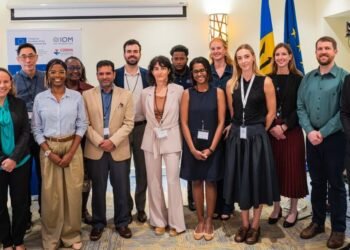

A surge of innovation and entrepreneurial momentum has been ignited regionally, following the successful conclusion of the 2026 Caribbean Climate-Resilient Agriculture Forum (CCRAF) 3-Part Beginner-to-Business (B2B) Webinar Series.
Delivered in three segments, the initiative brought together a diverse audience of farmers, entrepreneurs, youth, and development professionals spanning the Caribbean, Latin America, Asia, and Africa. The series equipped hundreds of participants with practical tools to start and sustainably develop agricultural ventures, maintaining strong engagement with more than 430 attendees from over 30 countries participating in each session, said a press release.
The CCRAF operates as a regional network supported by the Inter-American Institute for Cooperation on Agriculture (IICA), with a mission to promote knowledge-sharing on climate-resilient farming practices. It also aims to strengthen collaboration among stakeholders, foster a connected regional community, and translate knowledge into tangible agricultural action.
According to CCRAF Coordinator Nekelia Gregoire Carai, the initiative extends beyond basic instruction.
“The CCRAF Yearly 3-Part Webinar Series is about more than training—it’s about empowering people to take action. Our goal is to continue connecting knowledge with real opportunities and immediate actions that can transform livelihoods and strengthen food systems across the region,” she said.
IICA shared that the series featured experienced Caribbean practitioners who presented real-life insights and adaptable business approaches suited to regional realities.

In the session on starting a small hydroponics enterprise, Sherrie-Ann Brazier, Founder of SHAADE Hydroponics in Antigua and Barbuda, outlined her journey of building a thriving business from the ground up.
“You don’t need to know everything to start—just begin, learn as you go, and stay committed. Agriculture can truly transform not just your income, but your family and your purpose,” stated Brazier.
Her presentation highlighted the ability to produce up to 2,500 heads of lettuce weekly on less than one-eighth of an acre, while using far less water and land than conventional farming. She also emphasized the importance of continuous learning and innovation in growing a family-run enterprise.

Another session focused on vermicomposting, led by Micah Martin, Co-Founder and Manager of Compost-Inn in Trinidad and Tobago. He demonstrated how organic waste can be repurposed into valuable compost products.
“What many people see as waste is actually a resource. With the right approach, you can convert it into a product that improves soil, supports food production, and creates income,” he noted.
Participants learned how to transform organic waste into nutrient-rich compost often referred to as “black gold,” select worm species suited to tropical climates, manage environmental conditions effectively, and develop multiple revenue streams through value-added products.

Mushroom cultivation was also spotlighted as a profitable and climate-resilient opportunity. Pauline Smith, CEO and Co-Founder of Jamaica Exotic Mushrooms, explained the potential of the sector.
“Mushroom farming is one of the fastest ways to generate income in agriculture. In just a few weeks, you can go from production to profit—while building a business that is resilient and sustainable,” she emphasized.
Her session outlined how oyster mushrooms can be produced in roughly four weeks, using locally available materials such as bamboo and lemongrass as substrates. She also pointed to strong demand within the hospitality industry and the sector’s ability to create opportunities for women, youth, and small-scale entrepreneurs.
According to the press release, across all three sessions, a consistent theme emerged: individuals can begin with limited resources, start on a small scale, and gradually build sustainable income streams. Reportedly, for many attendees, the series marked an important first step toward entering the agricultural sector with innovative and resilient business ideas.
Looking ahead, the CCRAF is set to expand its role as a regional platform for knowledge exchange and practical implementation. Building on the success of the webinar series, the forum plans to introduce Special Edition Webinars and in-person training through its “CCRAF On the Road” Knowledge-to-Action Initiative, continuing its efforts to bridge the gap between agricultural knowledge and real-world application across the Caribbean.