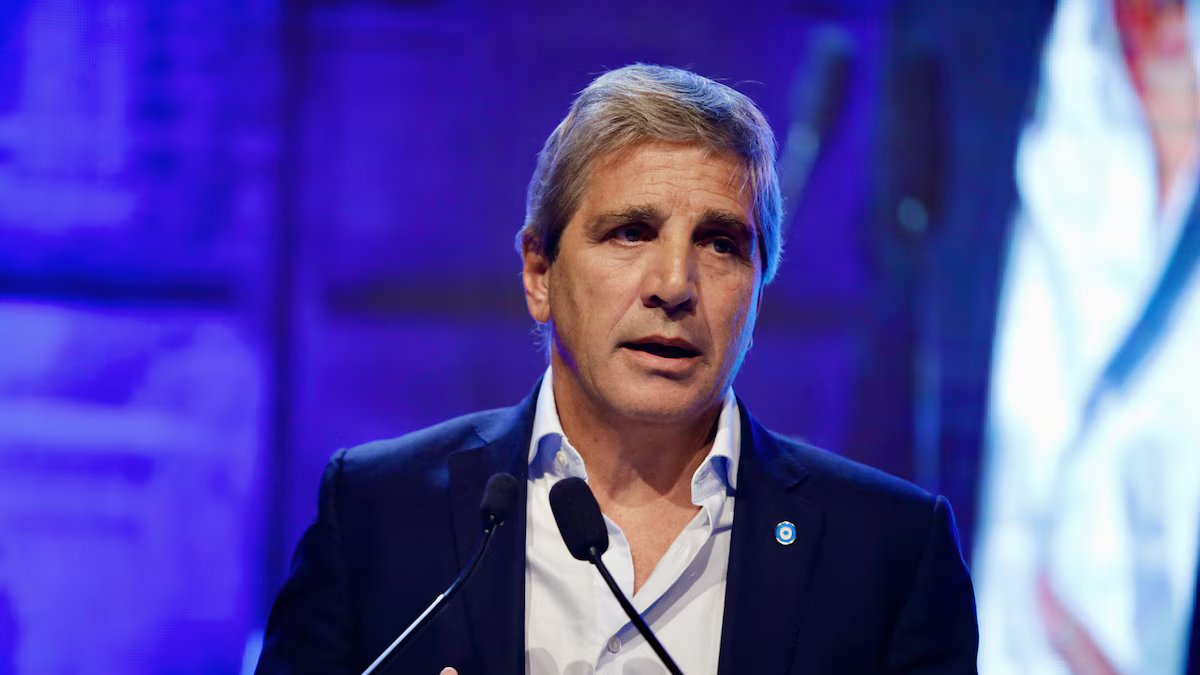
The Minister of Economy, Luis Caputo, announced this Monday afternoon that March inflation – which Indec will publish this Tuesday at 4 p.m. – It will “surely” be above 3%, so it would be the biggest increase so far this year.
Furthermore, at the presentation of the book by consultant Salvador Di Stefano in Rosario, he justified this advance in inflation. for him shock of oil due to the war in the Middle East and the characteristic seasonality of the month.
“Surely (it will be) above 3%,” said Caputo about the data that the organization will publish from 4:00 p.m. “Everything related to oil had an obvious impact, from domestic plane tickets to transportation, education and seasonality,” said the Minister of Economy, who in other interviews had also outlined that last year’s dollarization added to the increases in rates above prices since 2026 had had an impact.
“A process of disinflation and growth has been taking place since April,” Caputo promised. He added: “There is no trade-off; we are going to see disinflation and growth; The best months are coming.”
The minister announced that he believes that The war in the Middle East will be a short-term shock. Both YPF and the Government took measures to absorb the impact on the price of gasoline and diesel at the pumps.
Caputo had already recognized in an interview with journalist Luis Majul in LN+ that the March inflation I could “give it a little higher.” In February, the CPI had returned 2.9% and had accumulated nine months without decelerating.
“Inexorably the retail inflation rate is going to collapse, inexorably it is going to collapse. Now, what is happening? There is a saying in chess that says ‘black also plays’. Since we won the election in May in the Federal Capital, that wonderful triumph that the wonderful Chief of Staff that I have, who is Manuel Adorni, had, From there the system began to attack violently. This generated a deep drop in demand for domestic assets. One of the sides is that the country risk skyrocketed. The flip side is that the fall in the demand for money, one of the things that did, is that the inflation rate will accelerate.”said President Javier Milei in another interview one Public TV.
“In the middle you also had more of a recomposition of rates, plus an additional issue due to the effect on oil, you had issues of seasonality. So, that whole set of things made “This first quarter in terms of inflation has been difficult,” Milei added.
“Now, the reality is that the fundamentals They continue to be solid, so sooner or later the inflation rate will subside. In other words, we have no doubt about that. So, it has been a complicated quarter in terms of inflation, so to speak, given the preferences that we have, but we have no doubt that from here on it will continue (decreasing),” the President closed.
Last week it was known that inflation in March in the city – a figure that usually anticipates, at least, the trend at the national level – It accelerated again and reached 3% in the month. It was mainly explained by increases in sensitive items such as fuel, public service rates (electricity and water), bus fares and education.
The Buenos Aires CPI for March marked an acceleration of 0.4 percentage points compared to February (2.6%) and brought accumulated inflation in the first quarter of 2026 to 8.9%. In the interannual variation (12 months), the increase in the cost of living in the city of Buenos Aires reached 32.1%.
The national data from Indec will be known tomorrow and, according to the main private estimates, it would be in a range of between 2.7% and 3.3%.
According to the Market Expectations Survey (REM), the most comprehensive local survey on economic projections carried out by the Central Bank (BCRA), Inflation could end up being equal to or higher than in 2025 this year.
He top 10 from this survey – which averages the responses of those consulted who were most accurate in their forecasts – estimated that it would reach 31.8%, that is, three tenths above the 31.5% with which it closed last year. All this is explained because the acceleration in the pace of average price adjustment, which has been recorded for months, would have reached a “peak” in March, being between 3% and 3.1% – a figure that will be official from tomorrow -, according to the consensus of analysts. And although it would begin to decline in the coming months, it would not fall below 2% until August or September, at best.
According to the REM, which captured projections from 46 participants between March 27 and 31 (34 local and international consulting firms and research centers and 12 financial entities), inflation for the current month would close between 2.6% and 2.7%would decelerate in May to between 2.3% and 2.5%and from there it would continue descending slowly to be located between 2.3% and 1.8% from June to September (last month with screenings, since they are carried out six months from the publication of the exhibition).
The new market roadmap arises from recalculations after previous estimates had fallen “short” and considering the drag effect of the rise of 25% on fuel over the entire economy. Added to this were the larger tariff adjustments, which prevailed in the new projections.