Canada announced a second major deal on Wednesday to export liquefied natural gas to Europe, part of Prime Minister Mark Carney’s effort to reduce the country’s economic dependence on the United States.
The announcement came a week after President Trump signed an order imposing 50 percent tariffs on a range of Canadian exports, excluding energy, and amid global energy upheaval caused by the American and Israeli war against Iran.
Canadian natural gas and oil exports have historically gone almost entirely to American customers. In a briefing note on Wednesday, Canada said it now aims to sell 55 percent of its natural gas exports to customers other than the United States by the middle of the next decade. In 2024, other countries accounted for just 0.01 percent of Canada’s natural gas exports.
The deal comes as some politicians, including the leader of Canada’s most populous province, have called on Mr. Carney to use energy and mineral exports to the United States as leverage against Mr. Trump’s trade measures, which include tariffs of up to 50 percent on cars, steel and aluminum introduced last year.
The Trump administration also recently refused to renew the free trade agreement between Canada, the United States and Mexico for another 16 years, leaving it to be reviewed annually instead. Mr. Trump has repeatedly suggested that Canada should become the 51st U.S. state, and said last week, “without us, there’s no way they can survive.”
Tensions peaked last week when Canada canceled a joint ceremonial opening with the United States of the Gordie Howe International Bridge between Detroit and Windsor, Ontario, whose cost of 6.4 billion Canadian dollars, about $4.5 billion, Canada funded entirely.
American guests were uninvited and the event moved to the Canadian end of the bridge after Mr. Trump imposed his latest tariffs and delayed the bridge’s opening. The president relented only after the United States, which played no role in building the bridge, was granted a share of its tolls for the first 15 years.
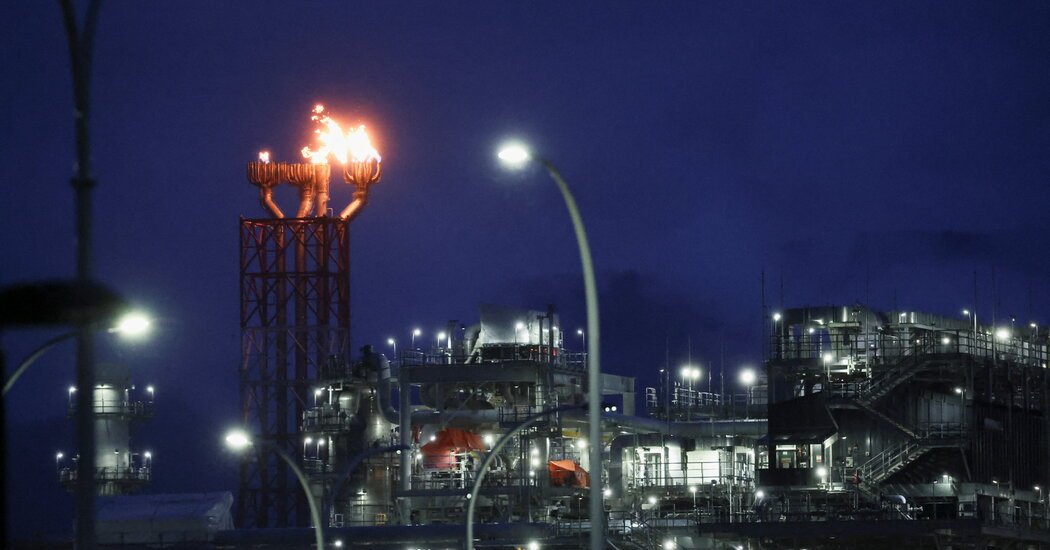
In the new energy deal announced on Wednesday, Uniper, a German gas distributor and electric power company, will buy up to 2 million metric tons of liquefied natural gas a year starting in 2032 from a proposed project in British Columbia led by the Nisga’a Nation. Uniper supplies gas to customers in Germany, Britain, Sweden and the Netherlands.
The contract is twice the size of one announced in May, between the Nisga’a Nation’s Ksi Lisims L.N.G. project in northern British Columbia and Securing Energy for Europe, or SEFE, which is owned by the German government.
Tim Hodgson, the natural resources minister, said in a statement that the deal shows “that by working with allies like Germany, Canada can strengthen its economy and sovereignty and support global energy security.”
While Canada’s manufacturing sector has been battered by Mr. Trump’s tariffs, those losses have been more than offset by gains in oil and gas, mineral and agricultural exports.
Europe has grappled with natural gas supply issues since Russia’s full-scale invasion of Ukraine in 2022, a problem compounded by the closing of the Strait of Hormuz as a result of the U.S.-Israeli war with Iran. As tankers have been blocked in the strait, a growing number of countries are now looking for alternatives to liquid natural gas from Qatar, which with the United States is one of the dominant suppliers of L.N.G. globally.
“This agreement is about far more than L.N.G.,” Michael Lewis, Uniper’s chief executive, said in a statement. “As a trusted partner, Canada helps diversify Europe’s energy supply and strengthens resilience against future disruptions.”
Dominic LeBlanc, the Canadian minister responsible for trade with the United States, said in a statement that the contract would “reinforce Canada’s position as a global energy superpower.”
Mr. LeBlanc is in Washington holding talks with the Trump administration on tariffs. His office declined to say whom he is meeting or to offer any details about the negotiations.