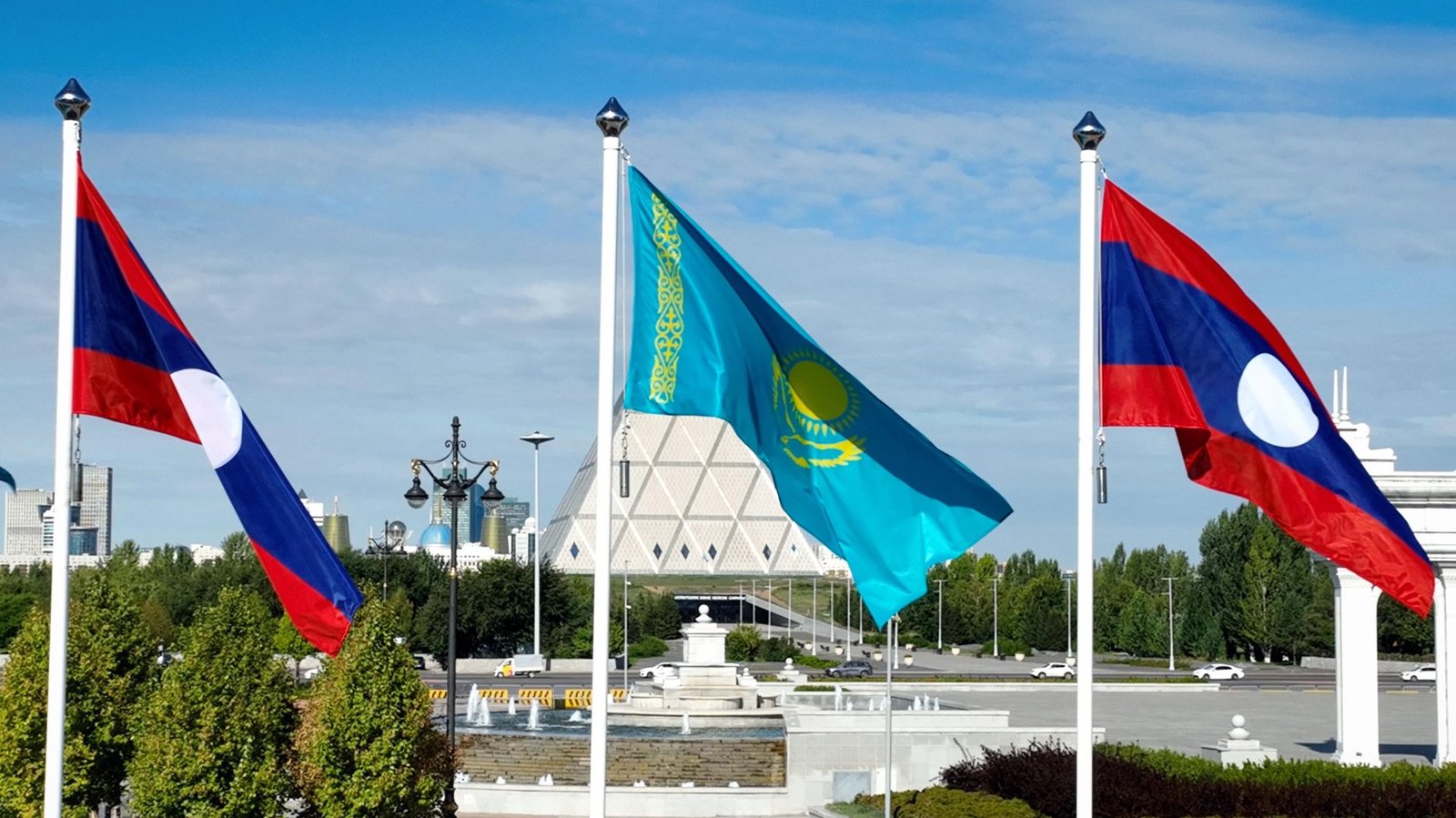
BAKU, Azerbaijan, September 7. Lao President
Thongloun Sisoulith paid his first-ever official visit to
Kazakhstan on September 3–4, 2026, marking a historic milestone in
bilateral relations. One of the key topics of the talks was the
expansion of trade and economic cooperation as well as the
development of transport connectivity.
In recent years, Kazakhstan, under President Kassym-Jomart
Tokayev’s leadership, has been consistently strengthening its role
as one of Eurasia’s major transit hubs by developing
infrastructure, expanding international routes, and creating
conditions for deeper integration between Asia and Europe. This
strategic course is opening new opportunities not only for
Kazakhstan itself but also for its partners, including Laos.
For Laos, cooperation with Kazakhstan could be important not
only from the perspective of increasing bilateral trade but also as
an opportunity to expand access to Central Asian and European
markets. Kazakhstan, in turn, is interested in promoting its own
products in Southeast Asia and developing new transport routes.
During the talks, President Kassym-Jomart Tokayev highlighted
significant potential for increasing supplies of Kazakh goods to
the Lao market. These include products from the metallurgical,
food, petrochemical, agricultural, chemical, machinery, and
pharmaceutical industries.
Thus, one of the initial areas of cooperation could be the
expansion of the range of Kazakh exports to Laos. At the same time,
Astana’s strategic interest goes beyond bilateral trade —
Kazakhstan continues to implement initiatives aimed at turning the
country into an important transport link connecting major economic
regions.
“We see an opportunity to use our transport corridors for access
of Lao products to the markets of Central Asia and Europe.
Kazakhstan is interested in expanding supplies of its products to
Southeast Asian markets through Laos. At the same time, we highly
appreciate Laos’ achievements in transforming from a ‘landlocked
country’ into a ‘land-linked country’ of Southeast Asia. The
Laos–China railway has significantly strengthened the country’s
transit potential and opened new opportunities for connecting ASEAN
with China and Europe,” Tokayev said.
For Laos, Kazakhstan’s potential role lies primarily in its
transport capabilities. In recent years, Kazakhstan has
significantly expanded its infrastructure base along key routes,
including the Chinese direction, the development of Khorgos, and
the establishment of logistics infrastructure at the
Kazakhstan–China terminal in the port of Lianyungang, which
provides access to international maritime routes.
This infrastructure has become a result of Kazakhstan’s
long-term policy aimed at developing transit potential, which
President Tokayev has identified as one of the country’s economic
priorities. In the future, these capabilities could also be used to
facilitate the movement of Lao goods toward western markets.
A potential cargo chain could connect Laos with Kazakhstan
through China and then continue toward Central Asia and Europe.
However, this remains a prospective route, as there is currently no
fully established direct transport corridor between Kazakhstan and
Laos.
At the same time, Kazakhstan could gain an opportunity to expand
its presence in Southeast Asia through Laos. In 2021, the
Laos–China railway was launched, connecting Laos with China’s
railway network. In spring 2026, Laos approved the first stage of
the Laos–Vietnam railway project, with its launch tentatively
planned for 2030.
The development of such routes corresponds with Kazakhstan’s
approach to building a diversified transport policy, through which
the country seeks to strengthen ties simultaneously with China,
Central Asian states, Europe, and Southeast Asian countries.
One of the key outcomes of this approach has been the
development of the Trans-Caspian International Transport Route
(TITR). Over the past five years, cargo volumes along the route
have increased 5.6 times — from 800,000 tonnes to 4.5 million
tonnes. Kazakhstan’s ports of Aktau and Kuryk are being expanded,
while new terminals are being built and existing facilities
upgraded.
By 2030, Kazakhstan plans to increase the combined capacity of
its maritime ports from 21.8 million tonnes to 30 million tonnes,
while by 2029 the national fleet is expected to receive eight new
vessels, including bulk carriers and container ships.
In this context, President Tokayev’s initiatives to develop
transport connectivity are enabling Kazakhstan to create new
opportunities not only for its own economy but also for partners
seeking access to major international markets.
For Laos, Kazakhstan could become an additional channel for
reaching Central Asian and European markets, while Laos could serve
as a potential link for Kazakhstan’s expansion into Southeast
Asia.
However, turning these opportunities into sustainable cargo
flows will require concrete agreements.
“I propose that our governments focus on concluding relevant
intergovernmental and interagency agreements in the field of
transport and logistics,” Tokayev said.
The practical implementation of these agreements will determine
how quickly Kazakhstan–Laos cooperation can move from political
statements to regular trade and transport operations. At the same
time, Kazakhstan’s course toward developing transit infrastructure,
promoted by President Kassym-Jomart Tokayev, is already creating
the foundation for new economic ties between Asia and Europe.