Synopsis: Meeting between foreign ministers takes place amid Phnom Penh’s protests over airspace and land violations and Bangkok’s move to revoke a key maritime agreement. Officials warn that continued ceasefire breaches and unilateral actions risk undermining trust and long-term border stability.
Cambodia and Thailand met on Monday for a discussion on border tensions, which have continued to simmer following a December ceasefire that brought a halt to two rounds of armed fighting last year.
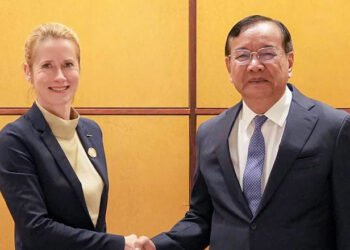
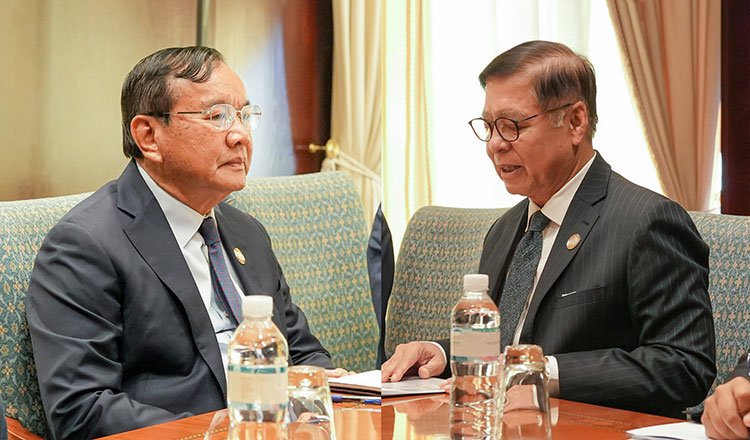
Foreign Affairs and International Cooperation Minister Prak Sokhonn held a discussion with his Thai counterpart, Sihasak Phuangketkeow, on the margins of the 25th ASEAN-EU Ministerial Meeting in Brunei.
Sokhonn said “candid” talks were held on the border situation, including confidence-building measures and broader aspects of diplomatic relations between the two countries.
He said the two sides reaffirmed their commitment to the ceasefire, peaceful resolution of the border dispute, and the full implementation of the Joint Statement of the Third Special GBC Meeting of December 27, 2025.
Sokhonn said “achieving lasting peace between our two countries, thereby contributing to peace, stability and unity within ASEAN, requires genuine commitment and full respect for international law, the ASEAN Charter, as well as all existing treaties and agreements that bind us.”

The meeting took place amid Thai media reports that Sihasak had informed Cambodia that Thailand is proceeding with the process of revoking MoU 44 on overlapping maritime claims on the continental shelf.
Sihasak is reported to have said that the move does not signal an end to bilateral negotiations.
Thailand’s withdrawal from the MoU with Cambodia was approved by the Thai National Security Council over the protests of Cambodia, which warned that a unilateral cancellation of the agreement would break legal norms and undermine years of dialogue efforts.
The MoU, signed on June 18, 2001, is a framework agreement to jointly manage and define a 26,000-square-kilometre overlapping claims area in the energy-rich Gulf of Thailand. It aims to simultaneously delimit maritime boundaries and develop oil and gas resources.
In a statement last week, the Ministry of Foreign Affairs and International Cooperation said the agreement reflects “the genuine political will and common intent of Cambodia and Thailand to pursue, in good faith, a mutually acceptable framework” for jointly exploiting resources in the overlapping claim area, while advancing maritime boundary delimitation in accordance with international law.

Meanwhile, Cambodia continues to raise concerns over escalating tensions with Thailand, citing repeated territorial encroachments, the latest incident being Thai fighter jet flights deep into Cambodian airspace.
Cambodian military sources confirmed that on Sunday morning Thai fighter jets entered the airspace over Banteay Meanchey province and penetrated deep into Cambodian territory over Samraong, the capital of Oddar Meanchey province.
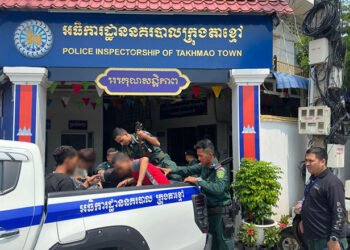
Thailand also continues to illegally occupy Cambodian territory in the border provinces of Preah Vihear, Oddar Meanchey, Banteay Meanchey, and Pursat. In Banteay Meanchey province alone, the Thai army has occupied six villages in Thmar Puok and O’Chrov districts.
Cambodia has sent multiple diplomatic notes to Thailand protesting military encroachments and unlawful construction activities in illegally occupied areas, while requesting the resumption of Joint Boundary Commission (JBC) meetings and joint surveys to install boundary markers and resolve the dispute.
Lieutenant General Maly Socheata, spokeswoman for the Ministry of National Defence, said Cambodia yesterday facilitated a tour by the Military Attachés Corps in Phnom Penh (MACPP) to observe the situation along the border.
The MACPP visited the Ou Phluk Damrei area, followed by the Chey Chomneas Border Checkpoint in Thma Da commune, Veal Veng district, both in Pursat province.
“This is the area that Thai forces have further blocked off with containers and barbed wire,” Lt Gen Socheata said.
The ministry said Cambodia welcomes friendly countries to conduct direct observations along the Cambodia-Thailand border to monitor the ceasefire and ensure transparency, credibility and accuracy regarding the situation on the ground.
It said it is committed to fully respecting the Joint Statement of the Third Special Meeting of the Cambodia-Thailand GBC as well as the Joint Declaration on the Peace Agreement between Cambodia and Thailand, along with all other existing agreements.
This is to support rapid recovery and restore normality while ensuring long-lasting peace and stability along the shared border.
“As a law-abiding and responsible state, Cambodia adheres to the peaceful resolution of disputes in accordance with international law and the fundamental principles of the United Nations Charter and the ASEAN Charter,” she said.
“Cambodia firmly opposes the threat or use of force and seeks to achieve a just, impartial and lasting solution, which will serve as the foundation for the peoples of both countries to live together in peace, stability and development.”
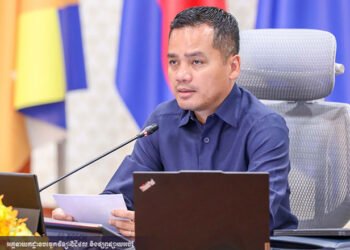
On Monday, Information Minister Neth Pheaktra urged Cambodians to have faith in the government’s handling of the border issue with Thailand, stressing that efforts are being carried out based on international law, treaties, conventions, and diplomatic principles.
Speaking before more than 1,000 residents of Chhloung district in Kratie province, the minister said the government remains firm and vigilant in safeguarding Cambodia’s territorial integrity and sovereignty, while pursuing peaceful and legal solutions.
Pheaktra highlighted the government’s commitment to defending national interests with a clear vision and comprehensive strategy. He said Cambodia faced Thai military aggression in July and December last year, adding that Thailand had used unilateral maps that are not recognised by law to claim Cambodian territory.
Despite the ceasefire, he added, Thailand continues to encroach on Cambodian land.
He said Cambodian armed forces have made sacrifices to protect the country, while the government continues to pursue the restoration of disputed areas through diplomatic and legal channels without resorting to violence.
“We choose peaceful methods to avoid bloodshed,” he said.
He noted that more than 640,000 civilians were displaced during the second round of Thai incursions in December.
Pheaktra said the country has no intention of invading its neighbours and seeks only peace, stability and friendship, particularly after enduring nearly three decades of war.
He urged citizens to continue supporting and trusting the government led by the Cambodian People’s Party, expressing confidence that Cambodia will safeguard its sovereignty and national interests.
- Tags: border conflict, National