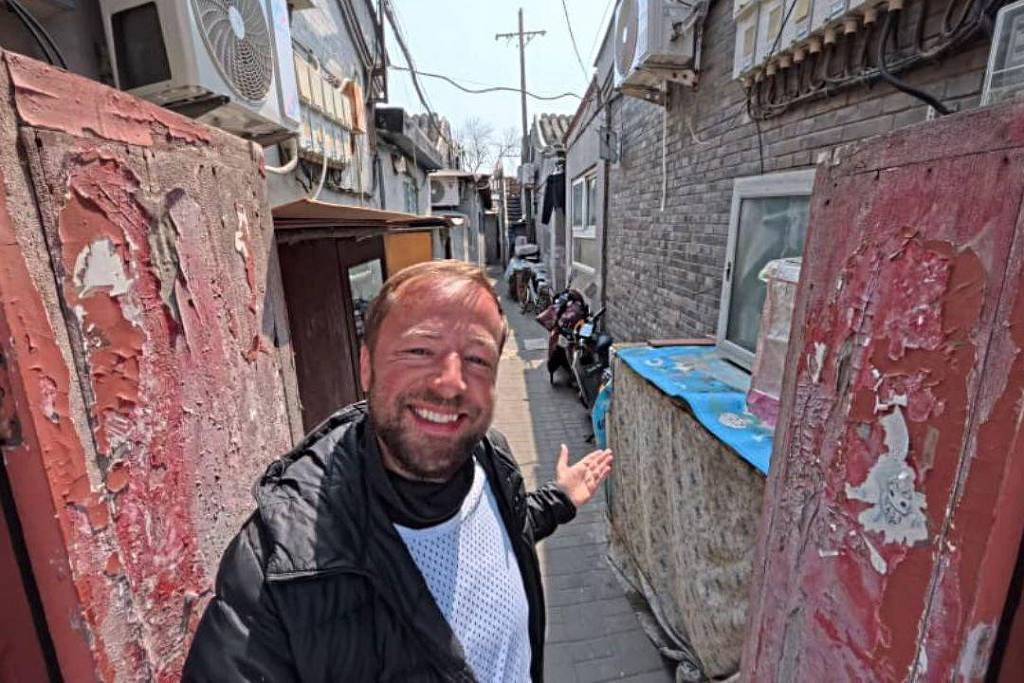
When he arrived at China For the first time, at the age of 11, Maurício da Cruz had the feeling that no other place could be his home.
The year was 2000, and his father had been transferred by work to the capital, Beijingwhere Maurício lived for two years until he returned to stay with his mother in the south of Brazil.
“From then on, the desire to move permanently to China never went away. I drew up my life plan based on that, and studied foreign trade hoping it would help me”, he says.
In 2012, Maurício packed his bags and never returned.
During his first two years in China, he focused on studying Mandarin to better integrate into society. Afterwards, he was hired to do the work that permeated most of his life in the country: translating electronic games from Mandarin to Portuguese.
“But with the evolution of artificial intelligence, I lost my job. As Beijing is very expensive, that’s how I decided to come and live in the home I live in today, a Styrofoam house in one of the Chinese ‘slums’, which helps me save a lot.”
28 square meters and R$30 rent
When he was still a Mandarin student, Maurício fell in love with his teacher, a Chinese woman six years older, born and raised in Beijing. “I tried to ask her out, but she thought it wasn’t appropriate. But after classes ended for a while, we ended up reconnecting,” he recalls.
The right to live on the property where Maurício currently lives belongs to his wife’s mother, who in the 1990s worked in a Chinese state company.
This type of housing was part of the system of so-called “work units”, or danwei, which organized not only employment, but also basic aspects of urban life in China until the economic reforms that began at the end of the 20th century.
State companies and public agencies distributed apartments or rooms to their employees as a benefit, with symbolic or heavily subsidized rents. Access to the market was not open: it was linked to employment and, in many cases, ended up being maintained within families over time.
“The company kind of ‘owned’ these places and gave it the right to always rent at a price below (the market price). And now my wife and I live here, and we pay the equivalent of R$30 per month”, says Maurício.
The property is in a traditional area that was previously occupied by wealthy families. They were houses with an internal courtyard — complexes where a single family controlled several rooms around a common space. After the Communist Party took power, these properties were confiscated or redistributed and divided among several families.
“An entire family owned everything, so they divided it up. Some of the former owners were left with a small room inside what used to be theirs,” he says.
Over time, these courtyards, called siheyuan, were further subdivided to accommodate new residents, many linked to the state-owned companies themselves. In this process, informal adaptations also emerged to account for the lack of space and infrastructure.
“My little house didn’t have a bathroom before until they built a somewhat irregular construction, which is common in this type of area. They’re ‘puxadinhos’ — you occupy a space that doesn’t belong to anyone there, the government, and build a wall. It’s not legal, but it’s always been done here.”
According to him, whoever managed to expand the property gained some comfort. “There are people who built bathrooms, but there are others who live in very small places, 10, 15 square meters.”
“There are people who live here in the courtyard and have followed the country’s economic growth, they are well off. But there are those who still live here, in the center of Beijing —where the square meter is now worth a lot— and are part of lower social classes. Here on my side there are neighbors who still collect recyclables to supplement their income, and many of the houses don’t have bathrooms”, says Maurício.
Before the renovation that he and his wife carried out inside the property, this was the reality of Maurício’s house. “My wife lived without her own bathroom until she was 20 years old,” he says, adding that there is a public toilet next to the courtyard where many of the residents relieve themselves.
“Today, inside, my house is modern, we added air conditioning and everything is brand new. Even though it’s only 28 square meters, it has everything we need.” On the outside, however, the contrast remains. “From the outside you can see that it is old, it even has a styrofoam covering”, he says.
For him, the biggest difference from the life he led with his family in Brazil is the limitation of space and privacy. “When I leave my house, I come face to face with the neighbor’s door. She has two parts of her house, so she goes back and forth all the time,” he says. “This issue of privacy is not the same as in Brazil, where I had my own space, but it’s not a big obstacle. I live peacefully here.”
Despite the large movement in the courtyard, the Brazilian says that security is excellent and that he has never had any problems with his neighbors. For him, the feeling of security is worth it. “What we buy on the internet stays at the door, you know? People pass by, and still no one touches it,” he says. “Not everyone here is rich, there are more humble people, but there is no robbery.”
He notes that there are still traces of a less safe period in the past. “There are bars on the windows, which are from a time when China wasn’t that safe,” he says. “Nowadays, this attracts attention, because it’s a super safe place.”
‘My journey never ended’
Without a job, Maurício, now 37 years old, began to invest more time in producing content about life in China – and found a new source of income there. His videos, which show everything from daily life in historic courtyards to cultural curiosities, began to attract millions of views from Brazilians interested in understanding what it’s like to live in the country.
“It seems like everything is so different that it attracts a lot of attention,” he says. “It’s a feeling of constant newness, you know? You’re always being surprised.” For him, the experience of living in China keeps the same feeling alive as when traveling. “You know when you travel and you’re amazed by everything? So, I feel that way to this day. Like my trip never ended.”
Part of the appeal, according to him, lies precisely in the differences. “In Brazil, you’re already used to everything. Not here: it’s the flavors, the people, the culture… in smaller cities, for example, people notice you, they want to take a photo, they’re very open.” Furthermore, he says that the country is constantly changing. “China is growing a lot. You go to Brazil and, when you come back, there are new things, things that have changed. That’s really cool.”
Growth in networks was rapid. “It was really crazy: I gained 300,000 followers on Instagram in one month,” he says. After resolving a technical issue that prevented him from posting on Facebook, his audience grew even more. “In one month, there were more than 120 thousand followers there. And then it started to monetize. In less than two weeks, it brought in around US$500 just from views.”
Today, he has more than 1 million followers on different platforms and is starting to see the activity as a possible source of livelihood. “I spent almost a year making videos without earning practically anything,” he says. “Now a little value has started to increase that already helps maintain the cost of living here.”
The plan, however, goes beyond the direct monetization of videos. During a recent trip to Brazil, Maurício opened a company and began structuring a new project. “The idea is to create a tourism agency, ‘China Sem Fim’, to bring Brazilians here in groups”, he explains. “I want to use all this knowledge and the audience I have to turn this into income.”
He says he has already turned down more lucrative betting proposals because they do not align with the type of content he wants to produce. “They offered a lot of money, but it’s not part of my profile. I think it’s possible to build something solid showing China as it is,” he says.