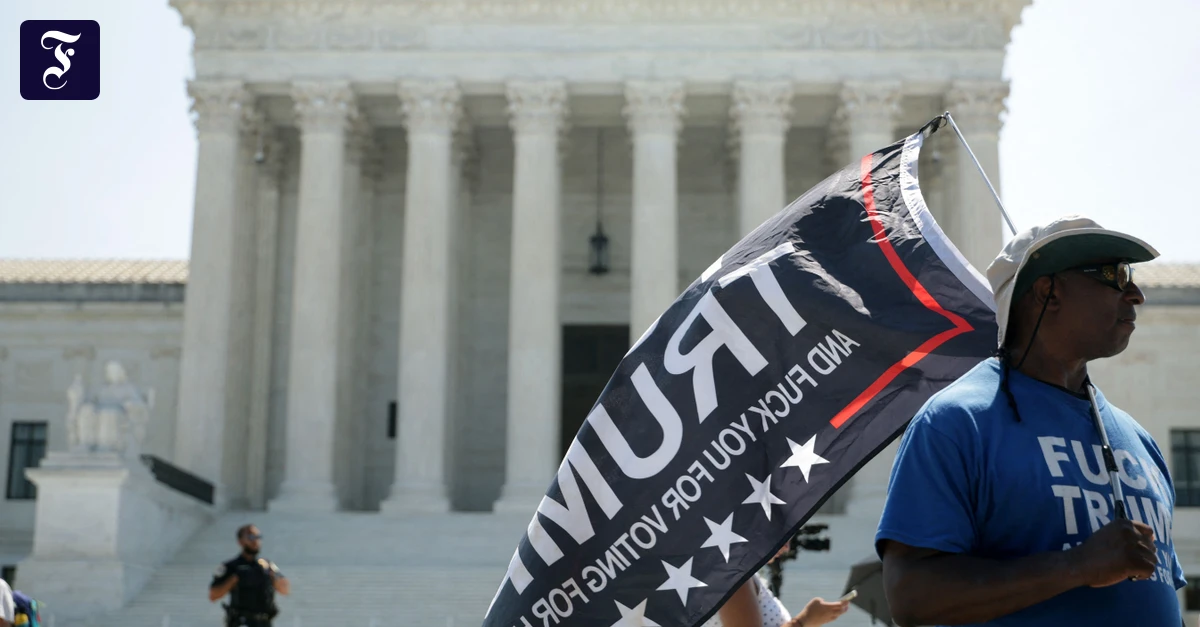
If the Supreme Court had ruled in President Donald Trump’s favor, it would have been one of his greatest victories in the fight against illegal immigration. But the conservative-dominated court upheld the almost 150-year-old constitutional principle of the place of birth principle on Tuesday: With a few exceptions, every child born in the United States will continue to receive American citizenship.
This was a significant setback for the president. The Chief Justice John Roberts In its justification, declared a Trump decree that sought to restrict the principle in the case of visa holders and migrants without a residence permit to be unconstitutional. “Then, as now, citizenship was the right to have rights – to participate freely in our political society,” the conservative judge wrote.
With the 14th Amendment, this promise was extended to “every person born free in this country.” It is still observed today. Roberts wrote explicitly that children of people in the country illegally or only temporarily also fulfilled the citizenship clause.
A Trump campaign promise
Trump already had the decree Election campaign and passed it as one of his first official acts last January. However, it was never used due to legal disputes in lower courts. He demonstrated in April how important this project was to him. Trump was the first president in American history to attend oral hearings in the Supreme Court and, despite skeptical comments from several judges, appeared confident of victory.
The government’s core argument was the language in the Constitution that those affected must be “subject to American jurisdiction.” According to their reading, simply being on American soil was not enough; What is more important is a permanent and legal residence through which one remains loyal to America. Restricting the place of birth principle would prevent “birth tourism”.
A majority of judges now rejected this argument. Roberts wrote in his justification that the problem is that “there is little evidence to support this dramatic revisionist view.” He had already criticized in the oral hearing that the government was drawing conclusions from special cases to a large number.
Kavanaugh only partially agreed with the verdict
The Supreme Court ruled on several cases on Tuesday. Trump initially only commented on the decisions that went his way and later wrote that it was a “very bad” judgment. But the judges are likely to be sure of the president’s anger. In previous cases he had particularly criticized the conservative judges who voted with the left-wing liberals. In the case of the “Birthright Citizenship” decision of six to three, that was Judge Amy Coney Barrett alongside Roberts. The conservative Brett Kavanaugh chose a different approach and wrote in his own opinion that he agreed with the verdict per se, but also rejected it “in parts”.
Kavanaugh’s statement aimed at another way to limit the place of birth principle: with the help of Congress. An option that Trump had spread on his online platform before Tuesday’s decision, perhaps in anticipation of defeat.
The conservative judge agreed with the other five that Trump’s order was unlawful. However, he was referring to laws passed by Congress in 1940 and 1952 that invoked the Citizenship Clause. Kavanaugh did not believe that the birthplace principle was constitutional – if he had his way, it could be restricted by Congress by law, but not by Trump alone.
The president’s reaction was extremely positive: the court’s decision could be avoided “quite easily.” Congress must begin working on a corresponding law “today.” That sounds more straightforward than it is. Not only is there unlikely to be a majority in favor of such a move; Without a constitutional amendment, it would also violate the Supreme Court’s decision.
The fact that Trump appeared surprisingly reserved on Tuesday towards the judges who voted against his decree could be due to the thought of last week. The conservative majority of the Supreme Court gave Trump two victories on migration issues. On the one hand, it ruled that the government could revoke the temporary protected status of some immigrant groups. In addition, according to the court, immigrants may be prevented from entering the country in order to prevent them from applying for asylum.