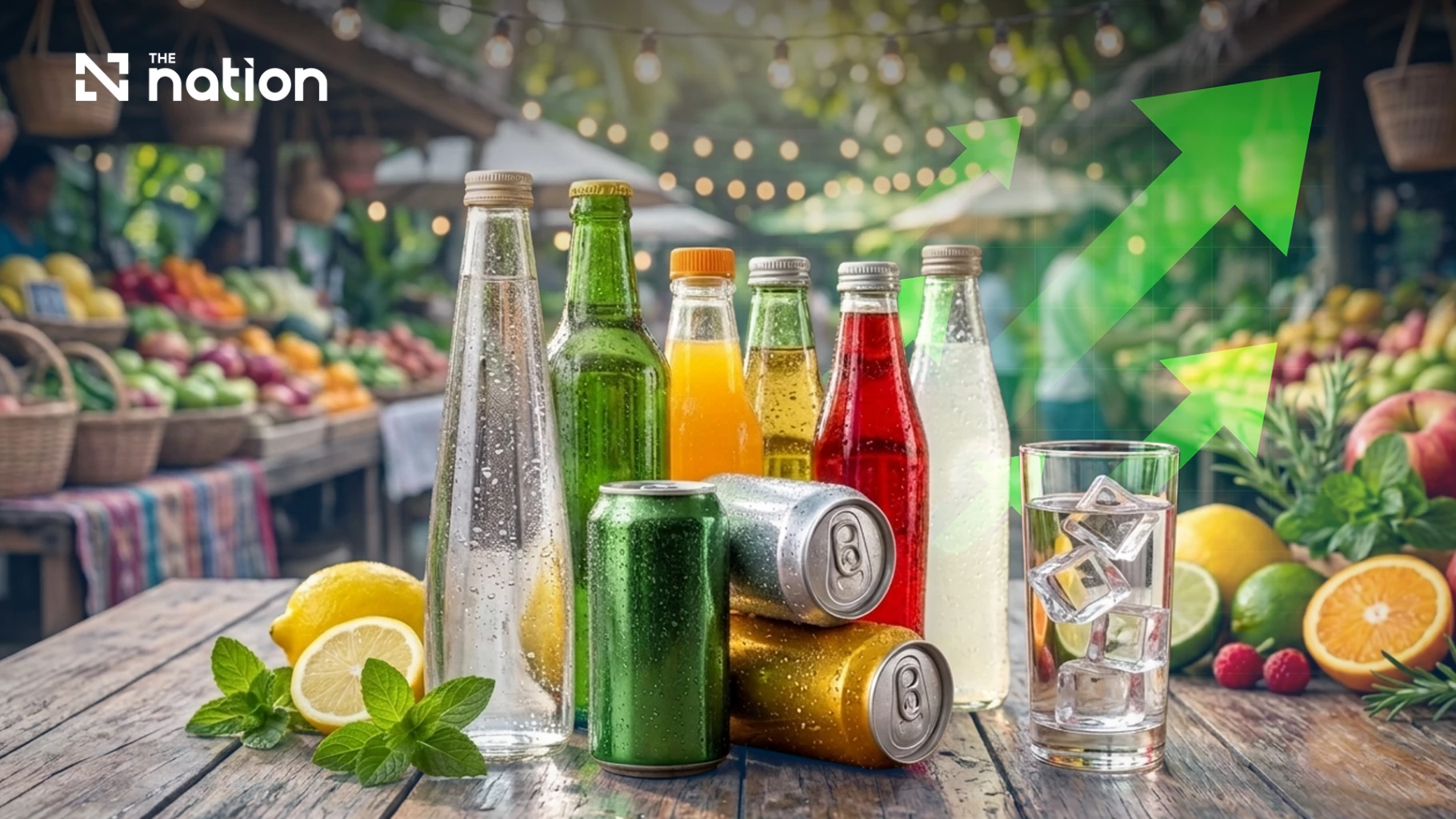
Meanwhile, cold-pressed juice and smoothie businesses recorded 7% year-on-year global sales growth, making them one of the fastest-growing segments in the food and beverage industry in 2025.


Thailand’s beverage market still growing, but at slower pace
For Thailand, TPSO said the beverage service market was valued at 56.9 billion baht in 2025, up 5% from the previous year.
The market is expected to continue growing in 2026, but at a slower rate of 2%, reflecting softer consumer spending and a more challenging economic environment.
In 2025, Thailand had 3,204 registered corporate entities operating in the beverage service sector, an increase of 14.96% from the previous year. Between 2023 and 2025, the number of operators expanded by an average of 15.47%.
The figures suggest that entrepreneurs still see opportunity in the sector, even as the market becomes increasingly crowded.
Non-alcoholic drinks dominate the sector
In 2025, the largest share of Thailand’s beverage service businesses was held by shops mainly serving non-alcoholic drinks, accounting for 70.32% of the sector.
This was followed by shops mainly serving alcoholic beverages at 28.68%, mobile beverage shops at 0.59%, and beverage services at stalls and markets at 0.41%.
The dominance of non-alcoholic beverage outlets reflects changing consumer behaviour, particularly the rise of coffee, tea, fruit drinks, smoothies and wellness-related beverages.
TPSO said the health trend is playing a growing role in reshaping the market, as consumers increasingly look for drinks that match their lifestyles rather than simply choosing products based on price or taste.

Small operators face profit squeeze
While the overall market is expanding, TPSO’s financial data shows that growth is not being shared equally.
Based on 2024 financial statements from registered companies, medium-sized beverage service businesses recorded net profit of 2.13 million baht, while large operators posted net profit of 1.168 billion baht.
Small businesses, however, recorded a net loss of 82.68 million baht.
TPSO said this may have been partly driven by losses among small alcoholic beverage operators, which posted a combined net loss of 185.28 million baht.
The figures highlight a key challenge for Thailand’s consumer economy: sectors may continue to grow in value, but smaller operators remain vulnerable to rising costs, weak purchasing power, intense competition and changing consumer habits.
Health trend changes drinking habits
Nantapong Chiralerspong, director-general of TPSO, said the beverage service sector has clearly grown in terms of market value, revenue and net profit, with expansion seen across business categories.
He said the growth was driven by several factors, including higher beverage prices, the health-conscious trend, the influence of online media on consumer behaviour, and operators’ aggressive expansion of branches to spread risks related to location and purchasing power.
The health trend has also affected alcoholic beverage businesses.
TPSO cited data from TIME indicating that consumers under the age of 35 have reduced alcohol consumption by 10% over the past 20 years, as younger generations place greater emphasis on health and wellness than previous generations.
This shift is creating more opportunities for non-alcoholic drinks, functional beverages, juices, smoothies, coffee and tea brands, while putting pressure on some traditional alcohol-focused operators.
Foreign brands raise competitive pressure
TPSO said one of the major challenges for Thailand’s beverage service market in 2026 will be fiercer competition, especially as more foreign operators enter the market.
Competition is expected to intensify across premium beverage shops, mass-market chains and outlets in tourist areas.
Foreign beverage chains often come with strong branding, efficient supply chains, pricing power and rapid expansion strategies. This puts pressure on Thai operators, especially smaller businesses that may lack capital, marketing resources or economies of scale.
At the same time, consumer trends are changing quickly, while brand loyalty is weakening. This makes it harder for operators to forecast sales and maintain repeat customers.
Weak economy and slow tourism recovery remain risks
Despite continued growth, TPSO warned that the beverage service sector still faces several limitations.
The economic slowdown is affecting purchasing power and consumers’ spending decisions. In a low-growth environment, affordable daily purchases such as coffee, tea or smoothies may remain resilient, but consumers are likely to become more selective.
The slow recovery of the foreign tourist market also remains a risk for restaurants and beverage shops that depend heavily on international visitors, particularly those located in major tourism zones.
This means beverage operators can no longer rely only on foot traffic or popular locations. They must compete through brand identity, product differentiation, customer experience and the ability to respond quickly to new trends.
Government urged to support small entrepreneurs
Nantapong said operators should study the market carefully and plan investments prudently. They should also adopt modern strategies that can respond effectively to changing consumer demand.
At the same time, he said the government should support the beverage service sector so it can grow more inclusively across the supply chain, from raw materials to downstream services.
Support should focus particularly on strengthening small entrepreneurs and helping them compete in a more crowded market.
TPSO said this would create opportunities not only for people to become consumers, but also for aspiring entrepreneurs to build strong beverage brands in the future.
Beverage business becomes test of consumer resilience
The growth of Thailand’s beverage market shows that some areas of consumer spending remain resilient, even as the broader economy faces pressure from weaker purchasing power and cautious household spending.
However, the sector also reflects the uneven nature of Thailand’s recovery. Large and medium-sized operators are more likely to benefit from scale, branding and branch expansion, while small operators face a tougher fight to survive.
From now on, competition in the beverage business will no longer be based only on taste or price. It will increasingly be a contest over brand strength, consumer experience, health positioning, digital marketing and the ability to keep up with fast-changing trends.
For Thailand’s economy, the beverage boom is therefore both a bright spot and a warning sign: demand still exists, but only businesses that adapt quickly are likely to capture it.