Some compare his style to “the shoulders of highways” and consider his works at best “suitable for industrial wastelands because he neglects to provide flowering plants and beauty.” The others – such as the “Wall Street Journal” – call him the “rock star among garden designers”.
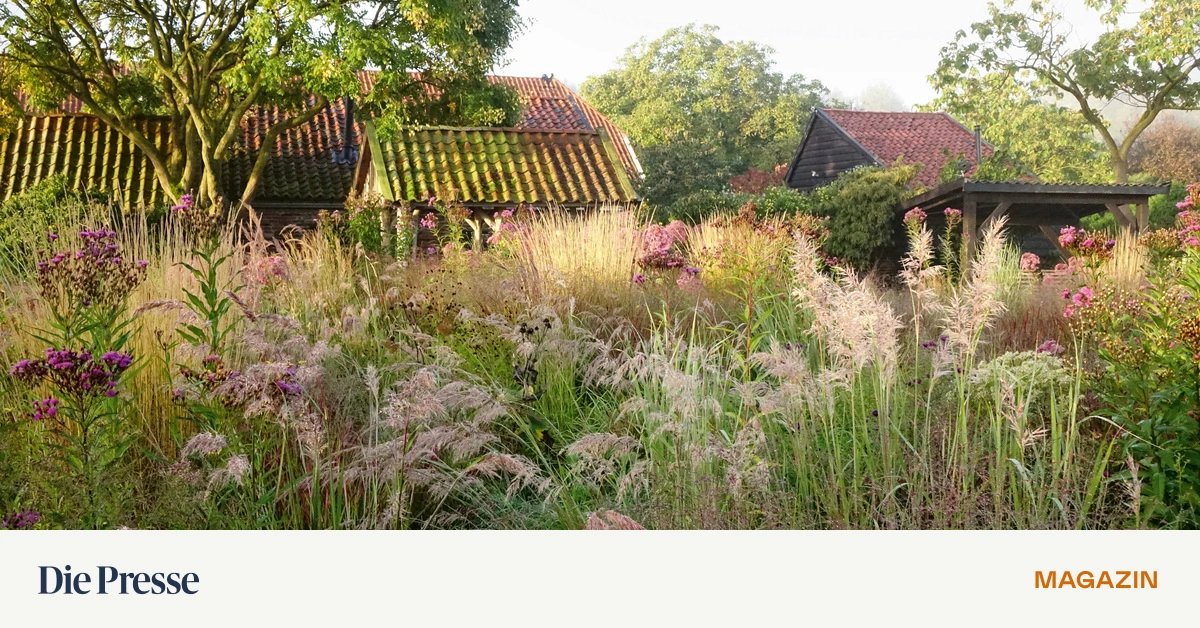
It is clear that Piet Oudolf’s gardens are different from others and cannot be pigeonholed. He’s definitely not into classic discounts, but he doesn’t have real wilderness either. The Dutch landscape architect’s projects look as if nature has just made a big splash, but behind them are sophisticated concepts, knowledge acquired over decades and precise instructions on how to care for which plants.

Piet Oudolf: always interested in new things. The next projects are coming up. Mark Ashbee (from the book “Piet Oudolf at Work”, published by Phaiton Press)
His fans – and today there are significantly more of them than critics – call his work artfully composed wilderness; He is considered the father of the New Perennial Movement, a movement in garden art that uses perennial plants to create natural designs, imitating prairies and meadows. His most famous works include the Highline Park in New York City, but also the garden of the Vitra Campus in Germany and that of the Hauser & Wirth Gallery in Somerset, UK.

Somerset, UK: Over 25,000 plants: Piet Oudolf Field for Hauser & Wirth Gallery. Jason Ingram (from the book “Piet Oudolf at Work”, published by Phaiton Press)
Anyone who is invited by the British as a foreigner to plant in the motherland of gardens undoubtedly has to be able to do something. In Oudolf’s story, however, one searches in vain for the names of great mentors, important gardening schools or even just an early love for all things flowering.
His career began with a simple garden center in his Dutch hometown of Haarlem – and that was his third professional attempt. “My parents had a restaurant in the country and I initially worked there,” he tells “Luxury Estate” in an interview; His early positions also included jobs as a fishmonger and steelworker.
The young Dutchman then found his destiny in many ways when his wife Anja came into his life. “When I got married at 25, I wanted to do something different and started working in a garden center,” he remembers. “I was then offered to stay longer there,” says Oudolf.
»You really have to know a lot to become a gardener.«
Piet Oudolf
From then on, his career took off: “First we visited gardens in England, then we bought and planted trees and later perennials for our own garden and that of my parents’ restaurant, which all developed very harmoniously.” A good 50 years ago, Oudolf founded his first garden design office in Haarlem, but the perfectionist, who grows all the plants himself and experiments with seeds, soon needed more space.
“In 1980 we bought a farmhouse with one and a half hectares of land in the east of the country, where we started our own nursery.” And thus put a new place of pilgrimage for garden fans on the map: The previously largely unknown Hummelo soon became known for the Oudolf Garden, which was open to the public until 2018.
Here Oudolf was able to live out his interest in grasses, which play an important role in his gardens: “They have strong personalities, are often more architectural than other plants and form a good balance with perennials.” He was not alone in his love for these hitherto little-noticed plants – keyword: highway verges.

New York City: City landscape instead of elevated railway line: High Line Park. Timothy Schenck 2019 (from the book “Piet Oudolf at Work”, published by Phaiton Press)
“In the 1980s, I met more and more people who wanted to garden close to nature. Instead of the English, highly decorative tradition, it was more about native plants and less about over-decoration. This made my gardens look different, and through a lot of trial and error, designs emerged that initially seemed unbalanced, but became known,” he remembers how Hummelo became a place of pilgrimage for the new garden movement.
“Our plant collection was a mix of English and European species. For the first seven or eight years we only worked for private customers, grew plants and had hardly any time to design.”
»I want to remain open, like a painter or writer.«
Piet Oudolf
The “we” in the sentences of the garden star, who is actually known as a lone fighter, always refers to his wife Anja, to whom he has been married for 57 years – and who is often not even mentioned in reports about him, as he reports with a slightly angry undertone. Because: “Without Anja I would never have been able to do what I did, we achieved everything together.” He would hardly have been able to take on his first big orders without her because he was too busy growing his plants. “Anja then took over the gardening and PR in 1989, and I was able to concentrate on other things.”
Like his first book, “Planting the Natural Garden,” which he published together with Henk Gerritsen in 1990. “The book was a great success and was translated into many languages, and with that the inquiries increased,” he remembers. Six years later, his first garden was created in England, of all places, as a show garden at a nursery in northern Hampshire.
Although it was not yet a “real Oudolf” like his later works, because the nursery wanted to show as many plants as possible – but even here, grasses played a leading role that was still unfamiliar to them at the time. They attracted a lot of English people who were enthusiastic about modern gardens. In the 1990s, further systems followed in England, Germany and the Netherlands, which included round bodies of water – and initially even borders.
With the beginning of the new millennium, word of the Dutchman’s unusual gardens had spread to the USA, where he received two major commissions that were intended to make his name known beyond gardening circles: in 2004, the Lurie Garden was opened in the heart of Chicago, which he designed together with Robert Israel and the US landscape architects Jennifer Guthrie, Shannon Nichol and Kathryn Gustafson.
The commission to design the High Line Park in New York City came shortly, together with Diller Scofidio + Renfro and James Corner Field Operations. The transformation of the disused elevated railway line in Manhattan is considered a milestone in the design of urban landscapes and catapulted Oudolf onto the list of international garden icons.

Chicago: What’s Built, What’s Grown: Lurie Garden in Millennium Park. Piet Oudolf
The self-made gardener had already taken liberties that were sometimes viewed harshly by experts: for example, transplanting prairie plants such as the coneflower from North America to Europe. Or to simply declare the Canadian goldenrods, which are actually decried as weeds, to be decorative garden plants. Always on the basis of immense knowledge that he has acquired over decades and shared in many books. And with extremely strict standards that he sets for himself and his projects. “You really have to know a lot to become a gardener. And you can be a gardener all your life and still not know everything,” he says with conviction.
“Like giving away children”. He doesn’t visit his works to bask in their glory, quite the opposite: “When I come to my gardens, I always see what’s wrong. In my job, you’re extremely dependent on the people who take care of it afterwards. It’s a bit like giving a child away and then hoping to see it happily again.” When planning for his babies to grow up happily, Oudolf takes into account what they will need and which plants can thrive in which environment. Because the over two kilometer long High Line Park, through which millions of people trudge every year, naturally has to withstand more than the much admired Garden for Vitra, which is visited by a more select audience with a love of architecture and design.
He hasn’t lost his joy in gardening in almost 60 years of work – the only concession to getting older was closing the garden in Hummelo to the public. “I’ve done so many public parks now that we deserve this privacy,” he says – especially since new projects are currently being built in Chicago and Long Island. “But I still love gardening and am still very interested in how it develops.”
That’s why he wants to travel to Japan soon, where there is a young generation that eagerly buys his books. A development that makes him as curious as it is relaxed: “I don’t want to change, but I want to remain open – like a painter or writer.” A fitting comparison for the master of artfully composed nature. e