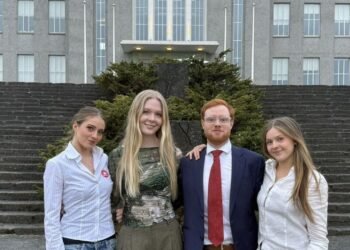
Björn Brynjúlfur Björnsson, executive director of the Swedish Chamber of Commerce, was among the guests in the latest episode of the podcast Þjðmál, which was released yesterday. When asked if the day, May 1, has any special significance for them, Björn says that the day is a definite time warp.
He added that he felt “unions are an ideological phenomenon that’s just become a bit outdated”.
Unnar Geir Unnarsson, who sits on the board of the Visku union, is one of those who have commented on the issue in an opinion piece in Vísi.
“It’s rather special to hear the executive director of the Chamber of Commerce claim that trade unions are a ‘waste of time’ and they should have been closed at the turn of the century.” Statements like this are at best a misunderstanding or at worst a serious privilege blindness,” says Unnar Geir.
“The good work of the labor movement is why we have the rights that many people take for granted today: shorter workweeks, holidays, sick leave, minimum wage and safety in the workplace. None of this happened by itself, these are earned rights that people fought for.”
Elsa Hrönn Gray Auðunsdóttir, vice-chair of ASÍ-UNG, says Björn’s comments call for a reaction.
“These views may not be new, but they paint a picture that does not match the reality of the Icelandic and international labor market.”
A misleading comparison
In the podcast, Björn talked about his recent trip to both Switzerland and Portugal and that even though the latter has “much stronger workers’ rights”, it is much better to be a worker in Switzerland. The unions certainly did good things in the 20th century, but would be unnecessary today.
Unnar Geir says that claiming that the trade union struggle has suddenly become unnecessary is not only wrong but dangerous.
“Because the reality is that the power imbalance between workers and employers has not disappeared, it just appears in a different way than before. In the world of globalization, the gig economy and the increased concentration of wealth, the need for organized countermeasures has probably never been greater,” he says.
Then it is cautious and superficial to compare the conditions of people in Switzerland and Portugal, where the standard of living is determined by more factors than the strength of trade unions. Elsa Hränn also comments on the same lines and says the comparison is misleading.
“The standard of living and the state of the labor market are not only determined by the existence of trade unions, but also by productivity, education, industries and economic policy. It is therefore unfair to put forward the conclusion that weaker trade unions lead to better wages, because the labor market is based on the interaction of many factors and trying to simplify it and mark one factor is simply wrong,” she says.
Elsa Hränn asks what would happen if the unions disappeared.
“Unfortunately, the situation is that the individual stands alone vis-a-vis his employer. In some cases, it might work out for a short time, but for most it would mean a weaker bargaining position, less protection and increased uncertainty. History shows us that workers’ rights are not a given.”