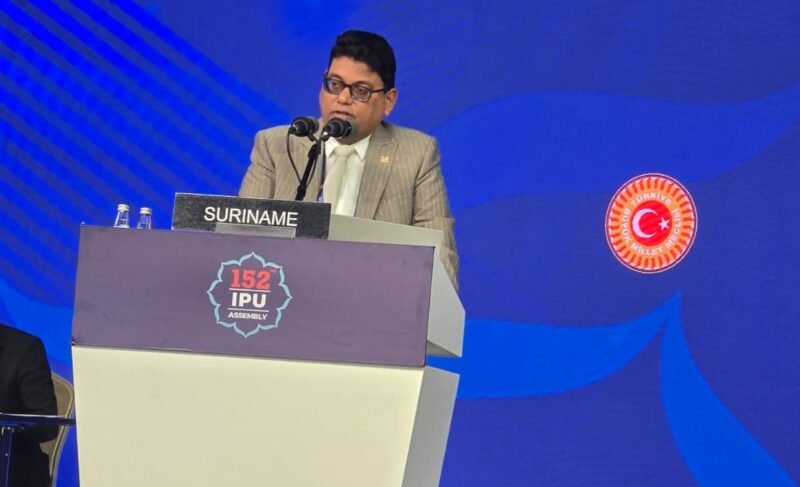
PARAMARIBO – During the 152nd General Assembly of the Inter-Parliamentary Union (IPU), Suriname, represented by Asiskumar Gajadien (VHP), member of the National Assembly (DNA), made a call to put the growing world crises and their impact on young people at the center of international decision-making.
In addition to Gajadien, Rabin Parmessar (NDP), who acts as delegation leader, and Ines Pané (Abop) are also part of the Surinamese delegation at the meeting in Istanbul. The meeting takes place against the backdrop of ongoing and expanding conflicts, with far-reaching humanitarian consequences in the Middle East and other parts of the world.
Consequences for youth
Gajadien stated that the current global situation, characterized by conflict and increasing instability, is not only a security issue, but also has direct consequences for the future of young people worldwide. He referred to warnings from the World Bank, which indicates that the global economy is not creating enough sustainable and dignified jobs for young people. “When young people are excluded from economic opportunities, serious risks arise: social instability, increasing vulnerability and declining trust in institutions,” said Gajadien.
In his contribution, he called for the final report to explicitly recognize the connection between armed conflicts, economic disruption and growing unemployment among young people. In addition, he emphasized the importance of decent work as a foundation for sustainable peace and advocated strengthened international cooperation to increase opportunities for young people. “A generation without a future is a risk the world simply cannot afford.”
With his intervention, Gajadien underlined the need for targeted and concrete policy measures that not only protect young people, but also actively involve them in economic and social development.
Repressive approach to terrorism is insufficient
During the meeting of the High-Level Advisory Group (HLAG) within the IPU, Gajadien further discussed the relationship between terrorism and broader global developments such as economic inequality, social exclusion and a lack of future prospects for young people. He emphasized that an exclusively repressive approach is insufficient and that countries must invest in strong institutions, economic opportunities and inclusive development to structurally counter radicalization.
He also pointed out the growing role of digital platforms in online radicalization and the importance of balanced legislation that protects both safety and fundamental rights. “Without prospects for young people and without trust in institutions, the risks of instability remain,” said Gajadien.
The meetings in Istanbul lasted from April 15 to 19 and focused on the overarching theme: “Nurturing hope, safeguarding peace and ensuring justice for future generations.”-.