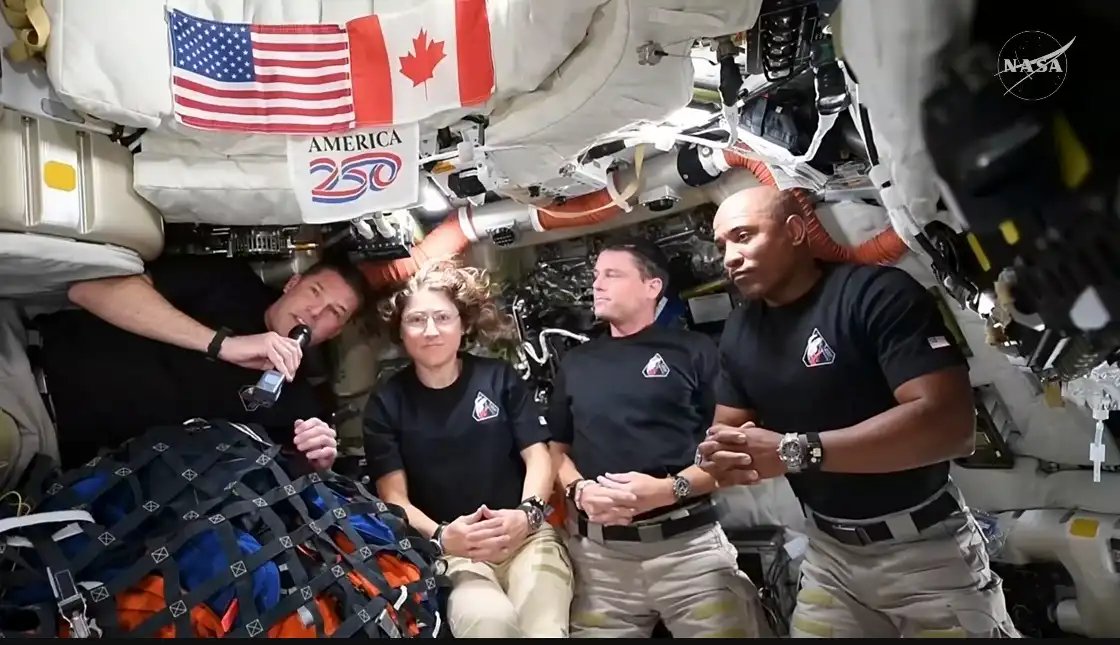
National Aeronautics and Space Administration (NASA) NASA astronauts Reid Wiseman, Victor Glover and Christina Koch, and CSA (Canadian Space Agency) astronaut Jeremy Hansen They prepare for their return to Earth, scheduled for Friday, April 10. This includes reviewing reentry and landing procedures and performing a return trajectory correction maneuver.
The official NASA website explains that As Artemis II approaches its return to Earth, NASA teams on the ground complete final preparations for Orion’s re-entry and splashdown around 8:07 p.m. (5:07 p.m. PDT / 6:07 p.m. Guatemala time) on Friday, April 10, off the coast of San Diego.
In this mission the crew was able to document data about the Moon not known until now. The crew of the Orion spacecraft managed to travel a greater distance from Earth, surpassing the record set by Apollo 13 in 1970. They also documented visual phenomena of the Moon that cannot be observed from Earth, such as the dark side of the satellite and an eclipse.
During the lunar flyby, the four astronauts documented the process. According to NASA, among the findings is the documentation of impact craters, ancient lava flows and surface fractures, aspects that will be analyzed by scientists seeking to study the geological evolution of the Moon.
See the progress, preparation and return of this mission. The Artemis program aims to return humans to the Moon, a trip that is now scheduled for no earlier than 2028 during Artemis IV, following the latest changes to the schedule made by NASA.
April 10, 2026, 8.40am
Orion’s advance
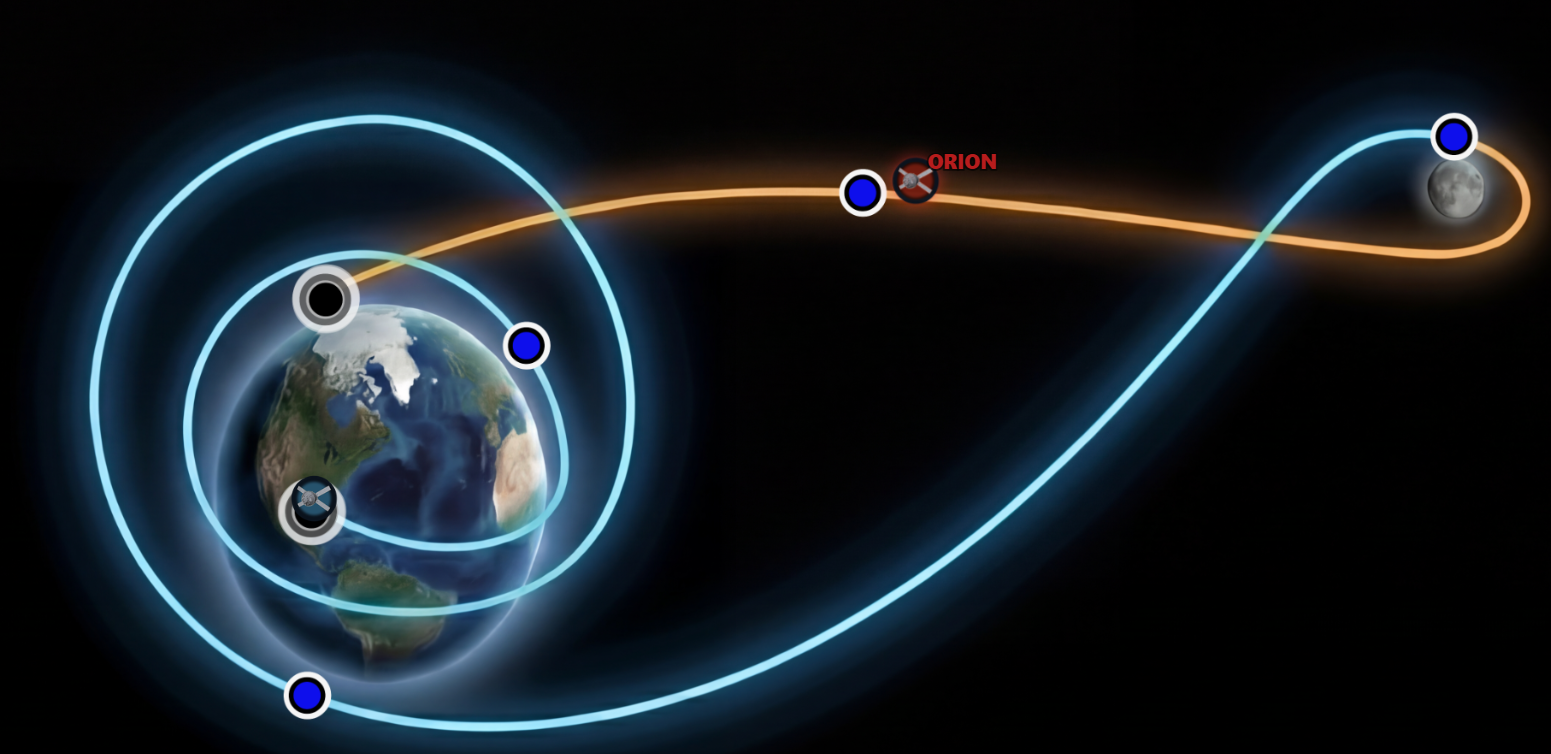
This is the route that Orion has taken up to this minute and shows how long it will take until he arrives back on Earth. He is about 66 thousand kilometers away from arriving home again.
April 10, 2026, 8.20am
What time does Artemis II land? Know the schedules by country
The landing is scheduled for 8:07 p.m. (EDT) from Friday, April 10, equivalent to 00:07 GMT on Saturday April 11.
| Country/Region | Local time |
|---|---|
| United States (Eastern Daylight Time) | 8:07 p.m. |
| United States (Pacific Daylight Time) | 5:07 p.m. |
| Mexico | 18.07 hours |
| Guatemala | 18.07 hours |
| Colombia / Peru | 7:07 p.m. |
| Chile / Argentina | 9:07 p.m. |
| Spain | 02.07 hours (Saturday) |
April 10, 2026, 8.00am
This will be the landing in the Pacific Ocean
The final descent will be controlled by a parachute system that will reduce speed before impact on the water.
Final phases:
- Module separation: 42 minutes before
- Entry into the atmosphere
- Parachute deployment
- controlled descent
- Landing off California
NASA equipment and US military will recover the crew for medical evaluations. In the following note see the time and how to see the manned return to the Moon live after 50 years
The Orion capsule, carrying Reid Wiseman, Víctor Glover, Christina Koch and Jeremy Hansen, will return after traveling more than 240 thousand kilometers and validating essential systems for manned flights in deep space.https://t.co/QMzMxnWd6I pic.twitter.com/g1ANtOTn2Q
— Ingrid Reyes (@ireyes_pl) April 10, 2026
April 10, 2026, 7.40am
Dangerous return maneuvers
The four astronauts who made history this week by reaching lunar orbit in more than half a century face this Friday, April 10, re-entry to Earth, a maneuver as critical as takeoff, with a fall at a speed 45 times faster than that of an airplane and temperatures that are almost half those of the surface of the Sun.
The Artemis II mission enters its most critical phase with the imminent return of the Orion spacecraft to Earth. NASA has detailed the key maneuvers that will mark this process. https://t.co/juiamii3l4 pic.twitter.com/TU2sX97amZ
— Ingrid Reyes (@ireyes_pl) April 10, 2026
April 10, 2026, 7.20am
Within hours of return
Artemis II is the first manned mission to orbit the Moon since Apollo 17 in 1972. Its success will allow progress towards Artemis III, whose objective is to take astronauts to the lunar surface again.
Moon joy (noun)
the feeling of intense happiness and excitement that only comes from a mission to the Moon
The Artemis II crew bring us endless Moon joy. pic.twitter.com/7vrS1lLd0C
— NASA (@NASA) April 10, 2026
April 10, 2026, 7.00am
An unprecedented eclipse
Among the highlights of this mission The Artemis II crew had the rare opportunity to view a solar eclipse from space.
The Artemis II crew had the rare chance to see a solar eclipse from space. 🚀🌘☀️
This video stitches together views from Orion’s solar array wing cameras throughout the eclipse, showing the Sun as it disappears behind the Moon, revealing a glowing halo around the lunar disk. pic.twitter.com/d3Z64hVbef
— NASA (@NASA) April 9, 2026
April 10, 2026, 6.35h
for history
The Orion spacecraft will return after a trip of more than 1,100,000 kilometers around the Moon. This distance will exceed previous crewed missions.
April 10, 2026, 6.20am
More settings
NASA reported that one of the first actions astronauts have taken is to store the equipment they have used during the mission, removing cargo and nets from the compartments, and installing and adjusting the crew seats to ensure that all items are securely fastened before their return to Earth.
April 10, 2026, 05.55h
The critical phases expected from the return
The crew will enter the Earth’s atmosphere at a speed of 25,000 miles per hour (40,233 kilometers per hour), after having traveled more than 400,000 miles (643,000 kilometers) in their 10-day mission, said Amit Kshatriya, associate administrator of NASA. Know the main risks you will face.
The Artemis II mission enters its most critical phase with the imminent return of the Orion spacecraft to Earth. NASA has detailed the key maneuvers that will mark this process. https://t.co/juiamii3l4 pic.twitter.com/TU2sX97amZ
— Ingrid Reyes (@ireyes_pl) April 10, 2026
April 10, 2026, 05.30h
You advance preparations for the return
As Artemis II nears its return to Earth, NASA teams on the ground complete final preparations for Orion’s reentry and splashdown around 8:07 p.m. (5:07 p.m. PDT / 6:07 p.m. GMT) on Friday, April 10, off the coast of San Diego.