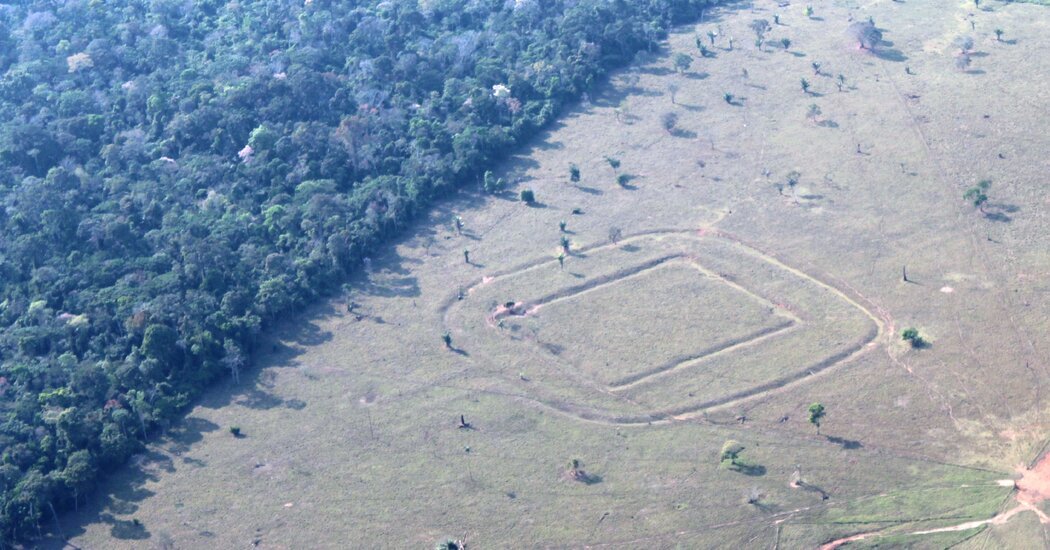
Flying over the southwestern Amazon, archaeologists have discovered hundreds of ancient, monumental designs carved in the earth that hint at complex societies in the rainforest a millennium before Spanish and Portuguese colonists arrived.
The research, published this week in the journal Nature, shows circles, squares and other geometric figures, some with connecting roads, beneath the forest canopy, with nearly 400 previously unknown earthworks in all. Many are formations that archaeologists call geoglyphs and date from between 600 B.C. to 850 A.D. All of them add to evidence contradicting the depiction of the Amazon as a largely untouched expanse before the arrival of Europeans in the 15th century.
To see under the dense canopy near the borders of Bolivia, Brazil and Peru, the researchers used a laser-scanning technology called lidar — an acronym for light detection and ranging — which archaeologists and other scholars around the world have used to map sites invisible to the naked eye.
The geoglyphs, shaped by embankments, mounds and trenches, vary in size. Most span seven acres, including many with ditches 30 feet wide and 15 feet deep. The biggest figure sprawls across more than 120 acres.
“This is an important and ambitious study, based on exceptionally extensive lidar coverage for this region, which reveals the remarkable scale of pre-Columbian landscape modification in southwestern Amazonia,” said José Iriarte, an archaeologist at the University of Exeter who was not involved in the research.
Further excavation, he said, would be crucial in investigating the geoglyphs, which in many ways remain mysterious, including “how they were used and whether they were associated with residence, ceremonies or other activities.”
Drawing in part on oral accounts from the Apurinã nation, the Indigenous group that lives in the center of the earthwork area, the researchers said that the designs likely had several purposes.
“We are quite sure that those are used for festivities, political occasions, ceremonies, dance, music and also competition like ball games,” said Martti Pärssinen, the lead author and an emeritus professor at the University of Helsinki.
The researchers attributed the structures to an ancient society they called the Aquiry, which Dr. Pärssinen described as a multicultural, multilingual group that “shared a common cosmology” reflected in these ceremonial centers.
“Nobody has totally figured out” the exact purpose or meaning of the geoglyphs, which may have astronomically related forms, said Anna Roosevelt, a professor of anthropology at the University of Illinois Chicago, who was not on the team.
Dr. Pärssinen said the archaeologists had not found any evidence of permanent residence at the mounds from the Aquiry era, which ended around 900 A.D. Nor did they believe any were meant to be defensive structures.
But the structures, stretching across a zone of 1,700 square miles, build on evidence that the Amazon basin was widely and densely populated in the centuries before Columbus. Chroniclers like Gaspar de Carvajal, a missionary who traveled the Amazon in the 1540s with the conquistador Francisco de Orellana, described a land “thickly populated” in some places, with many large settlements, including one that “stretched for five leagues without there intervening any space from house to house.”
Those accounts were largely dismissed in the centuries that followed, given the crushing toll that disease and colonization took on Indigenous people. Scientists who followed also struggled to see how large or complex societies could develop without European-style agriculture, contributing to a false idea that the Amazon was a pristine forest, rather than one where the population was almost wiped out.
“Archaeologists find all of these things that are not supposed to be found in Amazonia, and it’s not because Amazonia is different in terms of the soil but how you use the forest,” Dr. Roosevelt said.
Recent work in other parts of the Amazon has found the traces of roads, canals, plazas and residential platforms, including in eastern Ecuador. Dr. Pärssinen’s team estimated that there may be thousands more earthworks in the region, and noted that the rainforest remains so dense in some places that even lasers could not pierce the foliage.
In other places, scientists warned, deforestation for agriculture may have damaged or destroyed sites. “This heritage is highly threatened by logging and soybean farming,” said Eduardo Neves, an archaeologist at the University of São Paulo, who was not on the team.
Dr. Pärssinen’s team also suggested that at the peak of Aquiry society, between 100-300 A.D., the total population of just this region may have reached up to three million people.
Population estimates are a subject of intense and sometimes thorny debate among researchers. Some experts said that the latest study’s proposal should be treated with caution, since it extrapolates not from excavated settlements but from a number of other factors, like how many earthwork sites may be in the region and how many people were probably needed to build and maintain them.
But most scientists now hold that the 16th-century accounts of dense populations were not as far-fetched as many generations believed.
“They thought that it was imagination of Carvajal and the expedition of Orellana, which saw really huge settlements,” Dr. Pärssinen said.