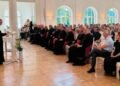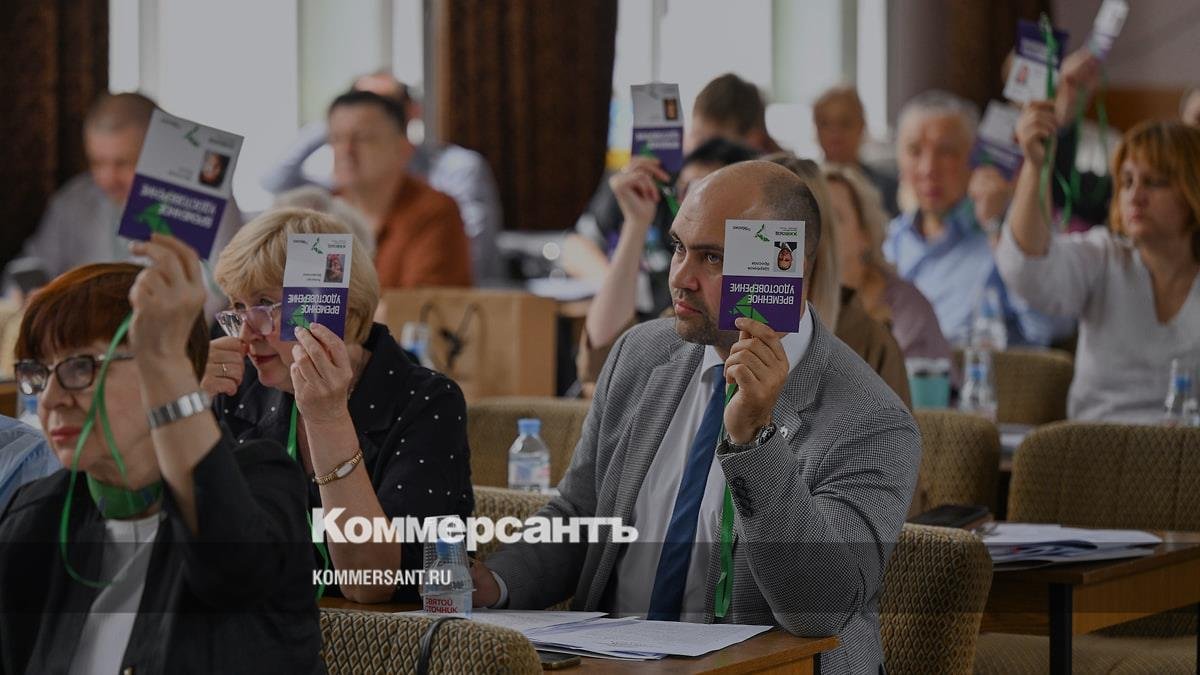
On June 27, the Yabloko party nominated its candidates to the State Duma. The federal part of the party list included seven little-known party members from the regions, led by the leader of the Chelyabinsk branch, Yaroslav Shcherbakov. The congress delegates explained such a non-standard approach to the formation of the top part of the list by the “referendum” nature of the Duma campaign, as well as by the fact that almost all prominent Yabloko members for various reasons were deprived of the right to participate in the elections.
Participants in the pre-election congress were greeted at the doors of the meeting room by two reproductions – “The Apotheosis of War” by Vasily Vereshchagin and “Guernica” by Pablo Picasso – and a black sign counting down the days from the start of the special operation in Ukraine. All this was in sharp contrast to the advertisement for contract military service, which was placed at the entrance to the building of the scientific and methodological center of the trade union of agricultural workers on the outskirts of Moscow, where the Yabloko members gathered.
Party Chairman Nikolai Rybakov began with memories of the previous State Duma elections 2021 and Vladimir Putin’s policy article “On the historical unity of Russians and Ukrainians,” published shortly before them. The president then actually asked the citizens: “What do you think about this?” Mr. Rybakov explained, and the founder of Yabloko, Grigory Yavlinsky, on behalf of the entire party, replied that there would not be a local conflict, but a war with the entire Western world. “We were told that we were alarmists, dreamers, that we were scaring people in order to score points,” complained the Yabloko leader. “People did not respond as they could have answered if they used the opportunity of elections.”
As a result, according to Nikolai Rybakov, the “stupid voting” of Russians for the Communist Party of the Russian Federation and “New People” in September 2021 led to February 2022.
And on September 21 of the same year, partial mobilization was announced – and, by the way, in 2026, September 21 is the first day after the elections, the speaker pointedly noted.
After this, Mr. Rybakov announced the main election theses of Yabloko 2026:
- “For the ceasefire agreement”
- “For receiving information without censorship or blocking”,
- “For life without fear and repression.”
He called this program “the shortest in the entire history” of the party. The party list at the State Duma elections also turned out to be unique: at first, its federal part entered six little-known candidates from regional branches, led by the leader of the Chelyabinsk Yabloko party Yaroslav Shcherbakov and deputy of the St. Petersburg legislative assembly Dmitry Anisimov. And late at night a seventh was added to them – the head of the Moscow branch of the party, Kirill Goncharov.
The Yabloko press service, which presented this part of the list on the eve of the congress, recalled in its message that more than 40 party members have been deprived of the right to participate in the elections in recent months. Several people, including Nikolai Rybakov and ex-Yabloko leader Emilia Slabunova, were brought to administrative responsibility for displaying extremist symbols. The Ministry of Justice included the party’s deputy chairmen Lev Shlosberg and Boris Vishnevsky in the register of foreign agents. Finally, another deputy chairman Maxim Kruglov June 24 was sentenced to seven years in prison for lying about the army.
Therefore, now, Yabloko members noted, they will have to focus their campaigning not on people, but on the ideas they represent. Separately, Mr. Rybakov pointed out the inherent youth of the party list: the oldest candidate from its head section is 42 years old, and the youngest is 31.
“People born in the 1990s and early 2000s should see politicians of their own age,” explained the youngest of the list leaders, lawyer Vitaly Isakov, to Kommersant. “Politicians who value the life and freedom of people of their own generation, and do not decide for other generations how they should live.”
To understand what young people really want, Nikolai Rybakov suggested studying photographs and videos from the Istanbul concert of the Belarusian musician Max Korzh: “Young people from Russia, Ukraine, and Belarus came there. They stood together, they laughed and cried. They were holding the flags of Russia and Ukraine. They understood that they did not want to kill each other, they wanted to live together, love and be in peace.”
After Nikolai Rybakov, Grigory Yavlinsky spoke. The only well-known Yabloko member, who retained the right to be elected, but was not included in the list of candidates, began with what seemed to be a topical issue: “The elections in which we will participate are more like a referendum. The question is what proportion of citizens want a different policy.” But then he returned to the past to recall his old interviews, in which he spoke about many current problems, including the “Versailles syndrome” of Russians after the collapse of the USSR.
The Yabloko members interviewed by Kommersant were not surprised by the absence of Mr. Yavlinsky on the election list. “Well, he warned about it,” one of them shrugged. And Nikolai Rybakov explained this decision of the party founder with his wisdom and desire to prepare personnel for the future: “If the same people come out all the time, they say: do you have anyone else in the party?”