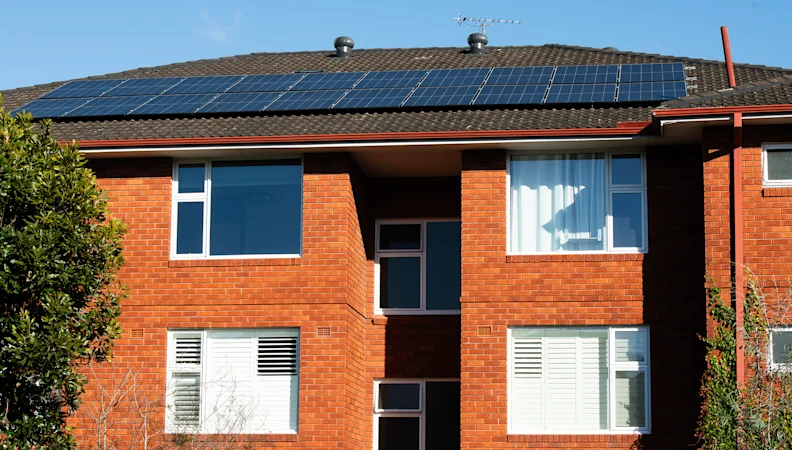

A push to improve access to rooftop solar for Australia’s 2.5 million apartment dwellers is gaining momentum, but owners are still facing headwinds from strata and government bureaucracy.
About 35 to 40 per cent of detached homes have rooftop solar – making Australia the world leader – but less than 3 per cent of apartments do, industry figures suggest.
Over the past two years, the NSW and Victorian governments, with federal support, have offered grants for apartment buildings to add solar panels.
Among them was Edmond Yan’s three-storey 1960s apartment building in Waverton on the lower north shore of Sydney, which installed solar panels last October. The NSW government’s Solar for Apartment Residents scheme contributed about $23,000 out of total costs of $58,000, which Yan said made the decision much easier for the owners’ corporation.
Rather than installing solar solely for communal power, the building bought Allume Energy’s SolShare product, which splits the 26-kilowatt system on the roof between the 12 apartments.
“That’s the much more appealing aspect of it for us because our common power uses hardly anything because we don’t have a lift or common hot water or anything like that,” Yan said. “We only have lighting, and that’s on at night, so actually the benefit of solar without batteries is minimal to almost none during the day.”
Yan said his electricity usage was 38 per cent lower for the six months after the installation than the same time period the previous year, which translated to a $250 saving on his bill. He has also paid to install an electric vehicle charger in his dedicated parking spot, which is connected to his apartment’s electricity supply.
Melbourne-based Allume Energy started selling SolShare in 2019, and industry sources say it has no direct competitors to date. The unit splits solar energy equitably between apartments – as few as five and as many as 60 – and SolShare 2 with support for solar batteries is launching this month.
In a sign of growing momentum for apartment solar, Allume Energy almost doubled its Australian installations in the past year. As of June 1, it had connected 6654 Australian apartments in total, with 3182 of those in the past 12 months, the company said.
The company’s co-founder and chief executive Cameron Knox said the rebates were a catalyst for significant uptake in both its home state of Victoria and NSW, its biggest Australian market.
“Victoria and NSW are forever competing in many ways, but for us, they’re competing on how many apartments are connected,” Knox said. “NSW has the highest density of apartments in Australia, and also the strata legislation in the state enables for the adoption of sustainability measures like solar and batteries more easily.”
In most states, including Victoria, an owners’ corporation needs a special resolution with 75 per cent support to approve the investment in solar. In NSW, strata law allows a “sustainability infrastructure resolution”, which only requires 50 per cent of the vote. The industry has urged a Victorian parliamentary inquiry into renewable energy for apartments to adopt this policy.
In Yan’s case, his neighbours voted overwhelmingly in favour of the solar installation, once they were satisfied that the roof could support the weight. Yan said the benefit to owner-occupiers was obvious, while landlords were persuaded it would increase the property value. Fortunately, the building did not need other capital works at the time.
The Victorian Solar Homes Program, which covers an average of 76 per cent of costs, has funded solar installations for 2736 apartments since February 2024, with a further 754 in the pipeline. Of those, 1115 were in the past 11 months.
A Solar Victoria spokesperson added that 46 per cent of installations had been for rental apartments.
The NSW rebate program since February 2025 provides grants of up 50 per cent of total costs, with an additional funding boost for specific suburbs. As of May this year, it has funded 165 buildings or 3000 individual apartments, a government spokesperson said.
The numbers are still low compared with the overall growth of solar, which reached a cumulative total of 4.1 million Australian households last month, figures from solar consultancy SunWiz show.
The 3 per cent figure comes from a research paper for the NSW government by Solar Choice, looking at the state’s 49,000 strata schemes with five or more lots. Solar Choice chief executive Jeff Sykes said the national figure would be similar.
Heidi Lee Douglas, chief executive of solar consumer advocacy group Solar Citizens, said organising solar for an apartment building took a lot of work, which fell on residents working in a volunteer capacity.
“You need to have a solar champion within your strata [scheme], who’s willing to jump through the hoops of the paperwork and co-ordinating advocacy in the strata itself to make the grant application,” Douglas said. “Sometimes there are other issues that they uncover in the process … One person I spoke to in the community found out they needed a $70,000 upgrade on their meter box before they could actually do the work.”
A Solar Victoria spokesperson said the difficulty of securing agreement within an owners’ corporation meant some installations were taking 12 to 18 months to complete.
The Owners Corporation Network of Australia this week won a grant from the NSW government to provide a specialist resource to help apartment owners through the process.
Douglas said high-rise apartments were locked out of the grant schemes and also tended to have limited roof space for panels. She advocates the creation of “urban renewable energy zones”, which involves upscaling solar and batteries on large commercial, industrial and public buildings, then sharing it with neighbouring apartment buildings within a local network.
SunWiz chief executive Warwick Johnson said Australia should allow balcony solar panels, which are used in Germany. As previously reported by this masthead, the devices, which cost about $500, hang on the balcony railing, plug into a standard power socket, and can be taken when the resident moves house.
Get to the heart of what’s happening with climate change and the environment. Sign up for our fortnightly Environment newsletter.
 Caitlin Fitzsimmons is the environment and climate reporter for The Sydney Morning Herald. She was previously the social affairs reporter and the Money editor.Connect via email.