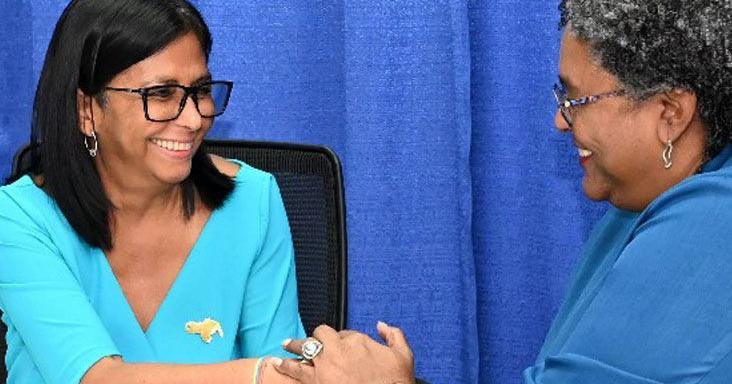
Venezuela’s acting President Delcy Rodriguez has created tension in Caricom after she boldly wore a brooch designed to look like a map of Venezuela which incorporates Guyana’s Essequibo region during her recent visits to Grenada and Barbados.
This is not sitting well with Guyana’s President Dr Irfaan Ali who, by letter dated April 28, 2026, wrote to Caricom chairman Dr Terrance Drew formally objecting to what he described as a provocative escalation by Venezuela in its long-running territorial claim to Guyana’s Essequibo region.

Venezuelan acting President Delcy Rodriquez, right, and Barbados Prime Minister Mia Mottley
Ali argued that the use of Caricom engagements to project or promote a territorial claim against a member state risked being interpreted as acquiescence or tolerance.
He described Rodriguez’s actions as “calculated and provocative assertion” of a claim that Guyana has consistently and lawfully rejected, and which is before the International Court of Justice (ICJ) for final adjudication.

PRESIDENT
OF GUYANA:
Dr Irfaan Ali
The case before the ICJ between Guyana and Venezuela centres on the long-running dispute over the Essequibo region, a vast, resource-rich territory that makes up about two-thirds of Guyana but is claimed by Venezuela.
On April 9, Rodriguez visited Grenada and met with the island’s Prime Minister Dickon Mitchell.
On April 27 she met with Barbados Prime Minister Mia Mottley in Bridgetown.
The United States carried out a military operation on January 3, 2026 that resulted in the capture and removal of Nicolás Maduro from power, with US forces extracting him from Caracas and transporting him to face charges in New York. Since then, Rodriguez has been in charge and is set to face a general election in Venezuela in the near future.
In 2018, Guyana asked the Court to confirm that the 1899 Arbitral Award—which fixed the boundary when Guyana was a British colony—was legally valid and binding, thereby affirming its sovereignty over the area.
Venezuela, however, rejects the award as flawed and argues that the issue should instead be resolved through the 1966 Geneva Agreement process, while also disputing the ICJ’s jurisdiction.
The ICJ has since ruled that it does have jurisdiction and has issued provisional measures ordering Venezuela not to take actions that would alter the status quo in the disputed territory while the case is pending.
The oral hearings before the ICJ in the Guyana–Venezuela Essequibo case are scheduled to begin on May 4, 2026 in The Hague.
Wrong signal
In his letter, while affirming that Guyana respects the sovereign right of Caricom countries to maintain bilateral relations with all partners, including Venezuela, Ali said it was “deeply regrettable” that such engagements were accompanied by “the prominent display of symbols asserting Venezuela’s claim to Guyana’s territory”.
Ali cautioned that the use of regional platforms to advance territorial claims risked sending the wrong signal.
“The use of Caricom engagements to project or promote a territorial claim against a member state risks being interpreted as acquiescence or tolerance,” he wrote.
He stressed that “no action, whether deliberate or inadvertent,” should create the impression that Caricom’s platforms can be used to advance claims currently before the ICJ.
The Guyanese president said the Community’s long-standing support for Guyana must be reflected not only in formal declarations, but also in “the context and conduct of official engagements”.
He noted that the issue was before the ICJ for final adjudication and argued that Venezuela’s actions run counter to accepted norms governing disputes before the Court.
“Venezuela cannot, while the case is before the Court, seek to normalise by symbols, maps, legislation, appointments or official display what it has failed to establish in law,” Ali wrote.
He added that such conduct “does not strengthen Venezuela’s case” but instead “undermines confidence in its stated commitment to peaceful settlement, international law, and good neighbourly relations”.
Reaffirming Guyana’s legal position, Ali pointed to the 1899 Arbitral Award, which he said determined the boundary as a “full, perfect and final settlement”.
He argued that Venezuela’s revival of the claim decades later, along with “more recent measures purporting to annex the Essequibo and appoint officials for that territory,” forms part of a “pattern of conduct inconsistent with international law and the process to which the matter has been submitted”.
Ali also cited the ICJ’s December 1, 2023 order, which required Venezuela not to take any action that would alter the status quo in the disputed territory.
He noted that the Court directed that Guyana continues to administer and exercise control over the area, while both parties must refrain from actions that could aggravate or extend the dispute or make it harder to resolve.
“These actions persist notwithstanding the Order of the Court,” Ali said, referring to Venezuela’s continued symbolic and administrative moves.
Caricom support
Addressing Drew in his capacity as Caricom chairman, Ali said he was conveying Guyana’s concerns and urging “continued vigilance in safeguarding the Community’s principled position”.
He reminded regional leaders of their “repeated and unequivocal support” for Guyana’s sovereignty and territorial integrity, as well as their backing for a judicial resolution through the ICJ.
That position, he noted, was most recently reaffirmed at the Fiftieth Regular Meeting of the Conference of Heads of Government.
Ali reiterated that Guyana remains committed to resolving the dispute peacefully and in accordance with international law.
He stated: “Guyana remains fully committed to the peaceful resolution of this matter in accordance with international law. We continue to repose our confidence in the Court and to respect its processes and eventual judgment.”
The letter concluded: “At the same time, Guyana expects all States, including Venezuela, to act consistently with the principles of the United Nations Charter, refrain from provocation, and respect the ongoing judicial process.”
Prime Minister Kamla Persad-Bissessar said yesterday she had no issue and remained unfazed by Rodríguez meeting with Caricom leaders.
She said Trinidad and Tobago continued to engage Caracas through diplomatic channels and via Minister of Foreign and Caricom Affairs Sean Sobers.
She said, “I have no problem. She has to do what she has to do and I have to do what I have to do.”
The Prime Minister pointed out that Rodríguez was previously sanctioned by the United States and had been unable to travel.
In addition to meeting two Caricom prime ministers, Rodríguez also met with former prime minister and energy minister Stuart Young, who disclosed the meeting publicly via a photograph of himself and Rodríguez on social media.
Flashback
At a meeting convened under the auspices of Caribbean Community in December 2023 in St Vincent and the Grenadines, then-Venezuelan President Nicolás Maduro and Guyana’s President Irfaan Ali agreed to pursue a peaceful resolution of the Essequibo controversy in accordance with international law.
The engagement, which produced the “Joint Declaration of Argyle for Dialogue and Peace” saw both sides commit to avoiding the use or threat of force and to maintaining dialogue while the matter remains before the ICJ. Within that framework, Maduro indicated that Venezuela would not escalate tensions and would engage diplomatically as the judicial process unfolds, effectively acknowledging that the dispute is pending before the Court even as Caracas continues to contest its jurisdiction.
While Maduro agreed in principle to avoid escalation and pursue peaceful means while the matter is before the ICJ, subsequent actions by Venezuela raised concerns.
Guyana and international partners repeatedly accused Caracas of violating both the Argyle Declaration and ICJ orders, including moves such as declaring Essequibo a Venezuelan state, pursuing resource activities in the disputed area, and maritime incursions near Guyana’s oil operations.
International bodies—including the Commonwealth—have stated that some Venezuelan actions “run counter to the spirit” of the Argyle agreement and have urged adherence to the ICJ’s provisional measures.