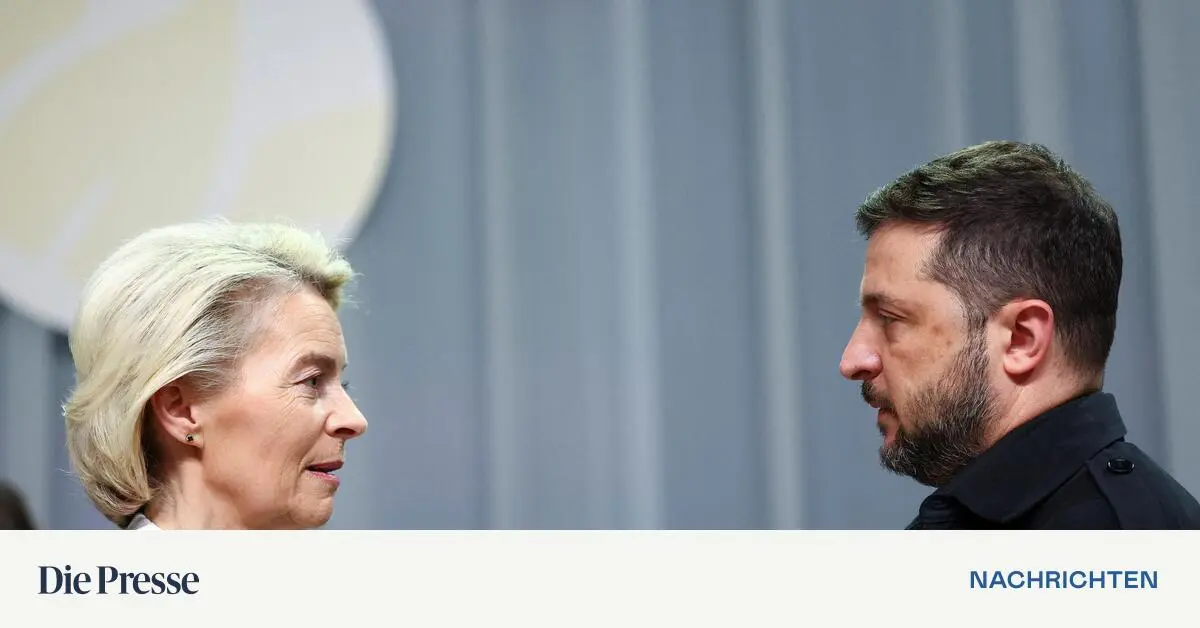
“It’s time for the next step”: In the picturesque Cypriot seaside resort of Ayia Napa, where the EU leaders are meeting for their two-day summit, there is unusual unity between Commission boss Ursula von der Leyen, foreign affairs representative Kaja Kallas and Council President António Costa. The trio is calling on the heads of state and government to speed up the accession process with Ukraine. The country has had candidate status since 2022 – the first year of Russia’s war of aggression; However, the opening of the negotiating chapters, which all 27 member states must agree to, has so far been blocked by Hungary.
With the end of Viktor Orbán, Brussels is now hoping that the individual “clusters”, as the chapters to be processed are called in EU jargon, will be opened “immediately”. Since the 90 billion euro loan and the 20th sanctions package against Moscow were finally approved at the summit, the way for this is now clear, it was said at the meeting in Cyprus, which the outgoing Orbán had already skipped. However, his designated successor is also taking a wait-and-see approach: Peter Magyar insists on a performance-based approach, but has indicated that he will not stand in the way of the usual accession process, which is mandatory for all candidate countries. “Budapest will accept those countries that are ready to join instead of making them wait. That would not be in the interest of the European population,” Magyar said recently. Austria’s government also does not want a special regulation for Kiev with a view to the Western Balkan states, which have been sitting in the EU waiting room for more than 20 years.
So when is it realistic to open the first of a total of 35 negotiating chapters? Kiev is hoping for a meeting of EU European ministers at the end of May, as Ukrainian Deputy Prime Minister Taras Kachka said in an interview with “Politico”. “All chapters could be open by the time of the regular EU summit in June.” Kallas, who is from Estonia, supports this approach – and is working behind the scenes on plans to further accelerate the process. Originally, Zelenskiy had also specified January 1, 2027 as the target date for accession.
From today’s perspective, this is completely unrealistic – because there is great skepticism among the member states. Important EU capitals such as Berlin are not keen on the idea of quickly admitting new members in light of the geopolitically uncertain situation. There is great concern that their governments may not take the EU’s high standards for the rule of law, anti-corruption and democracy too seriously. “Germany supports the goal of accession, even if we know that we cannot fully implement it in the short term,” emphasized Chancellor Friedrich Merz at German-Ukrainian government consultations in Berlin in mid-April.
Kachka remains optimistic: He thinks that his country could have taken all the necessary steps for accession by “the end of 2027.” In view of past accession processes, this hope seems unrealistic: Croatia’s youngest EU member, which has been a member of the community since 2013, took six years to negotiate. And that, Brussels diplomats emphasize, was relatively quick.