The interim government of Delcy Rodríguez says it has released 8,146 political prisoners without precautionary measures under the protection of the Amnesty Law. The last statement where this figure is supported was given by Jorge Rodríguez, president of the National Assembly, on March 26, 2026, but on the outskirts of some penitentiary centers, families are still waiting for the mass releases that were promised on January 8.
The release of people deprived of liberty for political reasons in Venezuela was offered by the Chavista authorities, after the capture of Nicolás Maduro and Cilia Flores by US forces, as a new “political moment”, but the reality is that in the country’s prisons there are still hundreds of prisoners of conscience.
Elderly, sick, military and female political prisoners hope to benefit from the Amnesty Law, which has been implemented in dribs and drabs after maximum international pressure and from the relatives of those arbitrarily detained who do not stop their fight.
Numbers war
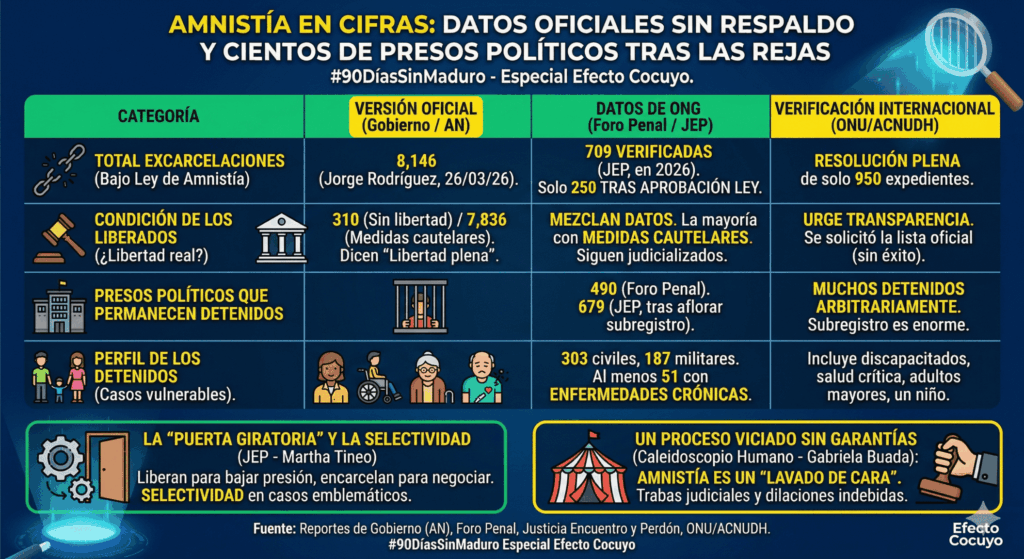
According to the government of Venezuela, of the 8,146 releases, 7,836 people were subject to precautionary measures such as presentation before a control court every 15 or 30 days, while 310 were under deprivation of liberty.
The non-governmental organization Foro Penal has counted 11,000 people subject to judicial proceedings for political reasons, while as of April 3, 490 remain deprived of liberty. Among them 44 foreigners or citizens with dual nationality, 303 of those detained are civilians and 187 are military.
For its part, the NGO Justicia Encuentro y Perdón (JEP) has only been able to verify the release of 709 political prisoners so far this year, of which 250 occurred after the approval of the law on February 19, 2026.
The figure shared by JEP of those released after the promulgation of the amnesty corresponds to people who were deprived of their liberty.
The office of the United Nations High Commissioner for Human Rights reported that, after auditing the notification slips and effective dismissals, they were only able to certify the full resolution of 950 files. They warn that the rest of the official figure corresponds to “administrative announcements without verifiable procedural execution.”
“According to the authorities, some 7,700 people have been unconditionally released under the law. My Office has requested the official list of those released, as well as unrestricted access to several detention centers, so far without success. I urge greater transparency regarding the release of detainees,” said UN High Commissioner for Human Rights Volker Türk on March 17 during his oral presentation before the Human Rights Council.
The first three months of 2026 have passed under uncertainty. In the special #90DíasSinMaduro Cocuyo Effect presents the amnesty in data, a legislation that sought reconciliation, but is still waiting for hundreds of families and excluding a large number of cases.
Not publishing the list is a common practice
For NGOs defending the human rights of political prisoners, the provision of information by State authorities is not only scarce, it also corresponds to common practices that prevent verification through third parties to contrast the official narrative.
Gabriela Buada, general coordinator of the NGO Kaleidoscopio Humano, in an interview with Effect Cocuyo, warns that this is a flawed process where there are no guarantees of transparency.
“Talking about the issue of political prisoners of an amnesty that in reality there is no indication that assures you that it is a clean process, that it is a fair process. It is for a kind of whitewashing or to impose a narrative that this is working,” he added.
Despite the official narrative of reconciliation and the promulgation of an Amnesty Law, human rights organizations denounce that the justice system continues to operate under a logic of political communication and whitewashing.
The application of the Amnesty Law also faces severe judicial obstacles, characterized by selectivity, refusal to deliver notification slips and undue delays by the courts. Organizations denounce that these practices prevent the appeal of decisions and exclude cases under political criteria, which turns the norm into a limited instrument
Unverified figures
Martha Tineo, coordinator of the organization Justicia Encuentro y Perdón, told Estudio Cocuyo that on January 8, when the start of the releases was announced, the organization had 1,011 political prisoners documented. From that date to the present, more than 709 people have been verified released from prison.
“To the extent we subtract, we also add,” warns Tineo. The opening process caused hundreds of families, previously silenced by fear or blackmail, to report old cases. The organization’s database registers 679 political prisoners who remain behind bars, until April 1, 2026.
«If we add those who left and those who remain, we are talking about more than 1,300 identified victims. The under-registration was enormous,” he added.
The High Commissioner warned: “Many Venezuelans continue to be arbitrarily detained, including people with disabilities and critical health conditions, older people and at least one child. Civic space remains restricted. Years of repression have generated fear of expressing themselves.”
María Eloísa Quintero, member of the Independent International Fact-Finding Mission on the Bolivarian Republic of Venezuela, during the oral update on Venezuela at the 61st session of the UN Human Rights Council, maintained that there is no certain and unique data on the identity and number of the so-called political prisoners.
“The official figures on people imprisoned and released are problematic and cannot be corroborated,” he said.
On January 23, 2026, Delcy Rodríguez put the number of people released from prison at 626, while non-governmental organizations estimate that the number was significantly lower.
For NGOs, government figures are misleading because they mix those who receive full freedom with those who only obtained a release with precautionary measures (prohibition of leaving the country and periodic presentation). These people remain prosecuted, that is, they are not free, but rather their imprisonment has been moved to the limits of national borders.
“While the Government says it is emptying the prisons, we are filling out new files,” says Tineo.
Buada described the current management as an extension of the practices of recent decades. «The amnesty has not been applied effectively. It is a flawed process, a circus that we are used to,” he says.
Selectivity of freedom
Tineo explains that the use of political prisoners is functional for the government. In moments of maximum pressure, power uses the “revolving door”: it releases some to reduce tension, while imprisoning others to maintain their negotiation quotas.
He pointed out that emblematic cases such as the denial of amnesty to Perkins Rocha, the human rights defender Javier Tarazona or those involved in the “Plaza Venezuela” case, demonstrate that selectivity is still in force.
Although the Organic Code of Criminal Procedure prohibits the detention of adults over 70 years of age and requires humanitarian measures for seriously ill people, the reality in prisons ignores the law.
Justicia, Encuentro y Perdón registers at least 51 political prisoners with chronic or terminal illnesses who have not been released.
“There are still adolescents in prison, such as the case of a young woman detained solely for being the sister-in-law of a dissident military officer,” explains Gabriela Buada. The lack of a differentiated approach for the more than 50 detained women and the generalized medical neglect keep the situation in an inhumane state.
“We have more than 600 political prisoners today, which is why we have insisted that, unfortunately, this entire process of release, and then the approval of the Amnesty Law, has more to do with a reaction to maximum external pressure than with the situation of political prisoners. The absolute abuse and arbitrariness in the exercise of power continues,” says Tineo.