How have governance, endowments and volunteerism reshaped the sector?
The non-profit sector… from filling poverty to creating impact
When the Kingdom’s Vision 2030 was launched about a decade ago, the non-profit sector was not just a sector supporting social and charitable work, but rather it was one of the targeted engines for building an “ambitious nation” based on community participation in development and maximizing economic and social impact. Today, ten years after the launch of the vision, the numbers contained in the annual report of Saudi Vision 2030 for the year 2025 reveal that the non-profit sector is no longer a marginal sector, but rather has become a real partner in national development.
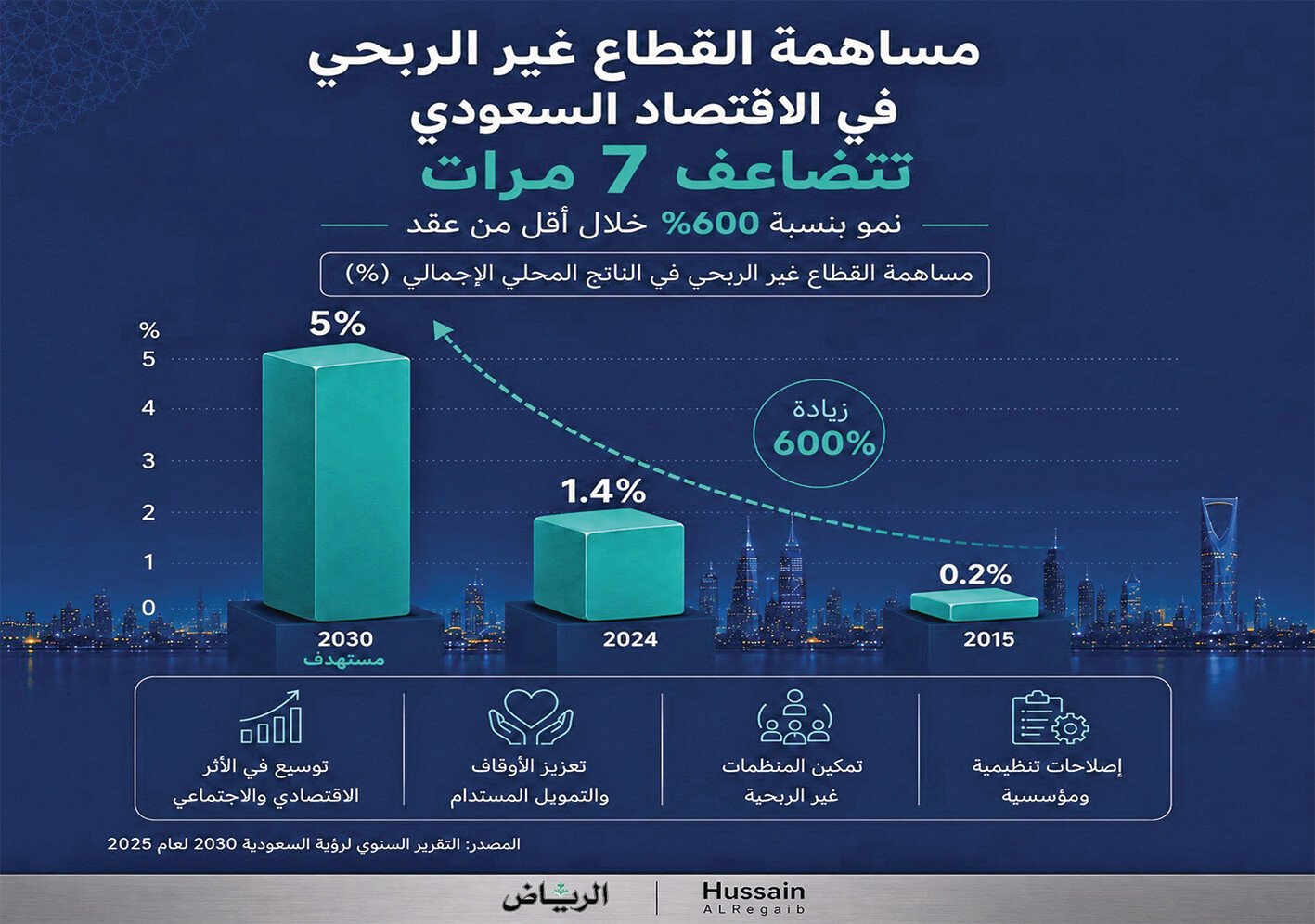
Data show that the contribution of the non-profit sector to GDP rose from 0.2% in 2015 to 1.4% in 2024, a seven-fold increase in less than a decade. Although the ultimate goal of the vision is to reach 5% by 2030, the current path reflects accelerated progress that confirms the success of the reforms that the sector has witnessed over the past years.
This growth was not a coincidence, but rather came as a result of a broad package of regulatory and institutional reforms that reshaped the non-profit work environment in the Kingdom. The most prominent of these reforms is the establishment of the National Center for Non-Profit Sector Development, which played a pivotal role in reorganizing the sector, defining roles and responsibilities, and enabling associations and institutions to work according to more professional and sustainable models.
Funding sources
The establishment of supervisory units in various government agencies also contributed to facilitating the establishment of non-profit organizations and accelerating their procedures, in addition to providing institutional and advisory support that enabled many agencies to develop their work and enhance their development impact.
Perhaps one of the most important transformations that the sector has witnessed over the past years is its move from relying on traditional donations to searching for more sustainable sources of financing. Here, endowments emerged as one of the most important tributaries of development financing, as the Kingdom witnessed extensive development of endowment systems and the launch of numerous incentives to encourage the establishment of endowments and increase their revenues, in addition to the establishment of endowment funds and institutions specialized in various development fields. The impact of the non-profit sector was not limited to the economic aspect only, but extended to enhancing community participation and raising the level of social responsibility among members of society. This is clearly evident in the big jump in the number of volunteers, as their number rose from only 22.9 thousand volunteers in 2015 to about 1.75 million volunteers in 2025, an achievement that reflects the Kingdom’s success in establishing a culture of volunteer work and transforming it into a widespread community practice.
The role of the non-profit sector has also emerged in many national programmes, most notably the development housing sector, which has become a successful model for integration between the government, private and non-profit sectors. Modern digital platforms have contributed to facilitating the access of support to the most needy families, and increasing the contribution of individuals and institutions in providing housing solutions, which has had a direct impact on the quality of life and family stability.
The development was not limited to the financing and regulatory aspects only, but also extended to building an advanced governance system that enhanced transparency and accountability and raised the level of confidence in the sector. The governance rules for associations and civil society organizations have contributed to consolidating practices of disclosure, internal control, and conflict-of-interest management, and have obligated major associations to form specialized committees for review, nominations, and rewards, ensuring efficient resource management and protection of donor and beneficiary funds. These rules also strengthened the role of boards of directors in monitoring financial and operational performance, and raised the level of disclosure of relevant contracts, rewards and fundamental decisions, which contributed to increasing confidence among donors, supporting bodies and beneficiaries. With the rise in standards of compliance and transparency, civil society organizations and institutions have become more able to attract funding, build partnerships, and achieve financial sustainability. Governance has also helped transform many non-profit organizations from entities that depend on individual efforts into institutions that operate according to clear policies, procedures, and measurable performance indicators. Today, commitment to governance has become a major factor in raising the efficiency of spending, improving the quality of services provided to beneficiaries, and enhancing the sector’s ability to expand and grow and attract specialized competencies and expertise, which has made governance one of the most important enablers that support the sector’s sustainability and increase its ability to achieve a long-term development and economic impact.
Vision indicators also indicate that the proportion of workers in the non-profit sector out of the total workforce has witnessed remarkable growth, which reflects the sector’s transformation into a real generator of jobs and employment opportunities, and not just a channel for volunteer or charitable work only.
When looking at the Saudi experience in this field, it can be said that the non-profit sector has become a unique model that combines social impact and economic return. Every successful association, every sustainable endowment, and every effective volunteer initiative contributes to reducing the burden on public services, improving the quality of life, and enhancing social cohesion, while at the same time creating job opportunities and supporting economic activity.
As the Kingdom’s Vision 2030 enters its third phase, it appears that the non-profit sector is facing a historic opportunity to double its impact and contribution to the national economy. Current numbers confirm that the sector is on the right track, but reaching the target of 5% of GDP requires continued development of legislation, strengthening governance, raising the efficiency of organizations, and expanding the scope of endowment investment.
The past ten years have proven that investing in the non-profit sector is not only charitable work, but rather an investment in people, society and the economy together. What has been achieved to date represents the beginning of a new phase that may make the Kingdom one of the most prominent global experiences in employing the non-profit sector as a sustainable development and economic tool.