Thursday, April 30, 2026 12:08 pm –
Jerusalem time

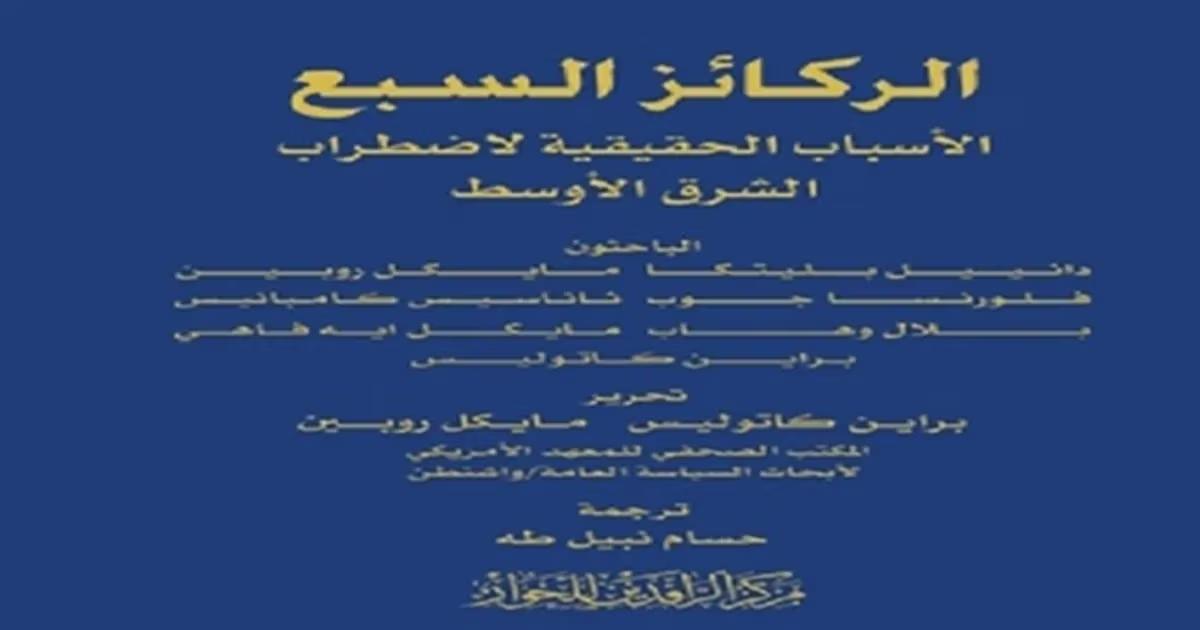
The book ‘The Seven Pillars: The Real Causes of Middle East Turmoil’, edited by Michael Rubin and Brian Katulis, presents a different analytical vision that seeks to go beyond superficial explanations of regional crises. The editors believe that the turmoil in the region is not just occasional events, but rather a deep structural problem in which political, ideological and social threads are intertwined in a recurring historical manner.
This research project, issued by the Al-Rafidain Center for Dialogue, aims to understand the imbalance from within the societal and political structure of the ruling regimes. Researchers point out that the fragility of stability stems primarily from weak popular acceptance, which pushes regimes to rely on force or religion as alternatives to legitimacy, which are alternatives that often reproduce crises rather than resolving them.
In the first chapter, researcher Daniel Pletka raises a central question about the reasons for the decline of the region that was the cradle of civilizations, criticizing the tendency to justify failure by blaming external factors only. Pletka believes that ignoring the deep internal roots of the crisis prevents presenting realistic solutions based on the structure of society itself, stressing that the Arab Spring revolutions were the result of complications from chronic diseases.
Michael Rubin deals with the concept of political legitimacy, considering it a living relationship between the ruler and the ruled, the collapse of which causes the fall of regimes, no matter how strong their apparent strength. Robin explains that the contradiction between international recognition and internal rejection of some regimes revealed that legitimacy is the primary driver of peoples, and is what drives them to sacrifice or resist.
The book argues that the nation-state in the Middle East was formed under the influence of colonialism, which made national identity less established compared to the European model. However, events have proven that the legitimacy of the state as an entity often remains in place, while what is being challenged and collapsed is the legitimacy of governments and ruling elites’ control over the reins of power.
Regarding ideology, Thanassis Kampanis argues that the region has not entered the ‘post-ideology’ stage as some promote, but rather totalitarian ideas still represent a framework for interpreting reality. Campanis links the rise of these movements to the desire to restore past glories, which makes political practice more related to historical nostalgia than to contemporary reality.
Technological development and means of communication have contributed to the creation of “thought bubbles” that have fostered societal division instead of dialogue, according to the book’s analysis. This intellectual isolation made every movement see in its theses a comprehensive solution, and with the inability of these ideologies to build strong institutions, the street lost confidence in them, which opened the door to the rise of Islamic movements.
The correct scientific diagnosis of the causes of the intractable problems that the region’s residents suffer from is an ideal key to solving them.
Researcher Florence Job deconstructs the stereotypical image of armies as a stabilizing factor in Arab countries, noting that the military institution has often turned into a direct political actor. Job indicates that there have been 73 coup attempts since Iraq’s independence in 1932, which proves that armies may be a source of political shocks rather than protecting national security.
Job also points out that the structure of the armies themselves suffers from a flaw, as recruitment is sometimes carried out for economic motives to escape unemployment and not based on a professional doctrine. Building military institutions on sectarian foundations or narrow loyalties weakens their unity and makes them a tool for protecting the regime, not the state, which creates a deep gap between the army and society.
On the economic level, Bilal Wahab explains that the relationship between money and politics in the region is very complex, as it is difficult to separate living crises from structural corruption. Wahhab believes that oil was a ‘blessing and a curse’ at the same time, as it provided huge wealth but hindered real reform and encouraged the building of a rentier economy that bought political loyalties.
Wahab describes corruption as an ‘epidemic’ that is spreading in rich and poor countries alike, and is the main reason for the lack of trust between citizens and the state. Although the region is rich in resources, it remains a hotbed of economic failure and the export of violence, which reveals a deep imbalance in how wealth is managed and distributed.
In a reading of the role of religion, A. rejects… Kadir Yildirim explores simplistic explanations that link the region’s crises to the Islamic religion itself. Yildirim believes that the rise of political Islam is a natural result of the failure of secular regimes to achieve justice, as religion has turned into a last political resort for people searching for a reliable alternative.
The study confirms that regimes used religion pragmatically to enhance their eroding legitimacy, which led to religious discourse losing its stability and the emergence of tensions between official religion and popular movements. The book also makes clear that sectarianism is not just an ideological difference, but rather a political tool used in regional conflicts and competition for influence.
Despite the scientific value of the book, a critical reading concludes that it adopts a discourse that may seem polemical that absolves the Western mind of its responsibilities. By ignoring the book’s implantation of Israel in the heart of the region and the major tensions that resulted from it, it seems as if it overlooks a fundamental factor in the structure of the disorder that it tried to dismantle, placing responsibility entirely on internal factors.