Friday, March 27, 2026 4:43 pm –
Jerusalem time

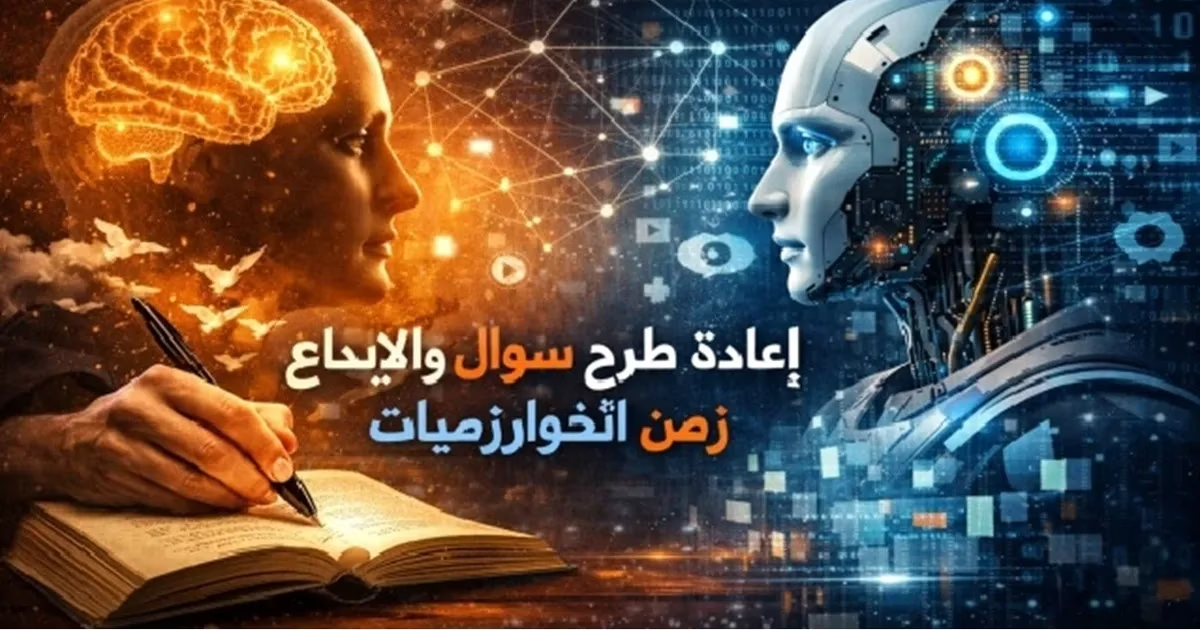
The cultural and intellectual community recently witnessed a qualitative shock with the publication of a philosophical book produced entirely by artificial intelligence under the title ‘The Rule of Hypnosis’, addressing figures such as Trump and Musk. This event is no longer just a technical demonstration, but has become a milestone indicating a profound shift in man’s relationship with the machine he created with his own hands.
This ‘parallel mind’ appears to have gone beyond simple simulation to begin directly influencing human thought patterns, putting the basic human function of free thinking to the test. This transformation poses urgent questions about the extent to which the contemporary creator has control over his choices in a space that seems pre-directed.
Historically, restrictions on creativity have been confined between the hammer of public censorship and laws, and the anvil of self-censorship stemming from social values. However, the current scene has revealed the emergence of a third, more complex and hidden authority, which is the authority of algorithms that have come to control the flow of knowledge and direct awareness.
Algorithms are scientifically defined as a set of logical steps designed to solve problems, and their development was inspired by the neural networks of the human brain. With the emergence of deep learning and big data technologies, these tools have transformed from mere computational methods into comprehensive guidance systems.
The danger of algorithms is evident in their ability to determine what is shown to the creator and what is hidden from him, which directly affects his stock of knowledge and sources of inspiration. This directive pushes cultural producers, consciously or not, to formulate content that complies with digital dissemination standards to ensure interactivity.
In modern communication platforms, it is observed that fast and dense content is preferred at the expense of intellectual depth, which forces creators to reduce and simplify their ideas. This pattern leads to an unspoken stereotyping of creativity, whereby the dominant aesthetic styles become those with the most views.
These systems practice a kind of ‘soft guidance’ that reshapes public taste without a direct clash with the creator. By analyzing behaviors, algorithms build a digital world that looks exactly like the user, confining him to a narrow circle of preconceived beliefs.
Creativity today has become a field of conflict between algorithmic logic, based on expectation, and human logic, based on innovation and difference.
The concept of ‘echo chambers’ emerges here, where the individual finds himself surrounded by opinions that are similar to his view of the world, while different points of view are completely absent. This closure not only threatens societal peace, but also kills the creative process, which essentially feeds on diversity, difference, and contact with others.
The biggest problem is that these systems give the user the illusion of complete freedom of choice, while he is moving in a precisely drawn space. The feeling of freedom within a programmed system raises philosophical problems about the nature of human will in the current digital age.
Returning to the philosophy of mind, John Searle argues that computers remain symbol-processing systems that lack the true consciousness that gives meaning. However, the ability of these systems to redirect our attention and shape our cognitive environment remains a reality that cannot be ignored.
Philosophers such as Thomas Nagel have called for a revolution in our understanding of consciousness that goes beyond purely physical and technical explanations. Academic research, such as that presented by Cathy O’Neill, has also warned against unbridled trust in algorithms that may deepen inequality and affect human destinies.
The challenge of creativity today is no longer limited to confronting traditional censorship, but rather to recognize the invisible guidance mechanisms exercised by technology. This requires a move from a concept of freedom as the absence of constraints to a full awareness of the technical conditions that produce our daily choices.
The contemporary creator is required to have a double consciousness; Awareness of the art or thought produced, and awareness of the digital environment that embraces this production. Algorithms did not abolish freedom, but they set new conditions for it that require constant intellectual vigilance to confront automated profiling.
Ultimately, creativity remains an arena of conflict between two contradictory logics: machine logic, based on expectation and repetition, and human logic, based on innovation. In this space between expectation and surprise, the features of human freedom in the twenty-first century are determined.