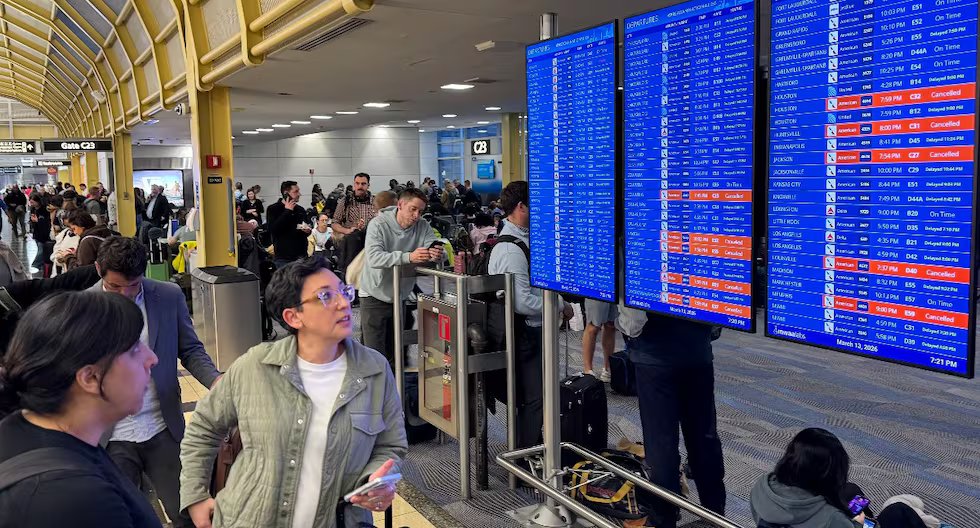
With a fifth of the world’s oil trade strangled by the closure of the Strait of Hormuz – after almost two months of intermittent closure and with uncertain reopening announcements that do not materialize -, the International Air Transport Association (Iata) and the International Energy Association (IEA) have raised their voices and They warned of the imminent risk in the supply of jet fuel for airlines. “Europe has about six weeks of jet fuel,” warned Fatih Birol, executive director of the IEA, last week. Thus, he warned that flight cancellations could soon occur if oil supplies remain blocked. for the war in the Middle East. Iata, meanwhile, said that the situation is worrying and that towards the end of May we could see more cancellations in Europe due to lack of fuel, something that is happening in some parts of Asia.

But the consequences are already being seen in Europe and the United States. The German airline Lufthansa announced just a few days ago that it will cancel 20,000 short-haul flights over the coming months, since with high fuel prices these routes are not profitable. Several airlines, including KLM-France, Delta and Air Canada, also temporarily canceled some flights, while others increased the price of tickets, passing the cost on to customers, which will become more pronounced if the conflict continues for longer. In the midst of this panorama, what is happening in Latin America and Peru?
Latin American airlines also feel the impact on their costs and this is already reflected in the price of tickets. Roberto Alvo, CEO of Latam, told El Comercio that they are paying double what they paid for jet fuel a little over a month ago. “What has never been seen before is such a rapid, violent price increase,” he said in the second week of April at Iata’s Wing of Changes Americas event. He was also clear about the effect on fares, confirming that ticket prices have indeed been raised.

Jet fuel requires different refining, which limits its availability.
“The increase in the cost of jet fuel has to be transferred to prices and, if the problem persists, we will also see impacts on supply in the coming months,” adds Alvo. In other words, the least profitable routes could be cut if the scenario persists, which is precisely what we are already seeing in other latitudes.
“Before the start of the conflict, crude oil was trading around US$70 per barrel. Today it exceeds US$110. In the case of aviation fuel, the jump was even greater: it went from US$90 to around US$220 per barrel,” said Peter Cerdá, vice president for the Americas of Iata, at the beginning of April.

An airline announced a reduction of up to 50% on long-haul flights amid global price increases. (Photo: GRANT BALDWIN / GETTY IMAGES NORTH AMERICA / GETTY IMAGES VIA AFP)
In fact, agree According to the Iata Jet Fuel Monitor, reviewed by Dia1, the world average price of this fuel was US$184.6 per barrel until the end of the week of April 17. In Latin America the weekly average price was US$179.6, an increase of 93.7% compared to last year. This, without a doubt, represents a critical challenge for the industry. “With net margins expected to be below 4% in 2025, airlines cannot absorb increases of this level,” Cerdá said.
The current fuel crisis is multifaceted and is affecting aviation globally, says Iata, explaining that in addition to oil shortages, there is a lack of refining capacity for jet fuel as refineries are prioritizing gasoline or diesel production, while some facilities have been damaged by the conflict.
This increase, he explained, It has inevitable consequences, since jet fuel represents on average 30% of airline costs. And it may even be higher for some companies. For JetSmart, for example, fuel ends up representing between 35% and 40% of the total operating cost of a flight.
Gabriel Oliva, CEO of Avianca, said during the Iata event this month, that before these tensions the ‘jet flue’ It represented around 30%, but today it is closer to 40% or even above that figure. As it is a very strong jump, he said that it is impossible not to transfer that impact to rates.
“In a ‘low cost’ the percentage is higher than in a ‘legacy’ (traditional),” adds Carlos Gutiérrez, general manager of the Association of International Air Transport Companies (Aetai).

Although the outlook for the airline industry in 2026 remains positive, IATA warns of problems due to a deficit in the delivery of aircraft and fuel. (Image: EFE)
In this scenario, Estuardo Ortiz, CEO of JetSmart explained to Dia1 that, the longer the flight duration, The impact of jet fuel on costs will be greater, especially on routes that exceed six hours compared to short journeys. This, he added, will lead airlines to review their prices and seat offerings based on the profitability of each operation.
According to the JetSmart executive – which has a 10% share of domestic flights in Peru – the industry is going through a first phase of adaptation, with moderate price increases and adjustments in supply while the real impact of the increase is evaluated. However, the full effect has not yet been transferred to the consumer. “The client has not yet felt 100% of the impact”he said, anticipating that in the coming months there will be a delayed effect on rates and demand.
Adrián Neuhauser, CEO of Abra Group – the holding company that controls Avianca and Gol – explained to El Comercio at the Iata event that before the conflict the average price of a ticket on his airlines cost around US$125. “Transferring 100% of the effect, until now, would mean raising the average ticket to more or less US$150,” he noted. An important percentage change but one that they classify as reasonable.
Although the company has hedges that allow it to partially cushion the impact in the short term, the rate adjustment will be progressive and in line with the rest of the industry.

In Argentina the impact is already being felt, with an average increase of 30% in rates, says Clarín. (Photo by LUIS ROBAYO / AFP).
/ LUIS ROBAYO
In ArgentinaAccording to a report by the consulting firm EcoSur, collected by Clarín, Flying from that country abroad today costs up to 30% more expensive than it did two months ago, since the war began. The average increase is 15.6%, going from an average price of international tickets of US$715 to US$824. But not all destinations felt the same impact. For example, the section from Buenos Aires to Los Angeles was among the most impacted with an increase of 29%, followed by the route to Los Angeles. Below is the route to Miami with an increase of 17%, and routes to high-demand destinations such as Madrid, Cancún and Punta Cana, with an increase of more than 16%.
In the case of Peru, currently, on several international routes leaving Peru You can see the marker confirming that prices are “higher than usual,” Google Flights tells us.when consulted by Dia1 about price fluctuations. In turn, searches for “cheap flights” in Peru have had atypical peaks in the last 60 days, validating that the user is actively looking for more competitive options.
To mitigate this turbulence, airlines – around the world – have implemented various measures, points out Iata. Some airlines have increased fares, added fuel surcharges or increased the cost of ancillary services such as suitcases, among others. In some cases, adds Iata, There has been the suspension of routes that are no longer economically viable, the temporary reduction of flights, the early retirement of old aircraft or the immobilization of aircraft on the ground.

Although Iata prefers not to issue a specific comment or projection for Peru, in this context urges the government of our country to do everything possible to ensure fuel supply and consider alternative supply options.
The entire game, Ortiz assures, will be played in the second quarter and the beginning of the third quarter, in reference to the evolution of oil, inflation and consumption.
According to Alvo, even if the conflict in the Middle East is resolved soon, effects will persist for months due to supply chain adjustments. “If you look at the entire chain—from production to distribution and inventories—the impact will be felt for several months.”
Cerdá adds that recovery will not occur in days, but rather over several months to return to previous conditions.
In this context, the CEO of Latam Airlines – which in Peru has a 64% share on internal flights and 40% on international flights – projects a base scenario in which jet fuel prices would remain high, with ranges between US$100 and US$120, and even highers. “Seeing prices (of ‘jet fuel’) at US$140 or US$150 is a possibility that is not ruled out,” he said.
For his part, Ortiz considered a return to the prices seen before the war (US$60 per barrel of oil) unlikely and indicated that a scenario between US$70 and US$80 is manageable. But, if prices remain high, the adjustment will be inevitable, with less supply on certain routes, especially those of longer duration, and higher fares.

Passengers pay more to fly due to fuel crisis due to war. (Image: Andina)
The Gulf is a major source of aviation fuel, accounting for about 50% of Europe’s imports. In the case of Latin America, Gutiérrez explains, it is supplied mainly with imports of jet fuel from the United States. But, in the region there are producers such as Ecuador and Colombia.
“Latin America increasingly depends on imports, and in that context the United States—especially the Gulf Coast—is a key supplier,” S&P specified. Latin America and Europe depend more on imports, while Asia and the Middle East concentrate production for their own consumption.