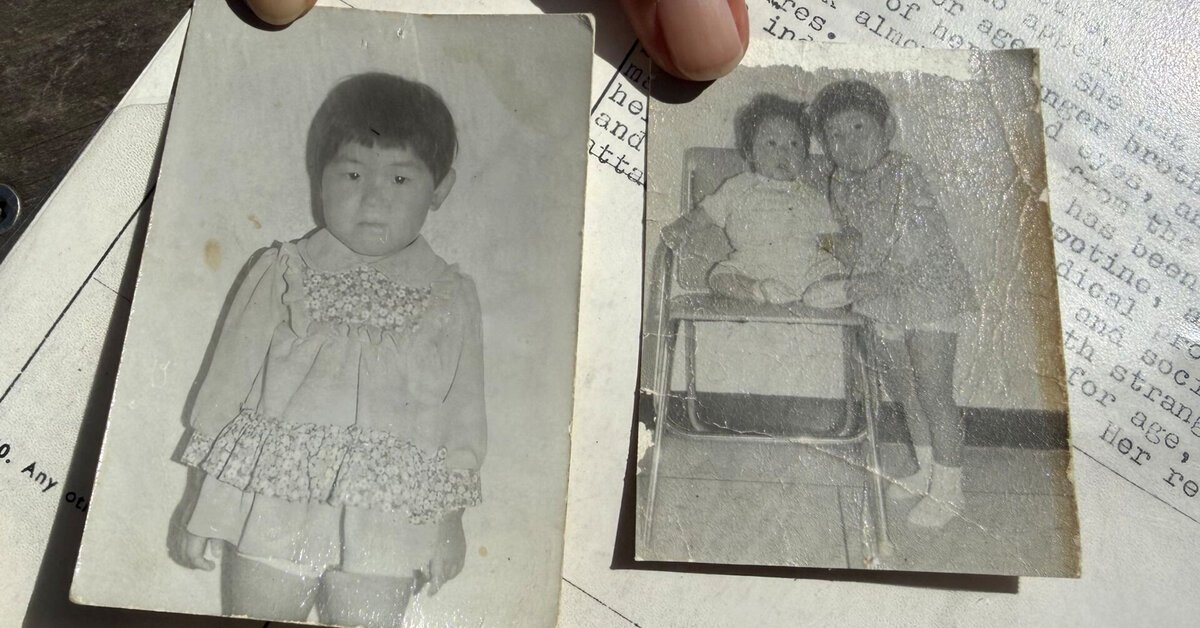
Sofie Randel was three years old when she and her younger brother came to Denmark in 1977, during the period of authoritarian rule in South Korea.
The vivacious, talkative little girl spoke fluent Korean at the time, and her adoptive father recorded it on a tape that then gathered dust for years.
In 2023, S. Randel gave the recording to a journalist who accompanied her in search of her origins.
Little by little, through her childish ramblings about coming to Denmark and some research done in South Korea, Ms. Randel uncovered a different story than the one on her Danish adoption papers.
Based on them, she believed that she and her brother had been left on the street with notes attached to their clothes, stating their names and ages.
But then she learned that their mother had placed them in an orphanage while the family dealt with financial difficulties.
Rather than being cared for in an orphanage, the two children were adopted together in Denmark, like tens of thousands of other children sent abroad in a decades-old state-sanctioned practice.
In South Korea, Randel’s three older siblings always hoped to see them again. All six finally met in South Korea in 2023.
“They’ve been looking for us for 45 years,” Randel, now 52, told AFP, wiping away tears.
She and her brother didn’t know anyone was looking for them.
She believes that the Danish authorities, in turn, tried to “cover up the story” by telling them that they had been left behind.
Adoption Research
According to an official study, South Korea sent more than 140,000 children abroad for adoption between 1955 and 1999. of children.
In October 2025, Seoul apologized for the first time for such state-sanctioned practices, claiming that “illegal human rights violations” had been committed.
Between 1970 and 1989, 7,220 South Korean children were adopted in Denmark, almost all of whom were told they were street orphans.
Research has proven otherwise, revealing that South Korean children from orphanages were given up for adoption without the consent of their families.
A 2024 report by the National Board of Social Appeals found that Danish state adoption agencies were aware that their partners in South Korea sometimes changed the children’s identities.
According to Danish media reports, the Danish agencies paid around DKK 54 million. crores (€7.15 million) to facilitate adoption.
“As a Dane, I believed that Denmark was on the side of good, and Korea, as a former dictatorship, was on the side of the bad guys,” said Peter Moller, who heads a South Korean adoption rights association that is not involved in the lawsuit against the Danish state.
“But Korea had the courage to face what they did,” while “Denmark prefers to sweep everything under the carpet,” he said.
An adopted child finds a father
Sidse Koch Jorgensen, a 53-year-old physiotherapist and adoptee, feels angry.
“It is a human right to know one’s identity and also to be able to maintain contact with one’s biological family,” she fumed.
Inaccuracies in her adoption documents have hindered her for years, but she is now nearing the end of her search, which began on her first trip to South Korea in 2013.
“A month before I left, I got an email saying they had found my dad,” she said.
She met him during her visit and learned that the actual circumstances of her separation from her biological family were very different from what was written on her adoption papers.
While her father was out of the country, SK Jorgensen’s grandmother sent her to a “camp” to be cared for without his consent. However, from there the child was sent to Denmark for adoption.
“I want the Danish government to take responsibility for such gross negligence,” added SK Jorgensen.
“They were the institutions that had to check everything, dig a little deeper if there were any doubts,” she testified.
The Danish Ministry of Social Affairs declined to comment when contacted by AFP.
Denmark froze international adoptions in 2024 after a number of serious problems with the practice of international adoption came to light.