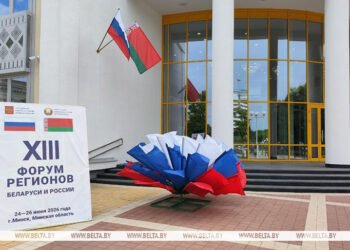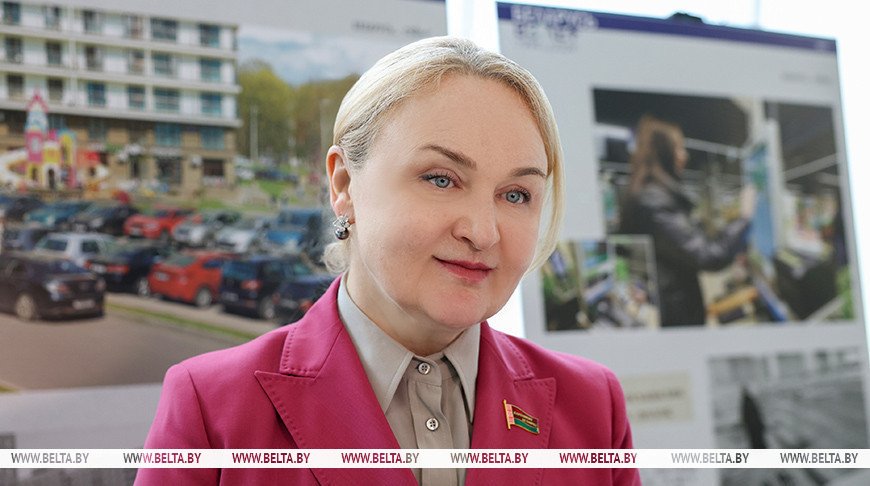
MINSK, 25 June (BelTA) – The shift to personalized medicine in Russia and Belarus opens up enormous scientific opportunities, Deputy Chairperson of the Council of the Republic’s Standing Commission on Education, Science, Culture and Social Development, Chief Physician of the National Clinical Medical Center under the Belarus President Administration, Doctor of Medical Sciences Irina Abelskaya said ahead of breakout session No. 6 Strategic Areas for Cooperation in Healthcare of the Union State at the 13th Forum of Regions of Belarus and Russia on 25 June, BelTA has learned.
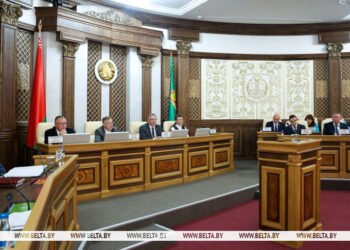
The event took place at the National Clinical Medical Center under the Belarus President Administration.
“Today, we will examine and analyze what has already been accomplished, including joint projects in education, the harmonization of our legislation, and the development of common approaches to organizing the diagnostic and treatment process. Of course, joint projects and programs in innovative medicine are also highly relevant. This includes the development of new pharmaceuticals, biopharmaceuticals, and research into the treatment of non-communicable diseases, oncology, and cardiovascular diseases,” Irina Abelskaya said.
The discussion will also cover joint progress in digital transformation. “I am confident that the outcomes of the meeting will be interesting. And most importantly, these results must be implemented in practice,” she emphasized.
Regarding the areas where joint innovations could be applied, Irina Abelskaya noted that the priority is the search for new methods of treating and diagnosing oncological diseases. “Today, both Russia and Belarus are moving toward personalized medicine. The shift toward individualized diagnostic and treatment methods naturally opens up enormous scientific opportunities. This is one of the key areas where the combined efforts of our two states and healthcare systems can yield very significant results,” Irina Abelskaya said.
Around 80 people took part in the breakout session Strategic Areas for Cooperation in Healthcare of the Union State. Among them were members of the Council of the Republic and the Federation Council, MPs of the House of Representatives, heads of executive authorities in Russia, leadership of the healthcare ministries of Belarus and Russia, heads of leading republican scientific and practical centers, national Russian research centers, medical higher education institutions, research institutions, and other organizations.
Participants discussed prospects for cooperation in healthcare within the Union State for the 2027-2029 period, innovative technologies in the treatment of oncological diseases, traumatology and orthopedics, the application of cellular and genetic engineering technologies, licensing of medical activities and certification of medical devices, the use of digital solutions in healthcare, and interregional cooperation in medical science and education.