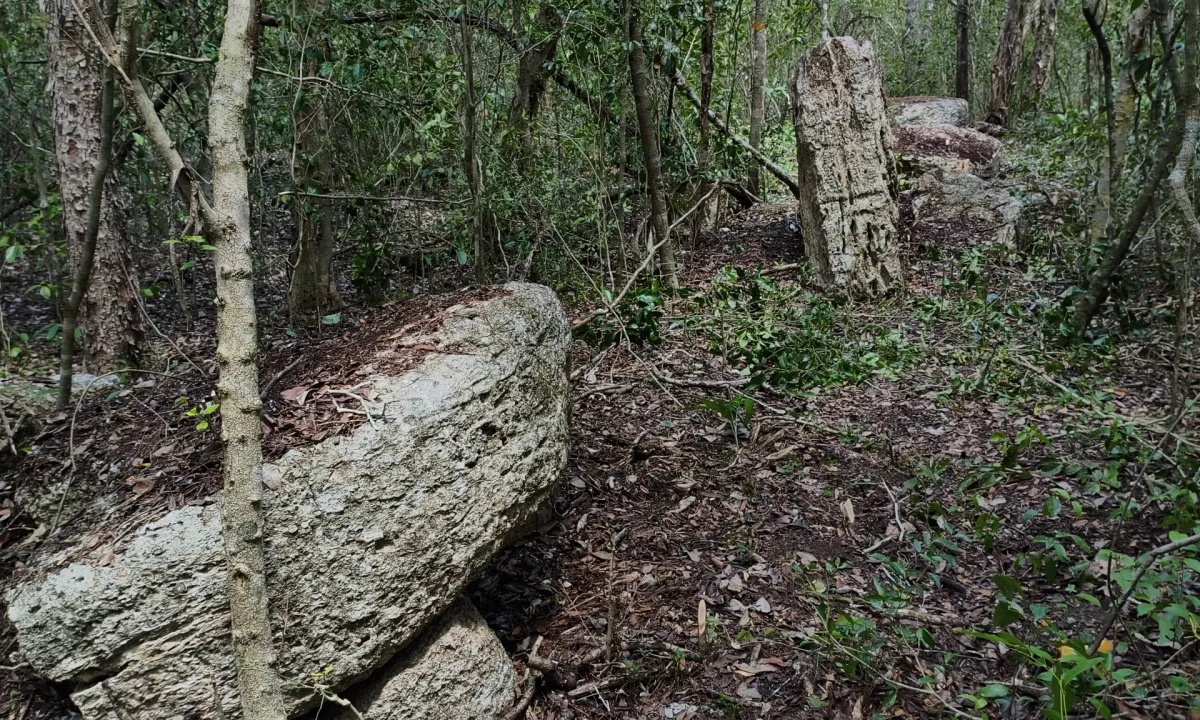
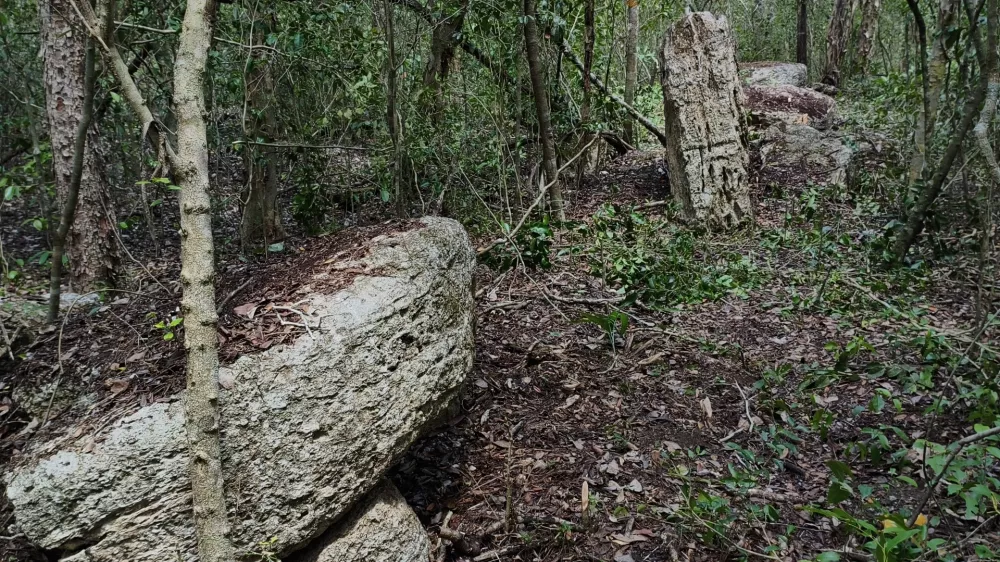
Lidar technology led them to the trail of the old Mayan city. Photo: INAH
A team of Slovenian archaeoastronomers discovered a hitherto unknown Mayan city
The team of archaeoastronomer Ivan Šprajec discovered the hitherto unknown Mayan city of Minanbe on the Mexican Yucatan Peninsula. The urban center with palaces, shrines, a pyramid and many stone monuments was hidden under dense jungle for more than a millennium. The discovery is particularly important because it is the first known Mayan site in this part of the Yucatan.
June 24, 2026, 6 p.m
they are

Minanbe is a previously unknown Mayan city to archaeologists, which was discovered in the Calakmul biosphere in the Mexican state of Campeche, announced the Scientific Research Center of the Slovenian Academy of Sciences and Arts (ZRC SAZU). For more than 1000 years, it was completely covered by dense jungle, as a result of which it remained hidden from predators and looters of archaeological sites.
The name the researchers gave it means “pathless” or “no way”. According to archaeoastronomer and head of the Institute for Anthropological and Spatial Studies Ivan Šprajec, the name well illustrates the difficulty of accessing the area. “Minanbe really lies in the middle of an extremely dense jungle. It is a protected biosphere and a national park, where we often come across old forest paths or carts, but this time there were none. That’s why we had to open the path ourselves. We cut about five kilometers of path, and then made our way to the site with four-wheelers and on foot,” he told STA.
Lidar technology led them to the trail of the old Mayan city, with the help of which they found that the remains of buildings are hidden under the lush growth on an area of approximately 15 hectares. A closer inspection on the ground showed that there was indeed an urban center with squares where palaces and sanctuaries stood, and the city was surrounded by agricultural terraces and canals for water management.
The pyramid, which rises to a height of 13 meters, attracted the special attention of researchers. According to the finders, the building shows all the elements of the Mayan architectural style called Rio Bec, which is characterized by the use of finely worked stone, the construction of staircases and decorative elements on the facades.

They also found 14 stone stelae and altars, which were arranged along the road that connects the central part of the city with the northeastern part. Some of the monuments have hieroglyphic inscriptions and iconographic representations, which suggests that the city of Minanbe played an important role as a religious and political center, the Mexican Institute of Anthropology and History (INAH) said.
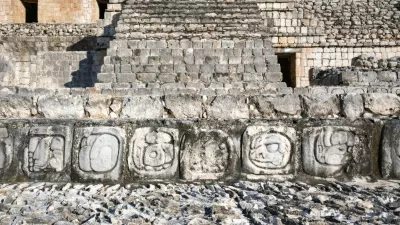
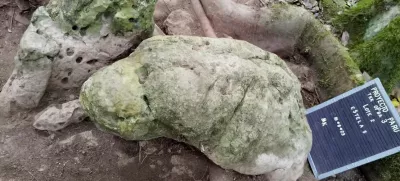
Among the stelae, the most interesting is the one named number 1, as it depicts the scene of beheading. At the top of the monument is a calendar entry with the year 849, which gave archaeologists an important clue when dating the recently discovered Mayan settlement. The researchers also came across many other monuments, some of which depict Mayan rulers wearing luxurious feathered headdresses and rich jewelry. According to the researchers, one of the hieroglyphic inscriptions probably dates from the end of the seventh century AD – it is very likely that it is the oldest inscription in the area. As they added, it is also interesting that some of the altars and stelae are intentionally damaged or moved, which hints at possible ideological or political changes that occurred after the decline and collapse of the city.