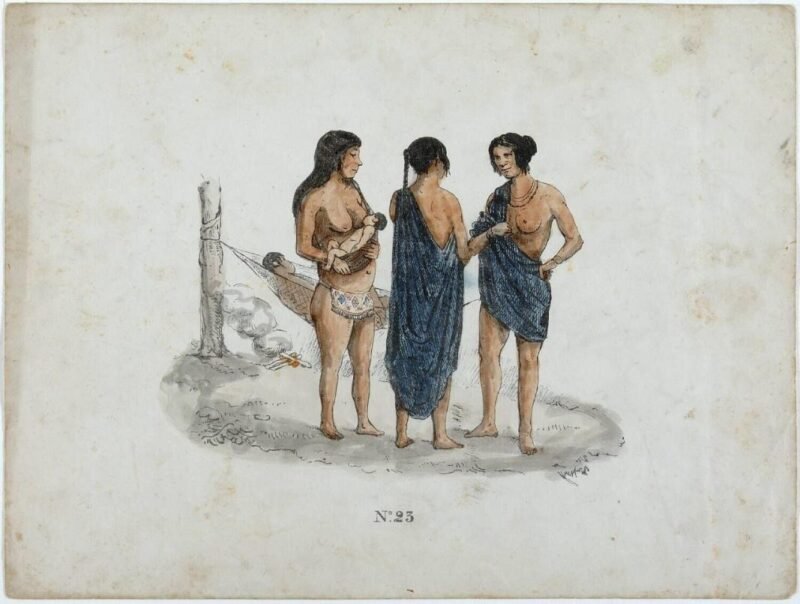
The battle between Israel and the Palestinians also involves the battle over one word: genocide. Israel denies that the same thing is now happening in Gaza as during the Holocaust in WWII. Then 6 million Jews were murdered with the aim of exterminating the entire nation. The parallels seem inescapable: a confined, fenced-off location where people cannot leave, where transport is very limited, and where bombs are thrown and land charges are carried out by the Israeli army. The result has been more than 25,000 deaths, 70% women and children. What is genocide? Acts intended to destroy, in whole or in part, a national, ethnic or religious group. With this definition we can ask ourselves whether there was genocide of the Indigenous people in Suriname.
Death to the Indians
There are stories from the Caribbean islands where the indigenous population has been completely wiped out. In Haiti (Hispanioala) the Taino were decimated because the Spaniards under Columbus exploited them in the mines where they were employed as slaves. In 1514 there were 32,000 left. The account: ‘A Short Account of the Destuction of the Indies’ (1592), which the priest Bartholomé de las Casas presented to the Spanish king in 1512, heralded the beginning of Trans-Atlantic slavery. On St. Kitts, approximately 2,000 Kalinago were murdered by English and French settlers in 1626.
There are also stories of Indigenous people being driven into the sea and drowned. Many of the different groups have died from wars, but especially from diseases such as measles, smallpox and influenza. The Indians had no resistance to contamination passed on by settlers. Childhood diseases had a fatal outcome. A chickenpox epidemic in French Guiana in 1704 claimed 1,200 Indian lives!
Indians in Suriname
Before European settlers set foot, the number of natives was significant. Major Scott mentions in 1665 figures of 17,800 Caribbean families, 8000 Arawaks and 1400 of the ‘Patricoates’. Martin says in his ‘Westindische Skizzen’ that there were 8,000 Indians living on the Corantijn, which had decreased to 1/10: 800 in 1792, namely 300 Warau, 350 Arawaks and 150 Caribs. It was not easy to estimate the correct number, due to the large distribution in the primeval forest and the nomadic way of life. Any further official figure is missing until 1921, when a census took place and the numbers were henceforth indicated in the census.
Assuming it happened in a proportionate manner, we assume that if there were 7,000 in 1959, that would be about 70,000 for 1,600 counting back. The cause of the decline was the isolation in which the peoples had lived for thousands of years. Short visits to the Trio often resulted in pneumonia, and death from respiratory infections. Until the arrival of missionaries – and improvements in medical care – they were slowly dying out. Then population growth started. Just Wekker, who has done a lot of research into Indigenous people, stated that authorities did not consider them among the actual inhabitants of Suriname and therefore saw them as a ‘quantité negligeable’. So negligible.
Fight among yourselves
In Suriname the Indigenous people were not exterminated en masse through battle. The English traded with them in a friendly manner. The Dutch did wage war and forced them into slave labor. Van Sommelsdijck concluded a treaty with them. Governor Crommelin’s journal states on November 28, 1757 that to keep them in ‘a good mood’ they were entertained in the garden of the Government during their stay in the city and were allowed to play ball. One of the chiefs had traveled to Holland and after returning stayed in Paramaribo for a whole month. He was ‘invited to dinner’ by Crommelin almost every day and not only behaved ‘orderly’ at the table, but entertained the governor and councilors with a story about what he had seen in Europe, ‘and showed himself extremely geloueert (lauded).’ The Court could ‘surprise that so much civilization has become possible in such a short time, from which much good can be hoped’.
But there was also infighting. In December 1758 some Indians came to Crommelin and asked him for guns, spices and lead in order to raid Akouris. Crommelin tried to bring them to more peaceful thoughts. But after a few days they returned ‘with a burning desire for revenge’. The Akouris had killed 48 people, including 6 chiefs. This act could not remain unavenged and was brought before the Court. They were allowed to take guns and ‘they killed and destroyed each other and then honestly returned the borrowed guns’. The archive shows the divide and rule policy.
Recent DNA research (National Geographic) has shown that high numbers need to be adjusted, and there was infighting. In addition to figures, this provides special information about group behavior and cultural changes, also for Suriname.
Hilde Neus