Since this government took office, Suriname has gained a new ministry, that of Oil, Gas and Environment (OGM). The establishment was already a wish of the National Party of Suriname (NPS) in 2020, but then-president Chandrikapersad Santokhi strangely saw no point in this at the time, while oil and gas will play a very important role in the Surinamese economy. But the new ministry, led by Patrick Brunings of the NPS, has not yet been able to make any progress and seems to be an empty shell.
Text Armand Snijders
Image OGM
It must be stated that friend and foe agreed that Brunings, who has gained a wealth of experience at Staatsolie, is on paper extremely suitable to lead the ministry. It was also beyond doubt that a ministry would be established to deal with future oil and gas extraction. But now that it has arrived, almost everyone is wondering what the department should actually do, including Brunings, it seems.
“A significant amount of catching up will have to be done to prevent this from yielding less money to the country than what politicians, in particular, have been dreaming of for years.”
Apparently no one within the government had really thought about the policy of the three parts that the ministry would have to manage. Coalition partner NPS also did not have a suitable plan in place. That is strange from a party that has been calling for a ministry for five years that would deal with energy matters.
Conversation with President Irfaan Ali
The fact that Brunings recently made headlines in the media after his meeting in Georgetown with Guyanese President Irfaan Ali about possible cooperation in the field of gas-to-energy development was not the merit of the communication channels on the Surinamese side. Judging from the photos that his ministry had distributed, they were there, but had not bothered to report the conversation in advance. Nor that he had visited the Guyana Energy Conference & Supply Chain Expo 2026, which was of great importance for Surinamese companies with a view to future oil extraction.
It would be expected that a minister of a new ministry that can and must play a very important role in the oil and gas sector will take every opportunity to put himself and his department in the spotlight and build trust among the public. Even during an extensive interview on television with the Communications Service Suriname (CDS), Brunings did not reveal anything and mainly stuck to the generalities about oil and gas that everyone has heard many times before; that Suriname will get a lot of benefits from this, and that above all local content must be deployed. But how this will be achieved and what policy will be pursued to achieve this was not explained.
The odd one out
In addition to oil and gas, the ministry also covers the environment. The latter in particular is surprising, because the environment is in stark contrast to polluting fossil fuels. It is in fact the odd one out; Brunings also apparently feels uncomfortable about this, as evidenced by the fact that he rarely talks about environmental matters when he talks about his ministry.
Reportedly, almost all parties in the coalition formation preferred a Ministry of Energy, but then parts of the Ministry of Natural Resources would have to be transferred. And that lucrative department was claimed by Ronnie Brunswijk’s Abop and he kept his leg tight, especially after President Jennifer Geerlings-Simons denied him a second term as vice president and was given to the NPS.
So eventually it became a Ministry of Oil and Gas, which was forced to include Environment under the umbrella. The new government did not know what to do with that. It used to be an excellent fit for Spatial Planning, with VHP Minister Marciano Dasai, but in all the reshuffling during the coalition formation it was closed down and added to Public Works. The environment then had to go to the new NPS ministry, which had to be set up from the ground up.
After eight months, the first outlines of what the department stands for should now be visible. In reality, very little seems to have happened, which is why many Surinamese do not even know that there is a Ministry of Oil, Gas and Environment and where it is located. And above all what it does.
Missed opportunity
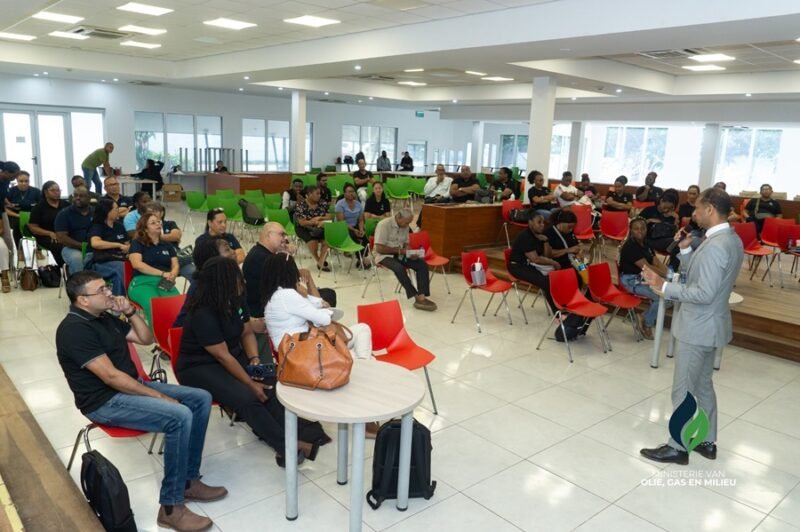
Not that nothing happens there at all, but it mainly takes place in the shelter. The two-day training workshop on hazardous waste management, held in late February, was a rare exception. The international agreements from the Basel Convention were central.
However, this meeting was only reported by OGM after almost three weeks, strangely failing to provide an explanation of what this Basel Convention entails. That is a missed opportunity to try to involve the people in the activities.
The fact that little seems to be happening and that the information officers are also failing is something for which Brunings is responsible and which he must quickly improve. The focus within the government should be mainly on his ministry now that Suriname is on the threshold of a potentially bright oil future. After all, the leaders have done virtually nothing for six years to prepare the country for this. Considerable catching up will have to be done to prevent this from yielding less money to the country than what politicians, in particular, have been dreaming of for years.