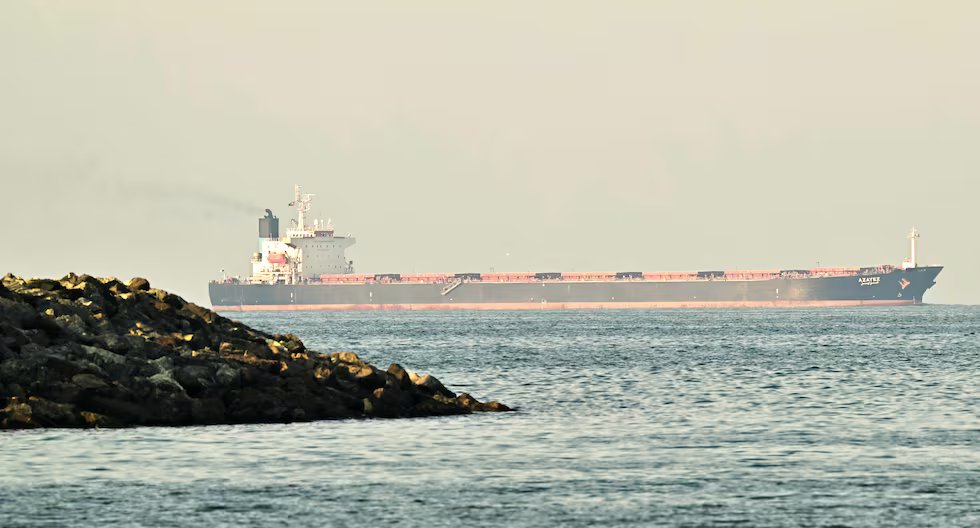
The announcement by the president of the United States, donald trumpto impose a naval blockade in the Strait of Hormuz marks a new point of tension with Iran. The measure, aimed at suffocate oil revenuesyes from Tehranopens a key question on the international stage: if it is a pressure play aimed at forcing a negotiation or the beginning of an escalation that could further harden the Iranian position and destabilize one of the most sensitive energy routes, through which 20% of the world’s oil passes.
The naval blockade on the Strait of Hormuz came into effect on Monday. The measure comes after the failure of the weekend negotiations in Pakistanwhere an agreement was not reached to end the war that began on February 28. At this point, it should be noted that this is a blockage of the control already exercised Iran.
The order of trump points directly to commercially isolate Tehranby preventing the transit of all ships entering or leaving its ports.

United States President Donald Trump raises his fist upon arrival at Miami International Airport, April 11, 2026. (Photo by Jim Watson / AFP).
/ JIM WATSON
trump threatened on Monday to “immediately eliminate” any Iranian ship that bypasses the blockade of the Strait of Hormuz.
For its part, Iran warned that military ships approaching the Strait of Hormuz will violate the ceasefire.
According to the United States Central Commandthe operation will be applied in an “impartial” manner to vessels from any country linked to Iranian ports, in practice establishing a naval cordon which will allow intercepting, inspecting and even capturing ships that violate the blockade. However, Washington assured that The Strait of Hormuz will not be completely closedsince ships that have no relationship with Iran They will be able to continue their transit normally.
Trump has also instructed the Navy to to search for and intercept all ships in international waters that have paid a toll to Iran.
The main objective of the measure is cut off Iranian oil revenuesthe country’s main source of financing, and force Tehran to negotiate under conditions more unfavorable to Washington’s interests. trump has defended the blockade as a necessary action to avoid what it describes as a “extortion” by Iran in the region.
From a legal point of view, the blockade is protected by norms of international law that consider it a tool of war, as long as it is formally declared, applied without discrimination and does not affect the access of neutral countries or the supply of humanitarian aid. However, its implementation significantly increases tension in one of the most strategic shipping routes in the world.

The Strait of Hormuz was mined by Iran. (EFE).
Iran formalized the closure of the Strait of Hormuz on March 2although it later maintained a partial opening scheme under military control: it allowed transit only to vessels that coordinate in advance with your authorities and, at times, directly excluded ships linked to the US and Israel.
In parallel, Tehran promoted a system of mandatory toll —even raised in cryptocurrencies or million-dollar fees— as a condition for crossing the pass, a measure widely questioned for contradicting international law.
Meanwhile, the Government of Pakistan said Monday that it is seeking to hold a second round of negotiations between the United States and Iran and Secure an extension of the ceasefire beyond April 22.
The background of the blockade of the Strait of Hormuz

A stack of copies of the Iranian newspaper Jame Jam with the headline “Maritime Cliff” is displayed in front of a kiosk in Tehran, Iran, on April 13, 2026. (EFE/EPA/ABEDIN TAHERKENAREH).
/ ABEDIN TAHERKENAREH
The international analyst Francisco Belaunde Matossian considers that the naval blockade responds to a multiple logic that combines pressure and political calculation. “It is a little of everything: deterrence, escalation and also an attempt to force negotiations on better conditions for Washington”he states to The Commercewhile warning that The move reflects the Trump administration’s difficulties in finding a way out of the conflict.
Along these lines, he explains that the central objective of the blockade is economically suffocate Irandepriving him of his oil income, with the bet that this pressure will end up forcing him to give in. However, he emphasizes that Tehran has built its strategy precisely around its ability to generate a global impact. “Iran knows that it can resist in the short term and cause energy and economic chaos that affects not only the region, but also the United States and the world,” holds.
Belaunde warns that the Persian country plays with the times and its geographical position, aware that Any alteration in transit through the strait has immediate consequences, such as an increase in the price of oil. In this context, he does not rule out that Iran chooses indirect or limited actionssuch as attacks on infrastructure or third parties, avoiding a direct confrontation that would provoke a massive military response from Washington.
From the political angle, he points out that Tehran perceives itself in a position of strength, which reduces its incentives to give in on key negotiating issues.such as its nuclear program or its regional influence. However, he considers it likely that, given the increase in pressure, both parties will end up returning to the dialogue table, although without guarantees of rapid progress.
For the specialist in defense and intelligence issues Andrés Gómez de la Torrethe United States’ decision must be understood as a direct consequence of the failure of negotiations between Washington and Tehran. “The differences between both parties, reflected in their respective proposals, have ended up pushing this measure as a pressure mechanism,” explains to The Commerce.
From the military point of view, he warns that A blockade is a belligerent operationtypical of armed conflict scenarios, which seeks to prevent the transit of ships and aircraft in areas controlled by the adversary. However, in this case, he emphasizes that the Trump administration’s intention would be apply the restriction to vessels of all nationalitieswhich increases its complexity due to the geostrategic importance of the maritime passage.
“The strait not only connects the Persian Gulf with the Gulf of Oman, but involves key regional players such as the United Arab Emirates and is an essential route for global energy trade”he points out.
For Gómez de la Torre, the background of the measure is clear: a strategy of economic coercion aimed at cutting Iranian oil revenues and forcing a change in its negotiating stance. However, he warns that Tehran has also historically used control of the strait as a negotiating card, which sets up a scenario in which both powers exploit this maritime route to obtain advantages.
China, the main victim

An oil tanker docks at the crude oil terminal at Qingdao port in east China’s Shandong province on March 19, 2026. (Photo by CN-STR/AFP)
/ –
A key element in this scenario is the role of Chinathe main buyer of Iranian oil. Approximately 80% of the crude oil exported by Tehran is destined for Beijing.
The oil Iranian represents between 8% and 15% of China’s crude oil importsdepending on the context of sanctions and availability on the market.
Its value to Beijing lies in factors such as lowest pricesince it buys it with discounts due to international sanctions against Iran; the commercial flexibility and the sstrategic securitybecause it reduces dependence on suppliers more aligned with the West, such as Saudi Arabia.
According to Belaunde, the United States is betting that China put pressure on Iran to renounce the closure of the strait.
“China is one of the actors most affected by the blockade, not only because of oil, but because of the impact on critical chains such as fertilizers or technological inputs”he explains.
In this context, he maintains that the development of the crisis will depend largely on the interaction between these powers and the extent to which the global economic impact accelerates a negotiated solution or, on the contrary, deepens the confrontation.
Gómez de la Torre agrees that “The problem of the Strait of Hormuz is not only a bilateral issue, but a node of global impact”. In this sense, the role of China as one of the main affected actors, due to its dependence on Iranian crude oil, which introduces an additional factor of tension in a context in which Washington and Beijing maintain a complex strategic relationship and a visit by Trump to the Asian giant is on the agenda.
In this scenario, he concludes, the blockade could lead to both a hardening of positions and a reconfiguration of negotiations, but with the latent risk of widening the crisis beyond the two actors directly involved.