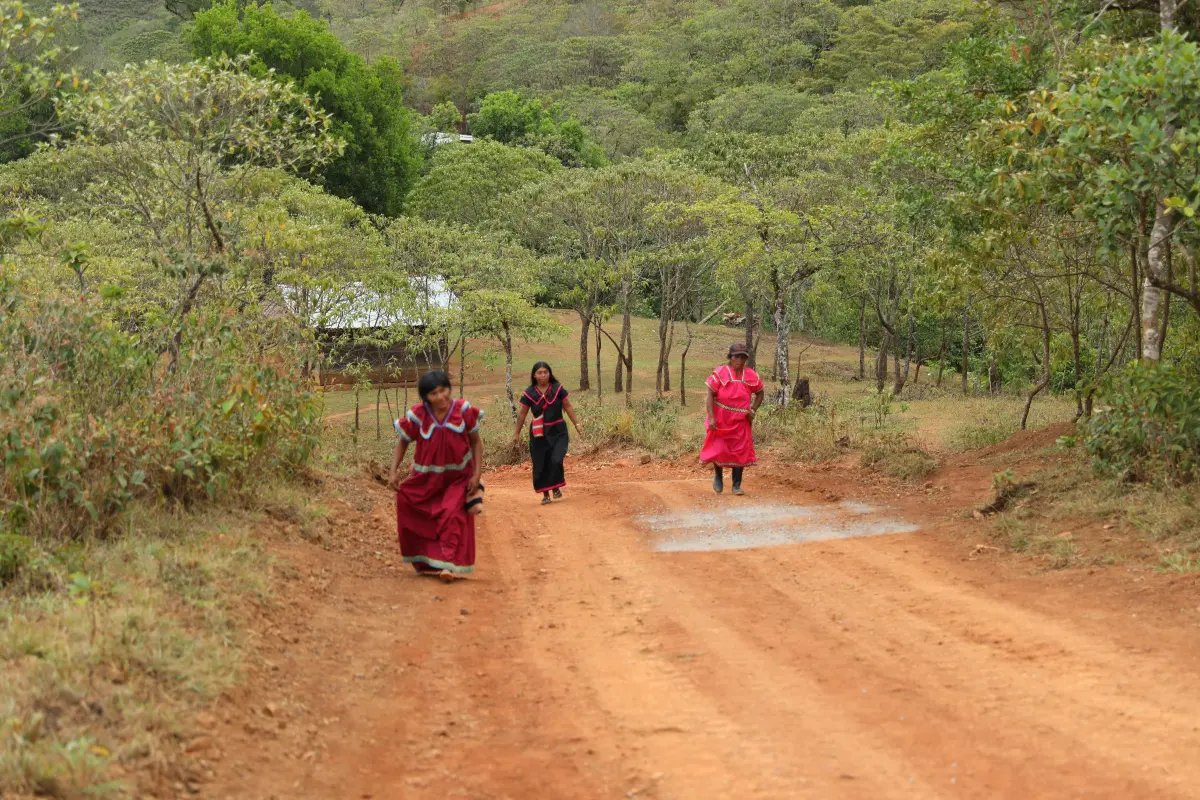
Despite the intermittent rain and steep roads, dozens of residents of Cascabel and Cerro Pita, in the Ngäbe Buglé region, began to gather early. The news that the Minister of Public Works, José Luis Andrade, and the Minister of Government, Dinoska Montalvo, would arrive in the indigenous region spread quickly, the reason being that it is not usual for authorities of that level to climb to the heights of the hills of the Mironó district.
While the ministers approached by helicopter, the families began their own journey. Parents advanced with babies on their shoulders, women ascended the mountain in groups, and others crossed the river after at least an hour of walking. The effort had a clear objective: to be heard after a long time of waiting.
The meeting point was zarzo three, in the La Pita ravine, a place marked by tragedy. There, in October 2025, Melanie and Kimberlin, two students swept away by the sudden rise of a head of water, died. The memory of that day was still present in each testimony.
“Here is a very difficult area and there are many points where bridges are needed. Children take risks every day to go to school,” explained Ovidio Araúz, representative of Cascabel, to the media.
The local leader described the October event as a “regrettable” event that still demands answers. According to their records, the community needs at least ten structures, in addition to roads in better condition.
“Many students cross one or two rivers to get to classes and about 5,000 people frequently pass through the stream,” he added.
The requests were not limited to bridges. Residents mentioned the dangers in Loma Chivo and Cerro Otoe, where the deterioration of the roads has already caused accidents.
Between complaints, frustration also surfaced. “You came by air, you didn’t want to come by land like us; you should do it to experience what we went through,” one of those present complained to Minister Andrade.
“I think your question is a little disrespectful. The projects are being studied. I invite you to Panama, to my office, so you can see what is being evaluated for the region,” the official responded.
During his speech before local media, Andrade detailed the scope of the government plan. He noted that 100 wattles have been promised for the region: between 15 and 16 have already been raised in emergency situations, the first 50 are in process and a call is being prepared to hire another 15 or 20 additional ones, he said.
He explained that the construction will involve opening between 20 and 30 kilometers of new roads, since some of these steps require enabling between six and seven kilometers of access.
The minister indicated that the first works should be completed between July and August, while the rest would begin next summer. He assured that the works will benefit communities in the northern and southern regions, mainly the district of Kankintú would benefit from the second group of wattles. The investment, he specified, amounts to $18 million in this first stage and about $20 million in the second.
The head of the MOP insisted that his visit sought to review the wattles and learn first-hand about the situation in the area. He assured that the Government “is solving the problems” and promised to take note of the pending requests. Surrounded by the crowd, he concluded: “Whatever is not being done we will gladly write it down and put it into practice.”
His statements were given in a tour organized by the MOP after the publication of La Estrella de Panamá titled ‘Zarzos en Ngäbe Buglé: direct contracts and at triple the price’, on March 16. The report revealed that, although teachers and parents requested these structures since September 2024, at the beginning of the government, it was not until last February when direct hiring was made public through “exceptional” purchases, on the Panama Compra portal.
The investigation showed that the first 50 wattles were awarded by invitation for $18.1 million, which is equivalent to an average of $358 thousand per structure and some even cost up to half a million.
These amounts exceed more than triple the prices recorded in similar projects tendered in recent years by municipalities in the region and nearby areas, as well as another zarzo built in Pacora by the MOP in this administration; and the estimates of the Foundation for the Sustainable Development of Panama (Fudespa) that estimates costs for the need for these bridges between $100 thousand to $150 thousand each.
Faced with questions about these journalistic revelations, the MOP defended that the characteristics of the land directly affect the cost and maintained that they are different projects.
The ministry argued that the exceptional mechanism – direct and by invitation – avoided a public tender under the argument of urgency, since an ordinary process could last up to six months. However, the institution had visited the indigenous region in 2024 without planning the hiring at that time.
Public procurement specialists pointed out that this type of procedure requires market studies and the presentation of several proposals, requirements that would not have been fully met. Among the invited companies are construction companies investigated and that have reached agreements with the Public Ministry for cases of corruption, such as Meco, and others with open processes for crimes against public faith, such as Desarrollos, Inversiones y Equipos Patria, SA (Diepsa).
Companies without recent awards or without a current technical board were also included – an essential requirement to operate in the field of engineering – despite the fact that the MOP claimed to have summoned firms with experience.
While the questions persist, the entity reiterates that the social urgency and the geographical conditions of the region justify both the contracting scheme and the costs of the works.
After the exchange between authorities and the residents of Cascabel, everyone present, led by the minister, descended a few meters down the slope to a ministry awning. While Montalvo continued to other points in Cascabel to inspect structures already built, Andrade met with his team while the snacks for the day were lined up on a table.
First, the personnel accompanying the authorities were attended to, under the silent gaze of the community’s inhabitants. Only later were the residents organized in a line to be given a canned soda and a bag of chips.