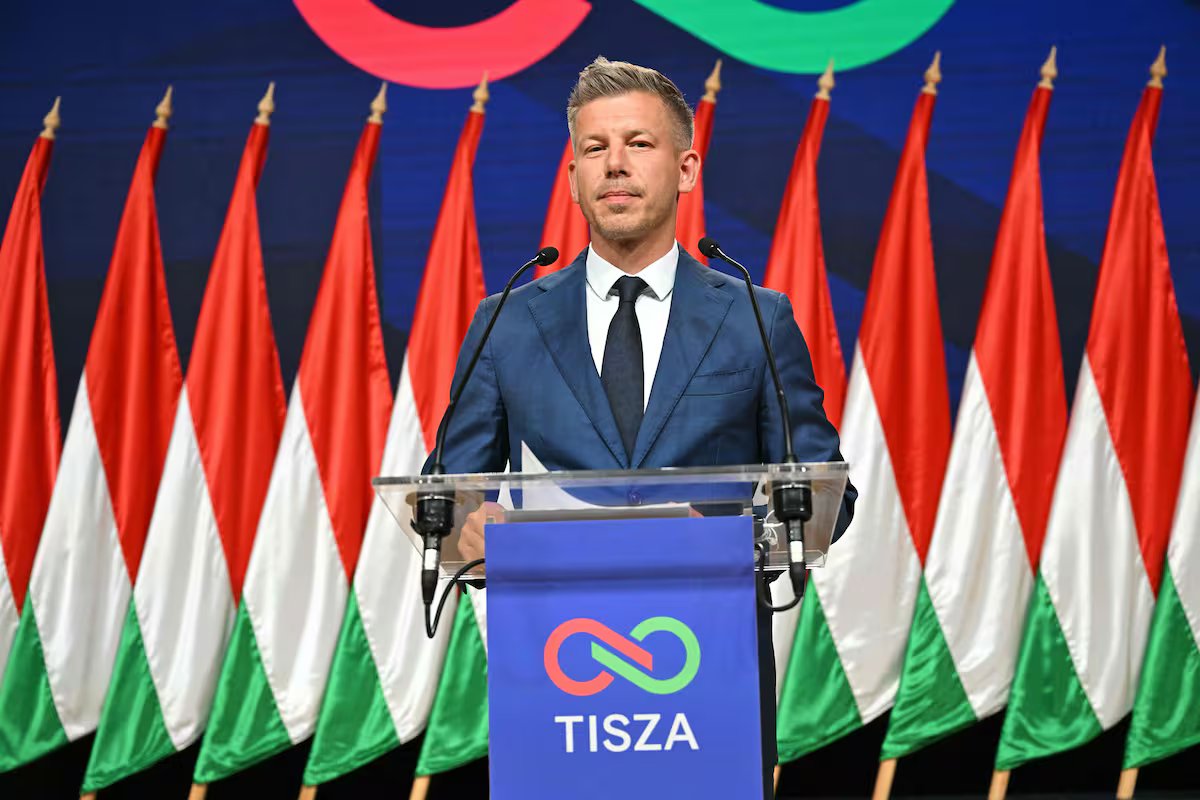
BUDAPEST.– The outgoing Hungarian Foreign Minister, Peter Szijjartobarricaded himself with a group of collaborators at the chancellery headquarters on Monday and began destroying confidential documents about the relations maintained by the Viktor Orban government with Russia, as denounced by future Prime Minister Peter Magyar.
In his first meeting with the international press, Magyar designed the broad lines of the foreign policy that he will develop during his mandate and, in that sense, he anticipated that will not take the initiative in calling Donald Trump or Vladimir Putin.
“If they call me, I will pick up the phone,” he simply stated. When referring to the attitude that his government will adopt with Ukraine, He recognized that a peace cannot be imposed on the kyiv government or ask it to give up part of its territory.
The future prime minister was interrupted in the middle of a dialogue with the press by a collaborator who handed him a piece of paper. After quickly reading it, Magyar revealed the attitude adopted by the chancellor.
“I have just received the information, I am going to tell you. Many people thought that the Foreign Minister had disappeared, since he was not seen yesterday during Viktor Orban’s speech”recognizing his electoral defeat, Magyar said.
“Today at 10 in the morning he appeared at the Ministry and, since then, together with his closest main collaborators, they have been destroying documents related to the sanctions.”
Magyar explained that the information comes from internal sources in the ministry, where many officials are actively collaborating with his Tisza party, winner of Sunday’s elections.
“It’s the only thing I know and I share it with you,” he insisted. In a solemn tone he commented: “That is what is happening right now in Hungary. For days we have known that the destruction of documents had begun, not only in the ministries, but also in other institutions related to Orban’s elites,” said Magyar.
During the election campaign, Szijjarta had been accused of maintaining close ties with his Russian counterpart, Sergey Lavrovand to act as Moscow’s agent.
One of the charges stated that he had offered Hungary’s help to remove the names of Russian citizens from the sanctions list adopted by the European Union (EU).
In Brussels it is pointed out as “spy in the service of the Kremlin” and it is claimed that he telephoned Lavrov the content of the conversations held by the European foreign ministers in closed-door meetings. For this reason, European ministers had decided not to discuss sensitive issues in Szijjarto’s presence.
“What he (Szijjarto) is destroying is proof of his betrayal with the Russians, that is, the information he transmitted to Moscow,” surmised a high-level personality of the future government.
The ministry’s headquarters remained locked at the end of the afternoon and its phones were not answering.
In his first meeting with the foreign press, the day after the electoral victory that allowed him to obtain a two-thirds majority in Parliament, Magyar admitted that – until now – he did not have any precision about the transition calendar, although he asked the Hungarian president Tamás Sulyok, not only to speed up this management, but, due to his close ties with Viktor Orban, to present his resignation.
The outgoing government of Viktor Orban has 30 days to transfer power to the winners of Sunday’s election.
His denunciation of the attitude of Chancellor Szijjarto suggests that the new government’s relations with Moscow will not be as fluid as the first statements from both parties claim.
This desire for “continuity” was promoted by the Kremlin spokesman, Dmitri Peskov, who expressed his confidence in maintaining relations as cordial as those that existed during Orban’s 16 years.
“Russia will still be there and so will Hungary. We will have to find a way to coexist,” Magyar acknowledged.
During the campaign, some influential figures in his party insisted, however, on calling for a policy of rapid “derussification” of the country in case of victory.
But this will to change will not be easy because Magyar will have his hands tied for a long time, due to the close ties that Putin had forged with Orban since 2010.
Hungarian dependence was accentuated even after the war in Ukraine began, in 2022.
Despite international sanctions, Hungary continued to purchase Russian oil and gas, and allowed the Kremlin to begin construction of a new Paks (II) nuclear power plant south of Budapest.
Furthermore, he always vetoed kyiv’s requests to join the EU. Recently, it even blocked a loan to Ukraine from the European Union (EU) of 90,000 million eurosintended to sustain the Ukrainian military effort.
The new government will have to wear velvet gloves because Orban placed the country’s economy in a situation of extreme dependence on Russian energy (oil, gas and nuclear).
To break this suffocating relationship, which Hungarians call the “bear hug” Peter Magyar will have to renegotiate these complex ties without provoking an energy crisis.
The Kremlin views it with extreme distrust and considers the new Hungarian leader to be an unknown quantity. He was a member of Orban’s team until a couple of years ago. He then went into open opposition and, although he is in favor of improving relations with the EU and NATO – two of Putin’s great obsessions – he never broke with Russia.
In his first press conference, Magyar revealed that Hungary will lift the veto that prevented the EU from releasing those 90 billion for Ukraine, although he reaffirmed that he will not participate in the loan, in accordance with the position previously assumed by his country.
His first announcements mark a fundamental shift in the orientation of his country’s foreign policy, which will consist of abandoning the strategy of hostility and boycott adopted years ago by Orban. “Hungary’s place is Europe,” he reaffirmed in a natural tone.
To clearly mark his desire to “change the regime and not just the government,” he indicated that at the beginning of May he will make his first trip to Poland in order to resume relations between the two countries, which have deteriorated since the pro-European Polish Prime Minister Donald Tuskcame to power.
He will then visit, in order, Austria and the European Union in Brussels. He also warned that Hungary will not be a land of asylum for internationally wanted criminals. Hungary, for the moment, cannot prevent its withdrawal from the International Criminal Court (ICC), decided by Orban, but “it will ask again for its reintegration,” he promised.