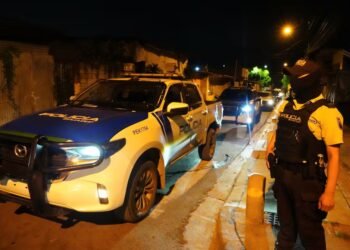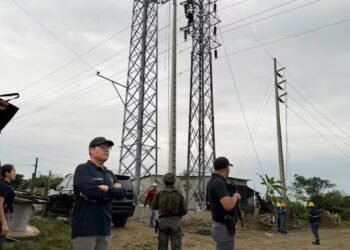
The Minister of Energy and Mines, Ines Manzanotook stock of the work being carried out in the country’s electrical system, including in the city of Guayaquil, while the suspension of scheduled work in substations was ordered.
The minister acknowledged that the system faces challenges due to the high demand especially for the heat wave that several cities are registering, especially on the Ecuadorian coast.
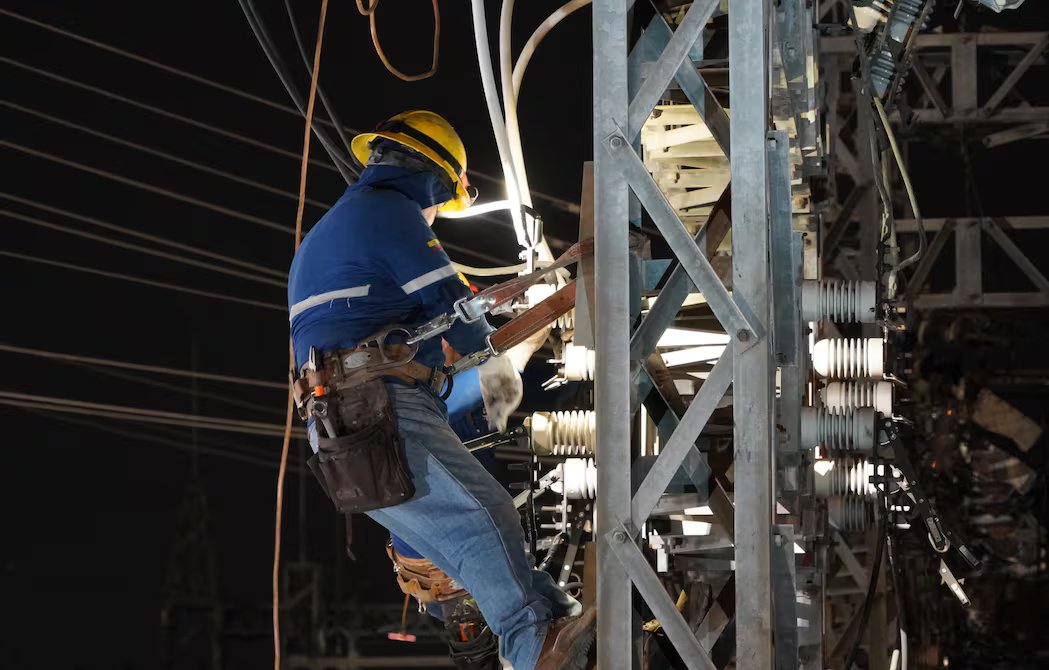
In this context, some scheduled outages have been recorded in recent days due to maintenance work and also inconveniences in distribution lines due to the heat wave.
“It was not smart of CNEL do maintenance in the heat of the heat wave, but if we don’t do it we have distribution problems,” said Manzano, during an interview in Center radio.
In addition, the official pointed out that in Quito there was a supply problem due to the collision of a car against a pole.
For now, the minister pointed out that the scheduled outages for substation maintenance are postponed until this period of high temperatures passes.
Over the weekend, Manzano explained that the heat raised consumption to unusual levels and demand reached peaks of up to 5,000 megawatts (MW)a figure that strains the electrical network.
Because of this, improvements are made to the substations to increase the loadability, power and voltage in the northern Guayaswhich includes Santa Lucía, Pedro Carbo, Isidro Ayora and Samborondón.
“For example, only what happened on Sunday, from 6 to 10 in the morning, was due to a maintenance issue at the Dos Cerritos substationwhich has a high load capacity. That means that its power reaches its maximum when there are high demands, which is good, because citizens can do what they want with their energy consumption,” he expressed.
However, that increase directly impacts substations and networks. The maintenance actions carried out on Sunday, he said, were necessary, since otherwise there would not be better service.
Manzano said that there is currently a capacity of 7,700 megawatts (MW) in equipment, but not all of it is available. For this reason, an estimated power of 5,800 MW is estimated, depending on the flows of the hydroelectric plants and the operation of the thermal plants.
The problem is in distribution, not in generation
The minister insisted that the country does not face power generation shortage.
“We have water, we have a reservoir that is at 2,138, because we have managed it very well these days, and we are 22 to 23 meters above what we were in 2024 with the Mazar reservoir, when we had that period of energy restriction. We are doing well in electricity generation, and what has happened is that the heat waves generate problems in the distribution lines,” he indicated.
He explained that the problem It is concentrated in networks, substations and power lines, where high demand causes surges and voltage drops.
The minister also clarified that some outages respond to emergencies, such as weather events, rain or falling trees that also affect the network and force unforeseen suspensions of the service.
He recognized flaws in the institutional communication. “They have to specifically notify and get into the territory,” he said, referring to CNEL’s handling of information about scheduled outages.
He added that notifications should not be limited to social networks and announced changes in strategy to report scheduled and emergent outages.
Investment of $78 million to modernize the network
Manzano also insisted that the Government executes an investment of $78 million in 2026 to improve electricity distribution, a level of amounts that has not been recorded in almost a decade.
“What we have done is for the first time put 78 million for investment. So, imagine, in two years we have done what no one has done in ten years,” said the minister.
These resources are allocated to new substations, equipment and network modernization. Part of these projects already shows results: equipment acquired in 2025 They begin to arrive and install themselves, while works progress in three substations, including those in Las Orquídeas and Esclusas, in Guayaquil.
These three substations try to avoid voltage changes that affect household appliances, he stated.
Manzano attributed the current crisis to the lack of investment accumulated in previous administrations. “It had not been invested in two previous presidential periods,” he said.
Among future projects, Manzano explained that there is a public project to select a transmission line in the south, in Loja,
Projected new generation
This 2026the Ministry of Energy and Mines plans new generation and replacement of electricity generation plants, with 361 MW of new generation and 311 MW of lease.
For 2027 New generation of 518.4 MW is projected, 250 MW for lease and 81.96 MW for replacement recovery. Furthermore, in 2028, the projection of new generation will be 740 MW, leasing 400 MW and recovery 240 MW.
In 2029, new generation of 640 MW and recovery of 300 MW are projected. Meanwhile, the private electricity generation projected for 2026-2029 will be 210.2 MW in 2026, while 511.56 MW in 2027. For 2028, the projection is 832.36 MW and in 2029 it will be 296.17 MW. (YO)