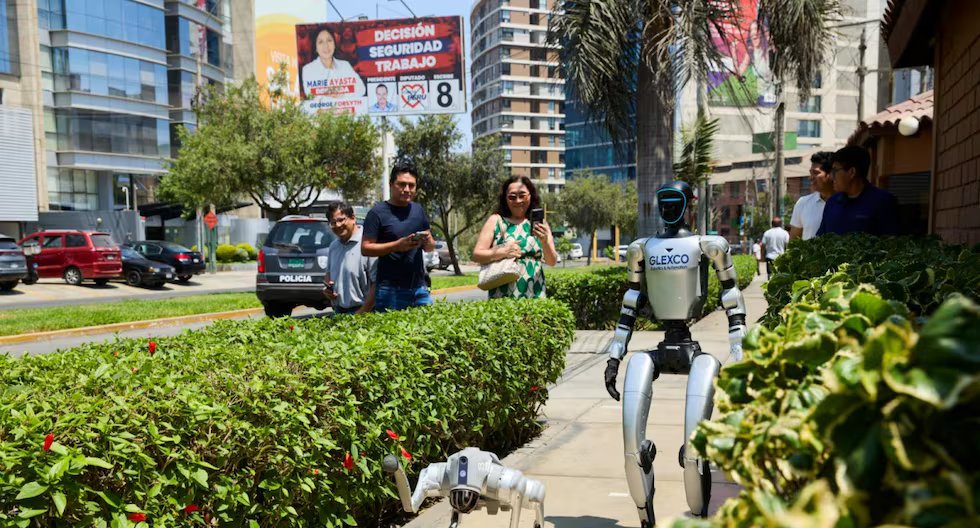
The press that covered the Peruvian electoral debate, full of barbs and unintelligible speeches, managed to notice that the best articulate speaker of the night was not a candidate for the presidency. Was Xpertusa humanoid-shaped robot that, present in the room, guided curious citizens through the labyrinth of the Peruvian electoral system 2026. “It was the first robot we developed here and its specialty is interaction with people. It can talk, resolve doubts,” he says. Jorge TuestaCEO of Glexco Robotics, about this Peruvian-style C-3PO.

Expertus, a robot developed in Peru, was programmed to talk with citizens and explain electoral proposals using information from the Informed Vote platform of the National Elections Jury. (Photo: Andina)
Like many compatriots of his generation, Tuesta grew up watching series about metallic automatons on television such as “Ultrasiete”, “Ultraman” or “Goldar and the space monsters”. For children of the seventies and eighties, robots were an obsession. If the children of the 19th century played with wooden horses and tin soldiers, those who grew up glued to the television in the following decades dreamed of “Astroboy”, “Mazinger Z”, “Transformers” or “Robotech”. In those cartoons, the machines walked, talked, and saved the world before dinnertime. The dream of more than one was to build their own. Today, that old childhood desire seems less and less impossible.

Jorge Tuesta, from Glexco, has developed an educational robotics program for schoolchildren that covers primary and secondary school. The proposal is inspired by training models applied in China. (Photo: Diego Moreno)
/ Diego Moreno
An old fascination
In the 18th century, when European watchmakers mastered the art of tiny gears, automata appeared, machines capable of simulating human actions. The most famous was The Turk, a supposed chess-playing robot presented in 1770. The artifact wore a turban, moved the pieces solemnly and even seemed to get irritated when it lost a game, for greater realism. In reality, it was a farce: inside the furniture a real chess player was hiding who moved the pieces. Still, his legend survived for decades—he was said to have defeated Napoleon—and fueled the old fascination, but also fear, that machines could one day replace human functions.
It was not until 1939 that someone usually presented as the father of modern robots appeared: Elektro, from the Westinghouse company. He was two meters tall, walked clumsily and could pronounce about 700 words, which was already enough for a machine… and for quite a few humans. Elektro even had a little dog, also mechanical, whose current whereabouts are unknown. At the fairs of the time, people paid to see that feat of science, divided between fascination and a slight fear that the device would one day decide to think on its own.

The robots arrived this week in the El Comercio newspaper library, as a unique synthesis between past, present and future. @richardhirano PHOTOS RICHARD HIRANO
/ @richardhirano
Cinema was the art that best knew how to take advantage of that mixture of wonder and paranoia. From the silent “Metropolis” (1927) to “Terminator”, without forgetting the “Blade Runner” saga, where Hollywood imagined androids who do not hesitate to kill their creators while searching for existential answers.
Meanwhile, real robotics continued to advance with much less drama. Companies like Honda developed machines capable of walking, such as the famous ASIMO, a kind of miniature astronaut that seemed to struggle not to fall. Currently there are androids with silicone skin and facial expressions that border on human without being completely human. The effect they cause has been studied by engineers, who call it “uncanny valley”: that uncomfortable moment in which a machine looks too similar to a person and, precisely for that reason, it is disturbing to us.
Made in Peru
Although the robots that today appear at technology fairs or dancing in political campaigns usually come from China, a small but creative ecosystem of own developments has also emerged in Peru. There are the sophisticated humanoids of Glexco, but there are also much more vernacular inventions, so to speak. At Vraem, for example, Professor Walter Velásquez built Kipi, a small educational assistant assembled with electronic scrap, recycled material and a solar panel to recharge energy. During the pandemic, when students in the rural communities of Huancavelica were left without internet or television signal, Velásquez carried Kipi and went on trails with his invention on the back of a donkey.

Kipi was created and programmed to sing, dance and learn with students with special needs. (Photo: EFE)
In some hospitals, robots with a nursing vocation have also begun to appear. PUCP engineers developed RoPI last year, an interactive robot designed to accompany children hospitalized at the National Institute of Children’s Health of San Borja. Its mission is to distract, talk and play with patients who spend long periods in treatment. Along those same lines, researcher Yadhira Valenzuela created Misi this year, a kitten-shaped robot designed to help children with autism spectrum disorder practice social skills while drawing, writing or interacting with the device.

Peruvian robotics has also crept into less expected places, such as the mansions and crypts of the Historic Center of Lima. A team from the University of Lima has presented Alqo, a robot dog equipped with sensors and cameras, to explore tunnels, passages and colonial structures where entering with a helmet and flashlight would be, at the very least, reckless. With the help of drones and laser scanners, the project seeks to create three-dimensional models of the city’s historical heritage. Thus, while the historians review papers on the surface, the robot goes down to the basements to see what secrets have been kept since the viceroyalty.

Two hundred years ago, when steam engines threatened to put half of Europe out of work, workers responded as they knew how: they took down the machines with a hammer. The fear of being replaced by a cog is as old as the industry itself. What will happen now is difficult to anticipate. While these lines are being written, Tesla’s Optimus robot—now in its third generation—begins to walk through the Fremont and Austin factories performing assembly tasks. Elon Musk’s idea is that, sooner or later, Optimus will also enter homes to take care of “boring tasks” such as cleaning, bringing things or cooking. What previously seemed like a science fiction plot that inevitably ends badly—as in “I, Robot”—begins to appear as a reality around the corner.
ROBOTS IN HISTORY AND FICTION
Astroboy
Astroboy was an iconic manga and anime character created by Osamu Tezuka in 1952. It told the story of a robot boy with extraordinary powers who fought for justice while searching for his place among humans.

Astroboy
Mechanical Knight
Recreation of The Mechanical Knight, an invention of the Italian genius Leonardo Da Vinci, which was designed around 1495. It is considered one of the first humanoid automata.

Recreation of a robot based on Leonardo da Vinci’s designs made by Mario Taddei at an exhibition in Berlin.
The Tin Man
The Tin Man is one of the most remembered characters from “The Wizard of Oz”, the novel by L. Frank Baum published in 1900. He is not exactly a robot, but a lumberjack turned metal man who believes he has lost his heart somewhere.

Portrait of Jack Haley (1897-1979), American actor, wearing character costume and holding an axe, in a studio portrait on a white background, released as publicity material for the film The Wizard of Oz (1939). (Photo by Silver Screen Collection/Getty Images)
/ Silver Screen Collection
Electro
It was a humanoid robot created by Westinghouse in 1937 and presented at the 1939 New York World’s Fair. It measured more than two meters, weighed about 120 kilos and could walk, speak about 700 words, smoke cigarettes and blow up balloons. He even had a robot dog named Sparko.

Elektro, the robot presented in the Westinghouse pavilion at the 1939 New York World’s Fair, sings while opening and closing its mouth with its sound mechanism. (Photo by Visual Studies Workshop/Getty Images)
/ Visual Studies Workshop
SO
It was a humanoid robot developed by Honda and presented in 2000. It could walk, climb stairs, recognize faces and respond to voice commands. With his appearance as a little white astronaut, he became one of the most famous robots in the world.

The popular android Asimo welcomed the Kings of Spain with a handshake. See that moment in the following gallery. (Photo: Getty Images)