He market fuels in Paraguay exceeds 3,698 million liters marketed and presents a lot of competition in which large operators and small ones coexist emblemsaccording to data from the private sector and the Ministry of Industry and Commerce (MIC).
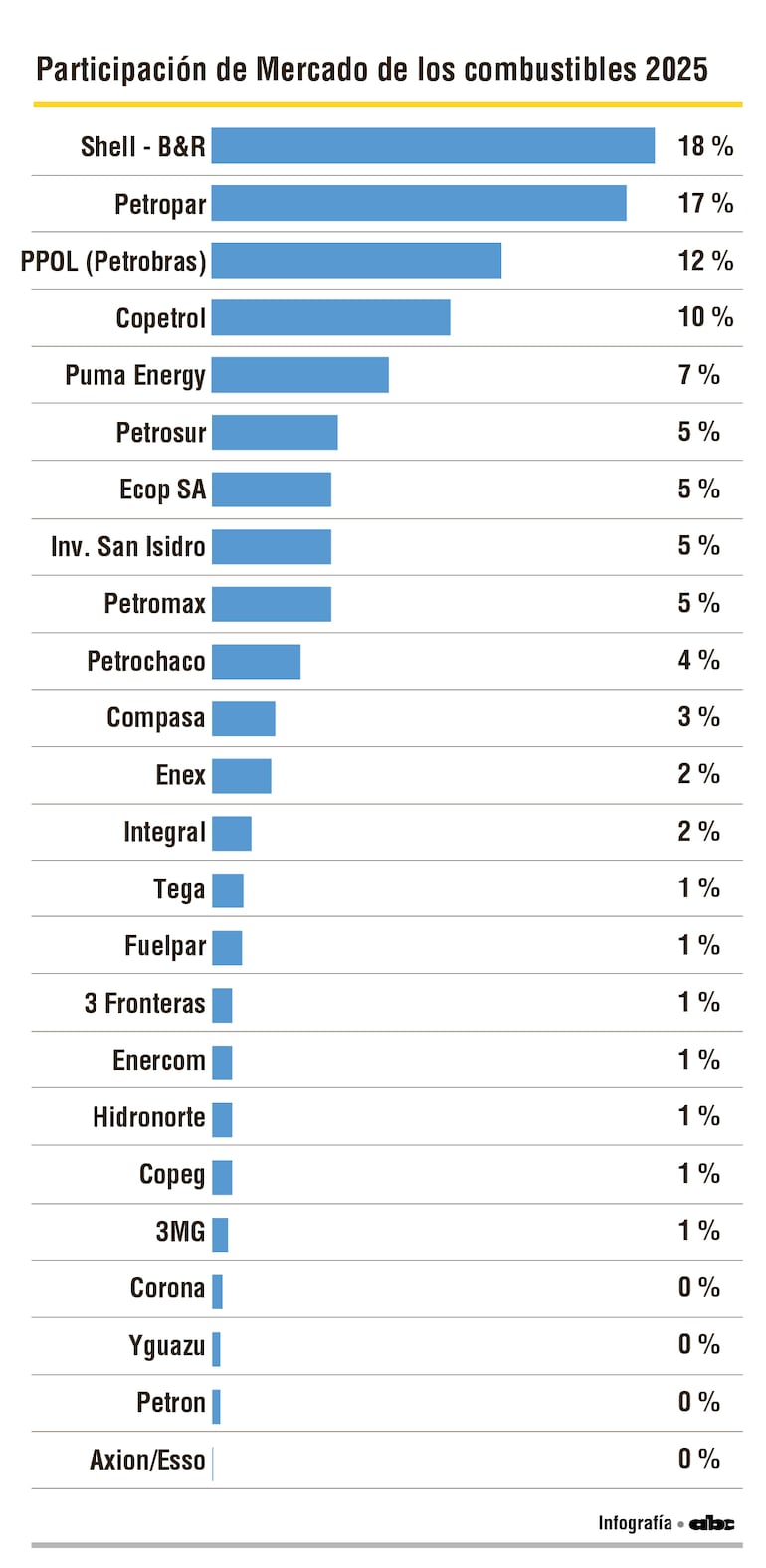
According to records from the last year, Shell (formerly Boats and Wheels) is positioned as the main player in volume, with 671 million liters soldwhich represents the 18% of the total market.
Very close is the state Petroparwith 621 million liters and a participation of 17%consolidating itself as a direct competitor and key player in price formation. Its pricing policy, however, has been questioned repeatedly by the private sectorwhich warns about possible distortions associated with political decisions.
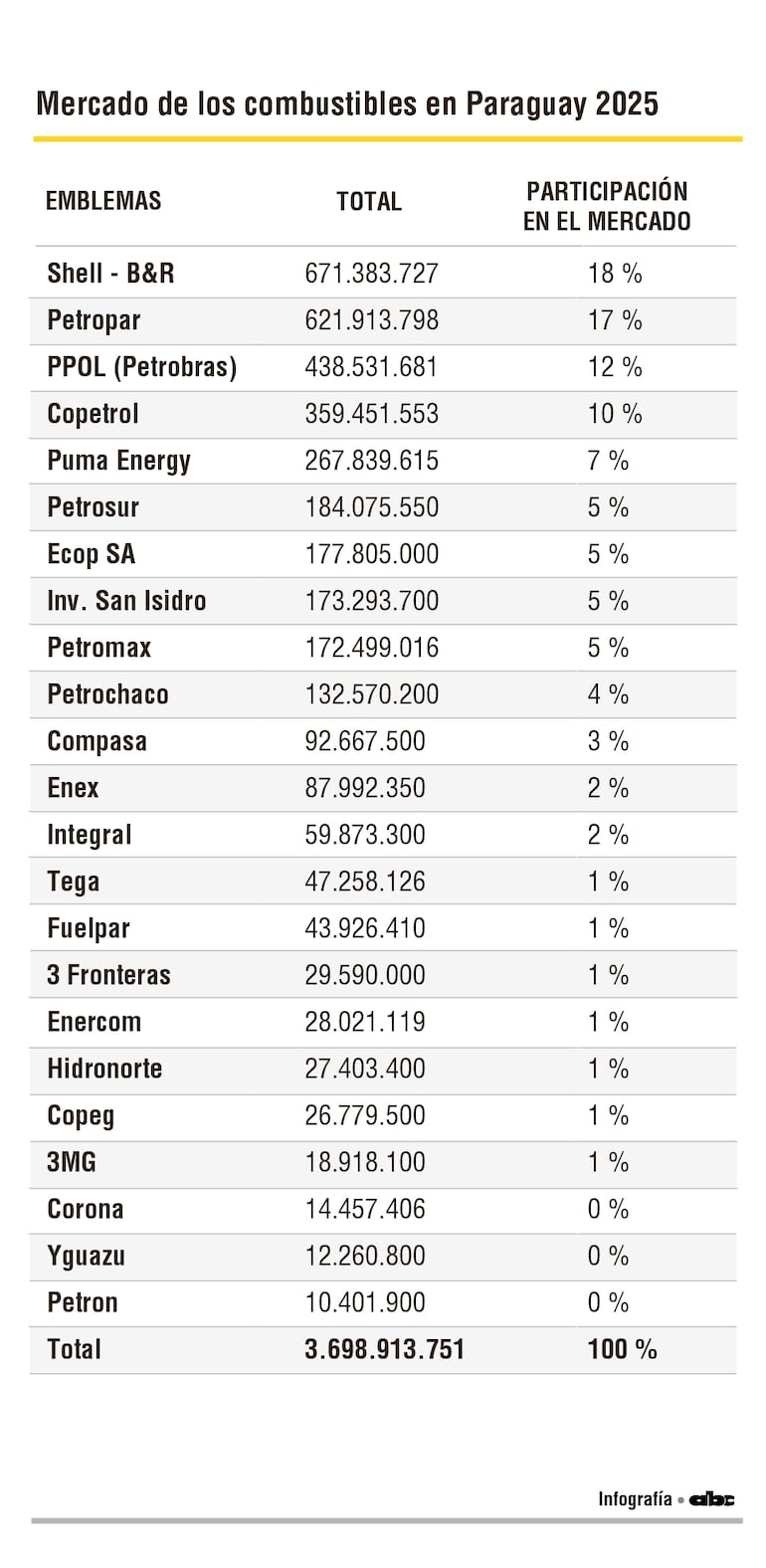
The third place corresponds to Petrobras (PPOL), with the 12%followed by Copetrolwhich reaches the 10%. Together, these four emblems concentrate approximately the 57% of the total marketed, according to sector data.
Fuel market: The protagonists of the remaining 43%
Behind is a second group led by Puma Energy (7%)next to Petrosur, Ecop, Investments San Isidro and Petromaxeach with about 5%which reflects an intermediate segment with relevant weight.
Below is a more dispersed group: Petrochaco (4%), Compass (3%), Enex and Comprehensive (2%), in addition to a long list of operators with shares of 1% or less, which shows the strong dispersion at the base of the market.
Among the latter are Tega, Fuelpar, 3 Borders, Enercom, Hydronorte, Copeg and 3MGall with close to 1% of the market, while Crown, Yguazú and Petron They register tiny participations.
According to sector technicians, unlike other countries with greater concentration, the Paraguayan market is divided between leadership of the greatest emblems and fragmentation of the smallest.
Although the main players dominate the volumethe presence of multiple emblems keeps competition active through commercial strategies such as alliances with banks for promotions with credit cards.
Read more: Fuel increase: this is the price difference between Petropar and private companies
Petropar’s role is decisive in the market
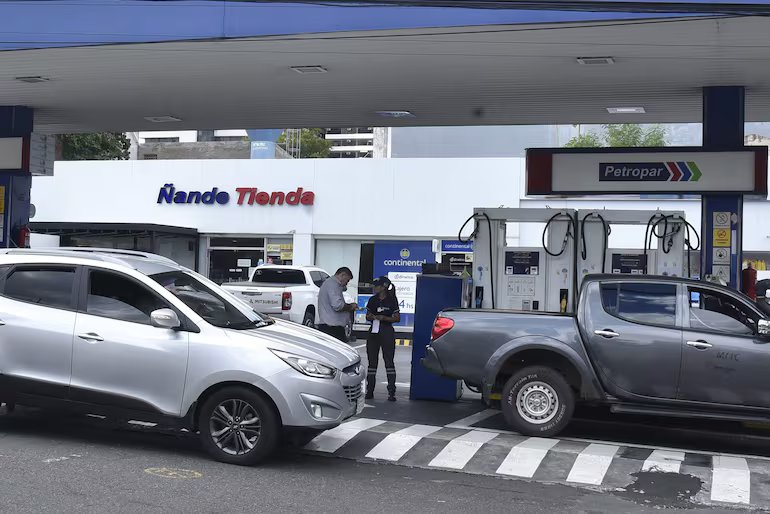
In this context, Petropar plays a decisive role in the market fuels of the country. Its status as a state company allows it to influence the dynamics of prices and act as a reference in times of international volatility.
However, his administration is often questioned by the private sectorwhich maintains that its structure gives it greater margin to absorb impacts without the same profitability pressure that private operators face.
The recent widespread increases reflect that “strain” of the public oil company with the private ones. Despite having applied its second increase in less than a month, Petropar maintains prices below private emblems, especially in diesel, where the gap exceeds G. 1,400 per liter. In total, the state company accumulated an increase of G. 1,200 per literin line with the international rise in oil prices driven by the conflict in the Middle East.
Read more: Is the fourth wave of fuel increases coming?: “Now it’s about not losing”
In parallel, the private sector specified up to three settings in the same period, with accumulated increases of up to G. 2,680 per liter in the diesel and close to G. 1,550 in gasoline. This widens the price difference and reinforces the role of Petropar as a market reference, in the midst of the debate about the impact of its pricing policy.
Taken together, the private emblems concentrate more than 80% of the marketwhich makes them key actors to guarantee supply at the country level. Sector leaders warn that, without their participation, the coverage capacity of the demand would be limited, especially in a context of high volatility and pressure on international prices.