The cold had eaten into the toes until they were dead and numb.
The darkness was so massive that orientation disappeared. It was no longer possible to go. The two traveling companions were dead. He was alone. And yet he forced himself on.
This is how Jørgen Brønlund describes his last days in his diary. A document that has since become one of the most shocking testimonies from the Arctic.
As a participant in the Denmark expedition 1906-1908, he became a central figure in an expedition that ended in tragedy. He was 29 years old.
Now his story is told on stage in a new theater performance “Piffissaq Sioqqullugu”, which brings the more than 100-year-old tale to life for a contemporary audience with actors Klaus Geisler and Kuka Fleischer in the lead roles.
But who was Jørgen Brønlund really? Who was the man whose diary, more than 100 years later, is still so famous that his story is now staged as a theatrical performance?
– He played a significant role in the expedition due to his broad knowledge and experience of the Greenlandic nature, says Aminnguaq Dahl-Petrussen.
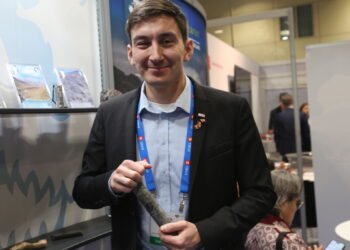
She is a journalist at KNR and in collaboration with Bibi Nathansen, also a journalist, has created the podcast series about Jørgen Brønlund, “Ajunaalernermik Nalunaarut” (in Danish: Nødmelding, ed.).
Nikolaj Isak Jørgen Brønlund was born in Ilulissat on 14 December 1877. He was the son of a prisoner and was a childhood friend of Knud Rasmussen, called Kunuunnguaq.
Brønlund participated in several expeditions, including the Danish expedition to Northeast Greenland in 1906.
– His knowledge of the ice, the weather, the dog sled and survival techniques made him invaluable as a participant on the Denmark expedition, says Aminnguaq Dahl-Petrussen.
A versatile man
Jørgen Brønlund was a seminary student in Nuuk, at that time the city’s only educational option, which was the catechist training.
– He has been a creative type, someone with musical talent. A very teachable person, says Aminnguaq Dahl-Petrussen about Brønlund.
Her descriptions are based, among other things, on research in the form of books, conversations with experts in expeditions and visits to the national archive.
Jørgen Brønlund is described as a loyal and social person – a real comrade. His circle of friends included several of those we know today as great poets and composers.
– The seminary students have really been close friends. Sometimes they didn’t have much money and went to bed hungry, but they took it with humor and not too hard, she says.

Aminnguaq Dahl-Petrussen’s research describes Jørgen Brønlund as a fresh guy – nice to be with, skilled, easy to learn and open.
– He often joked with his Danish business partners and met them as equals. He taught them Greenlandic. He was a brave person, curious and very intellectual, she says.
What Aminnguaq Dahl-Petrussen particularly noticed during his research was how Jørgen Brønlund and his companions joked with each other.
– They were many men who lived an intense and active life. They played sports, ran, they wrestled, there was always movement, says Aminnguaq Dahl-Petrussen.
Brønlund was someone who was good at drawing, a great dog lover and someone who was wanted on expedition trips.
Aminnguaq Dahl-Petrussen emphasizes that these are her own observations, and as she says herself, she sees it with eyes from 2026.
– It could be that I am completely wrong, she says.
During their research for the podcast, they have tried to immerse themselves in Jørgen Brønlund’s world: among other things, they have studied his old clothes at the national museum, visited his former residence in Nuutoqaq, seen his old school and experienced the view from there.
Part of the elite
When asked why he is still important today, Aminnguaq Dahl-Petrussen replies that the story of Brønlund will never become obsolete.
– He was part of the elite of his time and one of the first educated Greenlanders. But he was also a faithful companion. I don’t think the Denmark expedition would have been the same without him, she says.
His story can always be retold. The fascination of his diary never fades, and he died in a place almost no one could reach. In a cave in Northeast Greenland in 1907.
– His story can always be told, regardless of time and place. His personality is easy to imagine, and we have evidence of his life and deeds, evidence that will never be forgotten, says Aminnguaq Dahl-Petrussen.
Across generations
The story of Jørgen Brønlund fascinates not only adults. My 12-year-old son has long been interested in him and the dramatic tales of the expedition.
– I think it’s amazing that he could manage alone, even when it was so cold and dark that you could hardly see anything, he says.
He is particularly fascinated by Brønlund’s diary, where you can feel his struggle to survive, but also his humor and friendship with the other expedition participants.
– I think it makes the story cool that he was both smart, brave and funny. And he was really good with dogs, he adds with a smile.
Although more than 100 years have passed, Jørgen Brønlund’s story lives on. His courage, curiosity and human warmth means that we can still learn from him today, both as a historical figure and as a human being that you can admire and relate to.
From the lines of the diary to the theater performance, and from researchers’ archives to young readers like my son, Brønlund reminds us that even in the most extreme situations friendship, knowledge and courage can make a difference.
He is not just part of Greenland’s history, he is an example of how a single person’s strength and personality can continue to inspire generations.