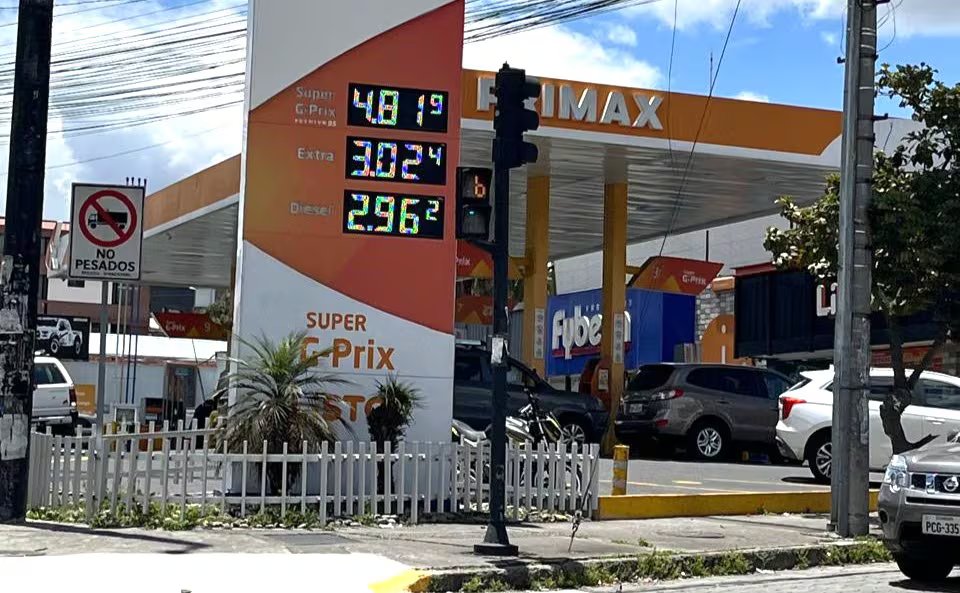
Starting at 00:00 on Sunday, April 12, the new fuel prices are in force. Values increased due to the increase in oil prices in international markets due to the war in Iran.


Prices at service stations will remain until May 11. They changed as follows:
- Extra and extra gasoline with ethanol (ecopaís), from $2.89 rose to $3.024 per gallon.
- Premium diesel went from $2,828 to $2,962 per gallon.
- The suggested price of super gasoline — which is released — rose from $3.62 to $4.57.
The Hydrocarbon Regulation and Control Agency (ARCH) sets the costs each month based on the price stabilization scheme for extra gasoline, ecopaís and premium diesel, which takes as a reference the international valuation of WTI oil (marker crude oil for Ecuador).
For fuel prices that are already in effect, the average crude oil price for March was used.
The formula used by ARCH does not allow the value to rise beyond 5% or fall to 10% monthly, relative to WTI.
Without the stabilization scheme, fuel prices in Ecuador would be higher, considering that, due to the war in the Middle East, oil has reached prices above $100 per barrel in March and April.
This is how José Luis Fuentes, a professor at the University of the Americas (UDLA), described it, who pointed out that the mechanism used in the country “buffers” in a certain way the upward impact of the international market, whose effect in other countries has translated into higher prices for final consumers, such as in the United States.
“The existence of a floor and a ceiling reduces the impact for the consumer. In any case, the State ends up absorbing the blow through tax revenues. In a very short time, the price of a barrel of oil went from between $60 and $70 to $100 or even $110,” Fuentes observed.
The expert noted that other alternatives to mitigate the consequences of sudden variations in crude oil are related to increasing the domestic production of derivatives—to reduce imports—as well as increasing strategic oil reserves and the application of energy efficiency policies, among others.
Measures of this style are being adopted by some countries to calm the constant volatility and uncertainty of the oil market while the conflict in Iran continues, Fuentes noted.
With the scheme, the new prices of extra and ecopaís gasoline have a state subsidy of $1.60 per gallon, said Oswaldo Erazo, executive secretary of the National Chamber of Distributors of Petroleum Derivatives of Ecuador (Camddepe).
By April 12, WTI crude oil stood at $96.57 per barrel, according to specialized international portals.
That amount exceeds the estimate of $53.47 per barrel that the Ecuadorian Government used for the 2026 fiscal budget.
Returning to full gasoline subsidies is not an option that benefits the country, Fuentes commented, because with high crude oil prices the resources of the fiscal fund would be affected.
The Government does not contemplate resuming fuel subsidies. President Daniel Noboa ruled out that possibility, in an interview with Bloomberg. (YO)