When the flight director of NASAZebulon Scoville, was working a shift during the unmanned test flight of Artemis 1, in 2022he realized that the agency was not consistently live streaming the Orion spacecraft journey to Earth.
“They said, ‘Well, we don’t have the bandwidth, we need to download all this vehicle and engineering data,'” Scoville recalled. “And I thought: wrong.”
“This program will end if people don’t buy into the idea and get on board with us.”
NASA ended up being able to broadcast the 2022 unmanned mission live, with low bandwidth.
And when she was done, employees appointed the agency veteran as the “image czar” to increase engagement.
He told AFP he spent two years working across the agency to figure out how to better bring the public to NASA’s new lunar missions.
This included adding an optical communications system to the Orion spacecraft, a laser that transmitted to a ground station on Earth, sending higher-resolution streaming video.
Along the journey of Artemis 2which started on April 1st and ended on Friday (10)NASA maintained live programming on its own streaming platform and on social media.
This, combined with independent streamers and TV news, generated millions of views.
And as Exploration Systems Development Mission Director Lori Glaze said on Friday: “To all our new followers out there, stay tuned.”
NASA on Twitch
From social media posts clipped from live-streamed events with astronauts to an extraordinary portfolio of photographsviewers were able to see everything about Artemis 2.
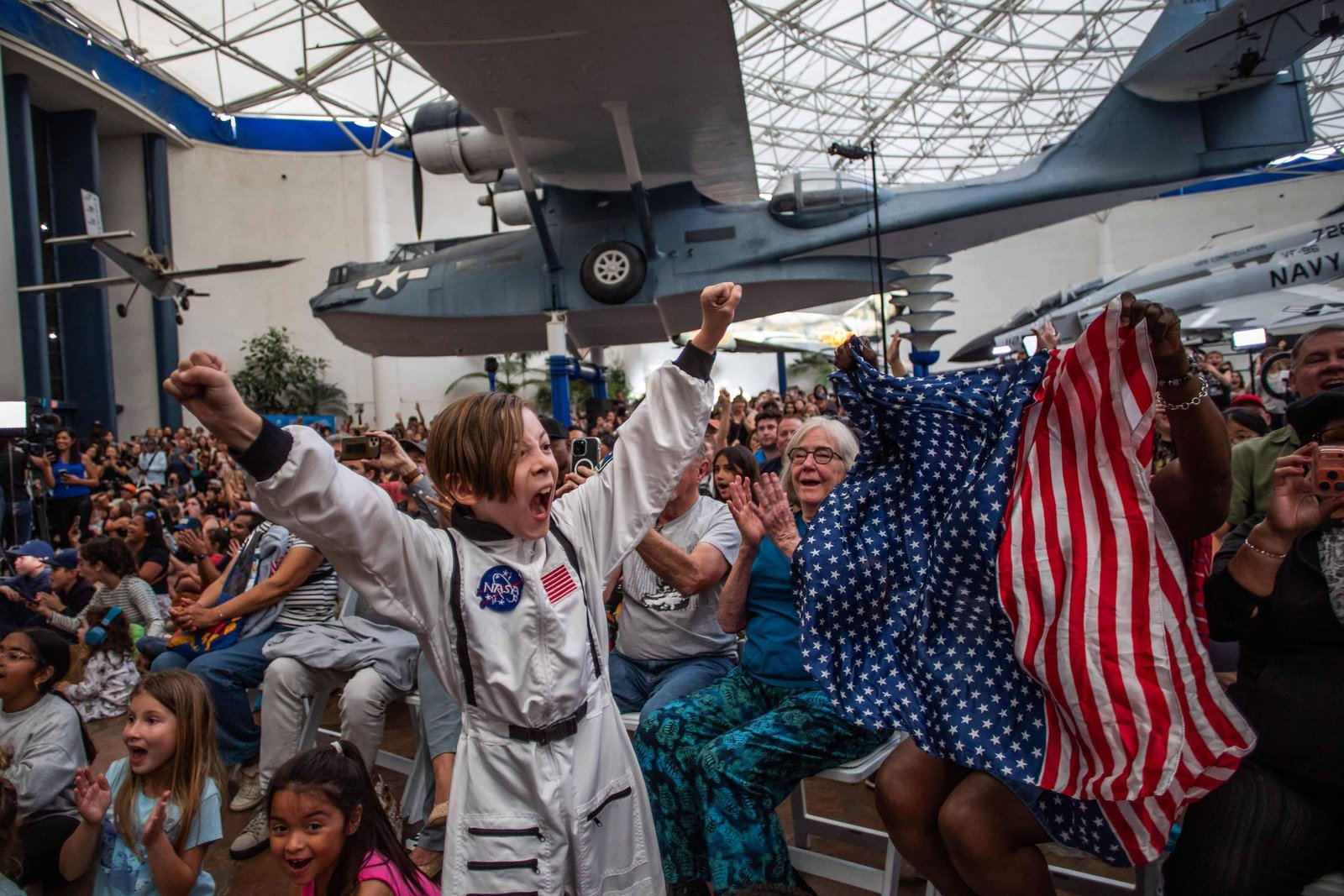
Institutions, including museums, organized parties to watch Artemis 2’s landing, and some teachers integrated the launch into their classes.
Wisconsin physics professor Alex Roethler said watching the mission helped his students become more engaged and made the classes feel more real.
“I love having live streaming available, and I also think it’s cool that they use Twitch,” Roethler said, referring to a video streaming site popular among gamers. “It’s a platform that more of our students use.”
The crew itself was a fundamental part of the narrative.
During the nearly seven-hour lunar flybyastronauts Christina Koch, 47, Victor Glover, 49Jeremy Hansen, 50, and Reid Wiseman, 50gave descriptions of the features of the lunar surface and left scientists in Houston awestruck.
With Artemis 2, there were “just smiles and genuine displays of emotion from NASA, which has sometimes had a history of being a little cold,” Scoville said.
“It’s okay to jump for joy and howl at the Moon“, he added.
Parallels between Apollo and Artemis
You United States They hadn’t sent astronauts around the Moon since 1972, when Apollo 17, the last of the famous space program that took human beings to walk on the lunar surface.
In preparing for the flight, NASA faced both an indifferent population and a fragmented media environment.
The space agency has had to compete for attention across traditional media and social media in a way that the three-channel Apollo TV era never experienced. THE landing on the moon from the Apollo 11in 1969, had approximately a fifth of the world’s population following.
Yet for all of Apollo’s mythic qualities, Jack Kiraly, director of government relations at the Planetary Society, said nostalgia perhaps “overshadows some of the problems the program faced at the time.”
“Everything leading up to that moment was actually largely unpopular among the American electorate, among the general public,” Kiraly told AFP.
The awakening of the space nerd
Before Artemis 2, Scoville had conversations with Wiseman, commander of Artemis 2, in which they reflected on the parallels between the mission Apollo 8in 1968, and the current mission.
In 1968, the United States was politically divided and at war. Almost 60 years later, not much has changed.
“We’re watching the news today, with wars, with division. Everyone is just longing for something good to happen,” Scoville said.
In a recent interview from space, Wiseman said that the only source of news during the mission was their families, who said that the Artemis program captivated people all over the world.
The astronaut stated that he hoped the trip could “make the world stop” to appreciate the beauty of our planet and the Universe. “I think for the people who decided to follow along — and it seems like there were a lot of them — it happened.”
Throughout the journey, the four astronauts emphasized how unified the Earth appears from afar — a reflection they hoped to instill in the public consciousness.
“People are wanting to bring out the space nerd in them,” Scoville said. “This is just a glimpse of what’s to come.”