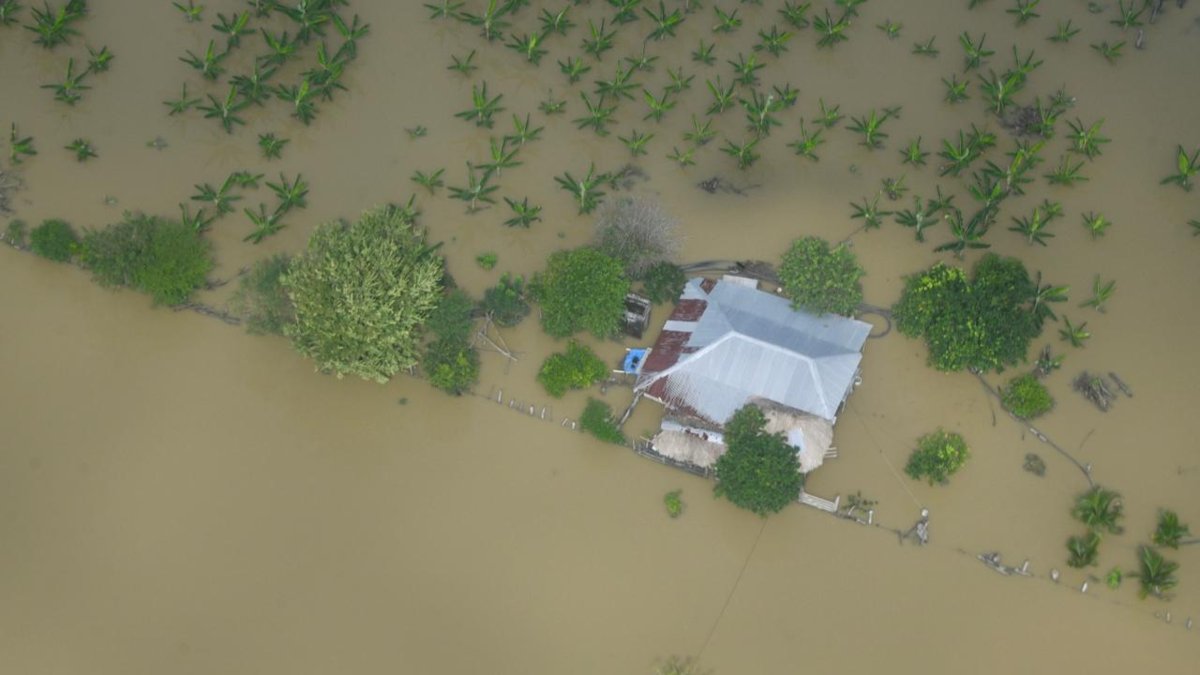
Among the arguments of the Constitutional Court for knock down completely the economic emergency decreed last December, indicated that the natural disastersone of the eight arguments that the Government appealed to, They do not constitute a supervening event.
“In the fourth fact related to the natural disasters associated with the winter wave and to climate changethe Court also considered that did not pass the judgment of supervenience“, considered the Chamber.
And he added that “what was stated in the legislative decree is a structural and progressive situationwidely known and warned, which has been manifested repeatedly in recent years and in response to which the State has had to adopt ordinary measures of prevention, mitigation and budget planning”.
Petro economic emergency decree Photo:Presidency
In fact, he mentions the decrees 1372 of 2024 and 1193 of 2025declaration and extension of national rain disasterto point out that the “risk was identifiable and manageable” with the ordinary powers of the State.
“In that sense, although the situation is serious and constitutionally relevant, it is worth clarifying, does not constitute a supervening event which, by itself, enables the exercise of exceptional powers in the terms of the article 215 of the Political Charter of 1991”, concluded the Court.
This concept, although it is framed in the first disaster events reported in December, does mark a line of what will legally be the economic emergency debate that still valid.
He decree 0150 of February 11, 2026 justifies the emergency and the taxes issued under this umbrella in the “atypicality” of a cold front which, last February, left more than 150,000 families affected in eight departments.
“Between February 1 and 6, 2026, the Colombian Caribbean region was affected by a atypical hydrometeorological eventassociated with anomalous latitudinal displacement of a cold frontwhich reached more southern latitudes than usual, according to historical climatological records corresponding to the period 1991-2020,” says one of the arguments of the “mother” decree.
To address this emergency, the Government issued a tax packageamong these company assets with more than 10,000 million pesos of capital, to raise 8 billionwhich will be allocated almost entirely to the National Unit for Disaster Risk Management (UNGRD).
These are the five tests requested by the Court in control of the second economic emergency Photo:Archive
The Comptroller already issued a technical concept in which he did not find where the calculation of this amount came from. However, there are also legal debate about whether the State, under its ordinary facultiescould address a natural disaster of these proportions, precisely through the UNGRDwhich is responsible for implementing strategies risk prevention and mitigation.
If it were for the concept of the decision of April 9 on the economic emergency repealedthis would also fall. However, the Plenary Hall will have to study the february events and determine if your magnitude exceeded the powers of the Government.
TIME knew for high court sources that, contrary to the quasi-consensus that existed with the unconstitutionality of the first economic emergencyand which was demonstrated in the vote 6-2 (with partial rescues), this time the waters would be more divided.
At least three of the nine magistrates would point out that the “cold front” is not an unpredictable event and, therefore, the state of emergency would be unconstitutional. This would knock down taxes which at this moment are already being collected.
Sara Valentina Quevedo Delgado
Justice Editorial