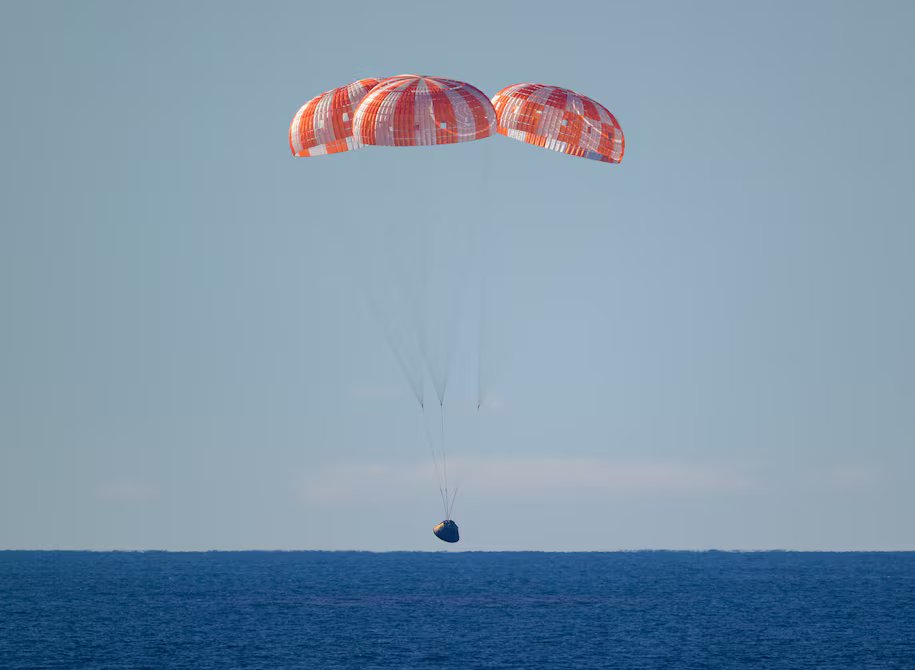
The four astronauts of the Artemis II mission landed on Friday, as planned, off the coast of Californiathus culminating a test mission around the Moon executed to perfection by NASA, half a century after the Apollo program.
“Houston, this is Integrity (ship’s nickname, ed.). We received them loud and clear“, announced Commander Reid Wiseman after overcoming the most dangerous phase of entry into the atmosphere, at more than 38,000 kilometers per hour. “What a trip. We are stable” he added, and reported a “green” code for the four crew members, meaning they were in good condition.
After taking off from Florida on April 1, Americans Reid Wiseman, Christina Koch and Victor Glover, along with Canadian Jeremy Hansenthey ventured further into space than any human being before. They returned with hundreds of gigabytes of data from the first lunar trip since the last Apollo mission in 1972.
Last Monday they passed behind the Moon, capturing in high definition the Earth setting behind a majestic Moon, whose tones changed between gray and brown.
Its Orion capsule made a soft splashdown, at 30 kilometers per hour, in the Pacific Ocean, off the coast of San Diegothanks to huge parachutes, at 17:07 local time (00:07 GMT on Saturday), exactly as the US space agency had planned.
Welcome home Reid, Victor, Christina, and Jeremy! 🫶
The Artemis II astronauts have splashed down at 8:07pm ET (0007 UTC April 11), bringing their historic 10-day mission around the Moon to an end. pic.twitter.com/1yjAgHEOYl
— NASA (@NASA) April 11, 2026
The US Navy recovered them from the capsule floating in the ocean, following a protocol that has not changed since Neil Armstrong’s mission.
This return of the crew represents a relief for the families of the astronauts and constitutes an undeniable success for NASA. after tens of billions of dollars, years of delays and many doubts about the convenience of relaunching the lunar program.
Margin of safety
Orion’s heat shield, which had caused NASA considerable concern after fragments broke off during atmospheric reentry in an unmanned test in 2022, apparently withstood the 2,700 °C generated by friction with the atmosphere.
The space agency decided to continue with the same heat shield, but modified the trajectory to reduce the risk. This decision generated considerable controversy. “I’ll be thinking about it constantly until they’re in the water” NASA Administrator Jared Isaacman recently admitted in an interview.
Goal 2028
This flight was a test to confirm to NASA that the Space Launch System (SLS) Orion rocket and its systems are ready for the return of American astronauts to the lunar surface, before future missions to Mars.
NASA plans a new mission in 2027 that will not go to the Moonbefore sending astronauts to the surface of the Earth’s satellite in 2028 during the fourth Artemis mission, in the last year of Donald Trump’s presidency… and theoretically before China, which plans to send its taikonauts to the Moon in 2030.
However, experts doubt that the lunar landers, developed by the companies of American billionaires Elon Musk and Jeff Bezosbe ready for 2028.
A Japanese and then a German astronaut were supposed to travel on future Artemis missions, but these positions no longer appear guaranteed since NASA completely restructured the Artemis program, and the European Space Agency has acknowledged having to negotiate to keep them.
Meanwhile, the US space agency hopes Artemis – which has cost tens of billions of dollars – will revive American interest in space exploration.
But also, the crew hoped, “to allow the world to stop for a moment,” as Commander Reid Wiseman said this week. (YO)