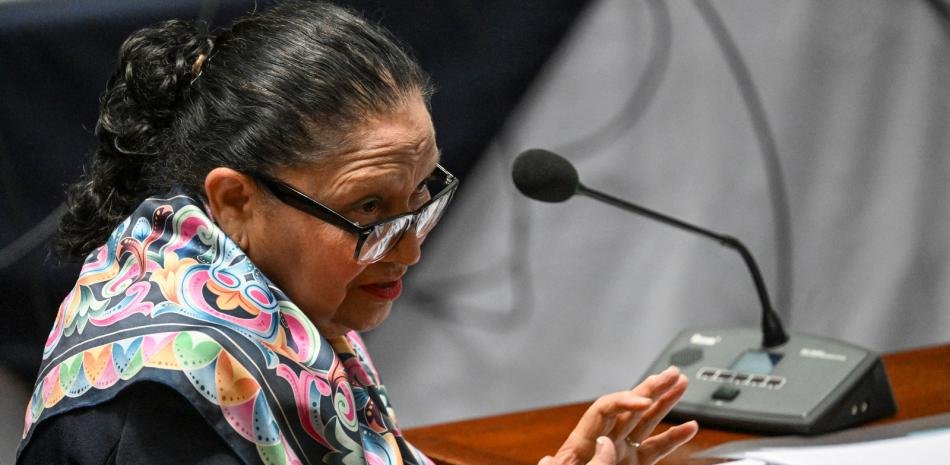
The attorney general of Guatemala, Consuelo Porras, sanctioned by the United States, which considers her corrupt and undemocratic, defended on Thursday her candidacy for a third term, the last card being played to maintain her immunity.
Porras, who also faces UN complaints for illegal adoptions, appeared before a commission that will define the deck of candidates from which the prosecutor will be chosen by the social democratic president Bernardo Arévalo, whose inauguration the official tried to prevent two years ago.
Guatemala is carrying out a process to renew key institutions of the judiciary, which only has the prosecutor’s office left, whose head will take office on May 17.
Porras, 72, recently failed in her attempt to reach one of the high courts, which would have protected her legally.
“I have represented (…) legality, institutionality, honorability and work. That is why I have been highly criticized,” the prosecutor, also sanctioned by the European Union, told the commissioners.
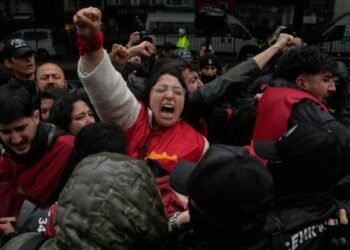
But the rejection of Porras by a sector was evident in the room, when dozens of indigenous people and activists turned their backs on him upon entering.
A commissioner asked her why she was running if she faced accusations and “social rejection.” There have been “conclusive results,” he responded.
Arévalo accuses Porras of operating for the “corrupt pact,” an alleged network of politicians and businessmen that manipulates justice to protect criminal activities.
Although it is ruled out that the president could choose her, the prosecutor is attributed enormous power in the justice system, which in this type of election gives more weight to experience than to ethics.
The accusations against the prosecutor are based on actions against former anti-mafia officials and journalists, many in exile, and for blocking Arévalo’s possession.
“some kind of shielding”
“It seems that the only reason” why she is seeking to be re-elected is to “generate some type of shield” against processes “that will surely arise” when she leaves, Peruvian lawyer José Ugaz, from a panel of experts observing the election, told AFP.
Although the prosecutor claimed efficiency, this indicator, measured in cases that obtain a response, fell from 14% to 6% in her period, Hugo Mangione, from the Institute of Comparative Studies in Penal and Social Sciences of Argentina, told AFP.
In February, the same day she was eliminated from the race for the constitutional court, UN experts linked Porras to illegal adoptions of some 80 indigenous children in the 1980s, during the civil war, which she rejected.
The group noted that the minors were given up for adoption after being taken to a state home where Porras was director and “legal guardian of the children from January 21 to August 30, 1982.”