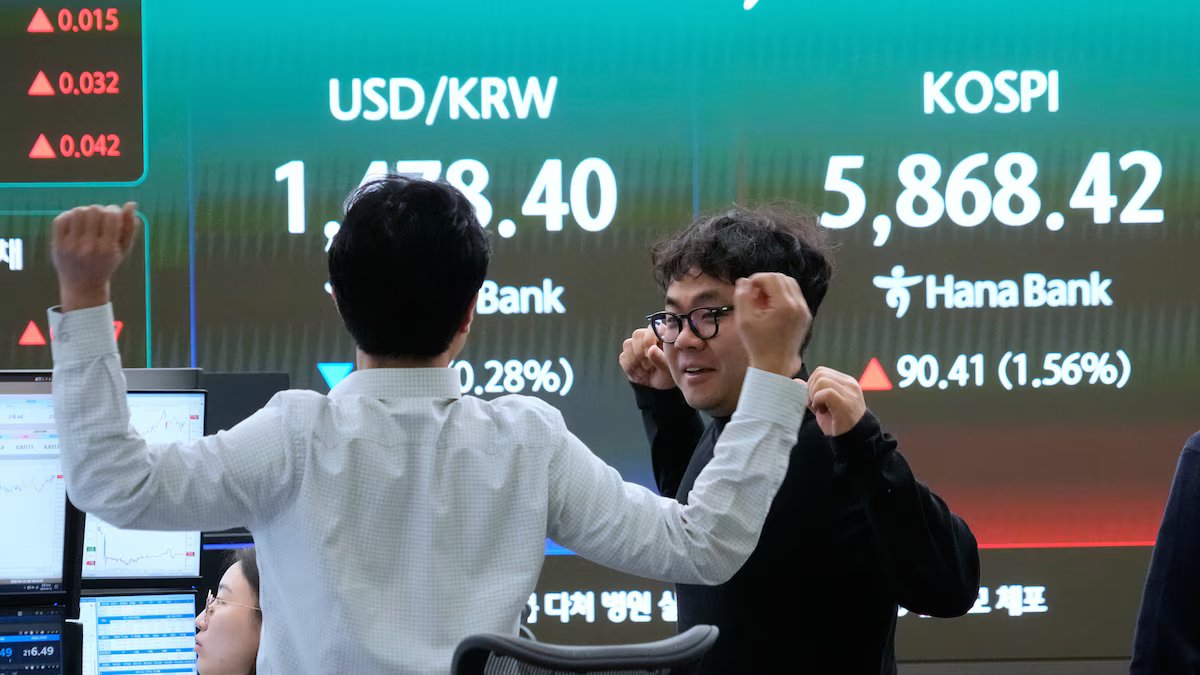
HONG KONG.— The stocks in Asia they mostly rise again this Friday, following in the footsteps of wall street, while the prices of oil They also increase in the face of fragility of the agreement ceasefire in the US-Israel war with Iran and before talks between the Islamic Republic and Washington in Pakistanwhich will begin on Saturday.
He Kospi of South Korea soared 1.8% to reach 5879.71 points. He Nikkei 225 Tokyo gained 1.6% to 56,789.58 integers. The actions of Fast Retailingparent company of Japanese clothing retailer Uniqlosoared more than 10% after the group raised its expectations for the year.
He Hang Seng of Hong Kong gained 0.7% to 25,919.12 points, while the composite index of Shanghai It rose 0.6% to 3991.14 units.
Meanwhile, China reported this Friday that its consumer price index – a leading indicator of inflation – rose 1% in March compared to a year ago, below analysts’ expectations, and less than the 1.3% increase in February.
On the other hand, the S&P/ASX 200 Australia lost 0.4%; Taiwan’s Taiex rose 1.3%; and India’s Sensex gained 0.7%.
In Europe, stock markets rose slightly, with the benchmark index STOXX 600 about to close the week on the rise, as investors maintain cautious optimism ahead of diplomatic talks.
He pan-european index It rose 0.2%, to 613.48 points, on its way to registering its third consecutive weekly increase. In addition, healthcare and technology stocks lead the gains in Europe, with an increase of 0.5% and 0.6%, respectively.
Meanwhile, in the energy sector they lost 0.7%, despite the increase in oil prices during the day.
European stock markets they were shot on wednesday and recorded their biggest single-day rise in more than four years following the news of the ceasefire in the Middle East. The announcement temporarily eased investor concerns, allowing the STOXX 600 to recoup some of the losses accumulated since hostilities broke out in late February.
Among other notable companies, Sodexo plummeted 20%, after the French restaurant company cut its annual sales and profitability targets. Looking ahead, market participants will closely scrutinize US inflation data, due out today, to get a sense of how the ongoing conflict could be impacting economic fundamentals.
Talks between the United States and Iran in Islamabad, the Pakistani capital, for a Possible permanent end to war with Iran to begin on Saturday. The American vice president, J.D. Vancewill lead the delegation of the administration of Donald Trump.
But before the talks, the Israeli attacks in Lebanon on Wednesday raised questions about the validity of the two-week ceasefirewhile the Persian country maintained its control over the Strait of Hormuz, that remains practically closed despite Washington’s demands to reopen a crucial sea lane for the global oil and gas transportation.
From Israel, the Israeli Prime Minister, Benjamin Netanyahustated that he had authorized the start of talks with Lebanon, and negotiations are expected to take place next week in Washington.
Against this backdrop, prices were headed for their biggest weekly drop since June, despite modest increases on Friday, due to fresh concerns about supply from Saudi Arabia and maritime traffic through the Strait of Hormuz.
At 9:20 GMT, crude oil futures Brent rose 56 cents, or 0.58%, to $96.48 a barrel, and West Texas Intermediate in the United States (WTI) improved 65 cents, or 0.66%, to $98.52.
Both contracts lost between 11% and 12% this weekafter Iran and the United States agreed to a ceasefire on Tuesday. However, fighting continued and the flow of oil through the Strait of Hormuz remains restricted, keeping futures prices just below $100 a barrel and pushing prices in the physical market to record highs.
Regarding these prices, “US$65-70 per barrel is not going to return,” he wrote. Ajay Rajadhyaksha, from Barclays, in a recent research note, referring to pre-war levels with Iran. The bank expects Brent crude to average around $85 a barrel this year. “A ceasefire is not a refund. Truces end wars; they don’t undo them”he added.
In other operations, Gold and silver prices fell. Gold lost 0.5% to $4,791.90 an ounce, while silver fell 0.6% to $76.02 an ounce.
AP, AFP and Reuters Agencies.