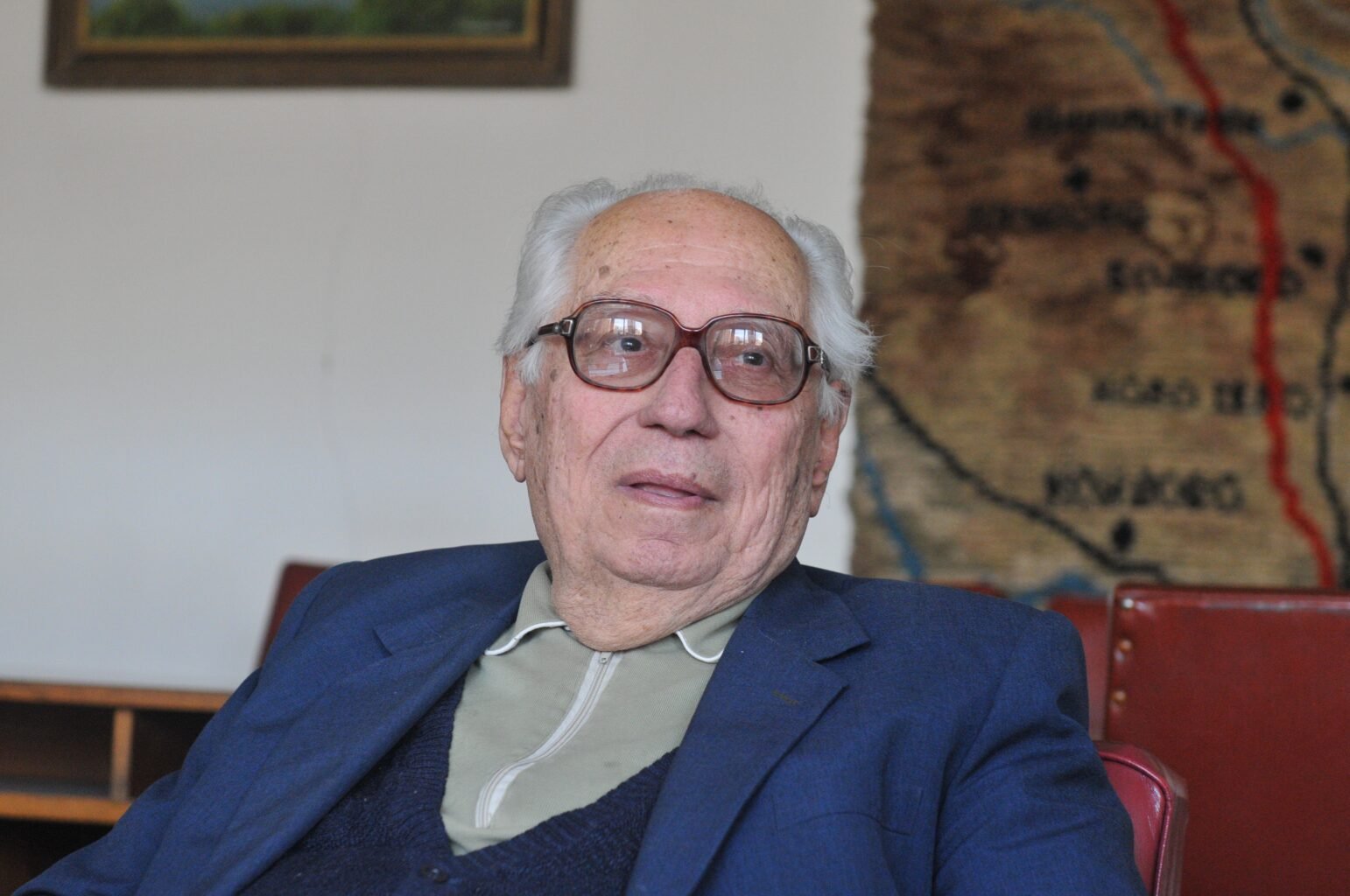
Revisiting the scientific work of the prominent Macedonian Trajko Stamatoski on the occasion of the 101st year since his birth
You cannot erase something that cannot be erased, said the great Macedonian linguist Trajko Stamatoski as his fierce and well-argued response to the attacks of linguistic and political Sofia, which with incredible persistence has been denying the uniqueness of the Macedonian language and identity for a century and a half. As one of the greatest defenders of the Macedonian language, Stamatoski remains forever remembered in European and world linguistic science, and even more so in the collective memory of the Macedonian people, due to his sharp scientific opposition to the Bulgarian claims about the Macedonian language at the world Slavic congresses (the events of the Slavistic congress in Prague in 1968 are particularly striking), as well as the dozens of books in which he explained the creation of the Macedonian literary language over the centuries – facts that make sense and demolish the claims of political and pseudo-scientific Sofia that “the Macedonian language was invented by Tito in 1944/1945” and that “it has Bulgarian foundations and roots as a dialect of the Bulgarian language”.
– We are all a continuity, we neither begin nor end, we are only a part of that continuity and that is why the title of my book is what it is – Stamatoski will say during the presentation of his notable scientific work “Macedonian language: identity continuity – final expression” on December 19, 2016 at the Macedonian Academy of Sciences and Arts.
Then, on that occasion, prof. Dr. Dimitar Pandev as a representative emphasized that Stamatoski opens the historical perspective of the Macedonian language and Macedonian philology with this book.
– At the same time, Stamatoski exalts the Macedonian language in its original and permanent recognizability of its territory and its witnessed spiritual space, it presents to the world the image of Macedonianness and the cultural thread, nested in it – stressed Pandev.
– The constant in Stamatoski’s working life and scientific oeuvre is his enormous dedication to the affirmation and further shaping of the Macedonian literary language, to the struggle to preserve its identity and the unceasing efforts for further development of the Macedonian language – academician Taki Fiti, in his capacity as the president of MANU, pointed out at this presentation.
Yesterday, May 6, was the 101st anniversary of the birth of this great scientist, and therefore this is a suitable occasion to return to his long and rich life and to his scientific work, which remains permanently in the treasury of the scientific treasures of domestic and world Macedonian studies. Stamatoski was probably the greatest Macedonian onomastic artist. Stamatoski’s scientific work consists of about 500 scientific and professional works: monographs, articles, abstracts, symposia and a large number of contributions. At the same time, his 16 monographs, which are completely dedicated to the Macedonian literary language, deserve special attention. Stamatoski was part of the first generation of Macedonian language graduates at the Faculty of Philosophy in Skopje in 1950. He was the director of the Macedonian Language Institute “Krste Misirkov” for many years and the last of the generation of great Macedonian linguists.
Scientific activity in the function of protecting the Macedonian identity
As one of a number of distinguished European and world linguists and intellectuals, who dedicated their scientific activity to the role of protecting the identity and language of the Macedonian people, the prominent French writer Henri Barbis said: “It is really about a people. A people that has its own original ethnic character, its own traditions, its own aspirations, its own unique and specific personality… For the Macedonians, who have their own special language and indisputable ethnic originality, and they have no right to be called Macedonians”.
– What a beautiful example of defense of the Macedonian national identity from a foreigner, almost a century ago, and at a time when our nation did not have its own institutions that could act, in various ways, in its favor. But he was lucky at that time to have intellectuals with high moral values and they were willing to support him in his struggle to prove himself as a special subject, to express at least solidarity in his sufferings – wrote Trajko Stamatoski in the book “Macedonian Language: Identity and Continuity – Final Statement”.
Emphasizing that the Macedonian self-importance is being denied again, in that work this Macedonian writer will point out: “We are left with faith that reason will prevail, because the realization that something that cannot be erased cannot be erased will win.”
Stamatoski defended the Macedonian language not only against Bulgarian denials and forgeries, but also against such challenges from Greece. Thus, the organ of the Communist Party of Greece, “Rizospastis”, published in 1934 several letters in the Macedonian language and handed over in Greek the famous letter signed “Many Macedonians” (January 30, 1935), in which it was requested to be allowed “to speak our Macedonian language freely and to open our own schools, Macedonian, in which our children will learn”.
– These requests were in accordance with the publication of the primer Abecedar (in Athens 1925) in a beautiful vernacular Macedonian language, published as a result of the international agreements for the protection of the rights of minorities. But that was as soon as it was published – Stamatoski wrote in connection with these requests for learning the native Macedonian language in the Aegean part of Macedonia, today in Greece.
He remains remembered as one of the founders of Macedonian onomastics
In the first years after the liberation, Stamatoski was engaged in journalism at Radio Skopje. But he soon switched to scientific activity under the great influence of the work of Blaže Koneski. And not only Stamatoski but also other outstanding Macedonian linguists, regardless of whether they were of the same age as Koneski, considered this scientific and literary genius as their constant inspiration, but also as a guide in their scientific work. The relationship between Trajko Stamatoski and Blaže Koneski is one of the closest, noted in Macedonian science, and he contributed a lot to the scientific establishment, further development and wide affirmation of the Macedonian language. Stamatoski was also the president of the Foundation for the Macedonian language “Nebregovo”, named after the village where Koneski was born.
Trajko Stamatoski is one of the founders of Macedonian onomastics (a special branch of linguistics, which deals with the study of proper names, investigates the origin, meaning, historical development and the way names are created in a language: it is closely related to history, geography and ethnography, because names often store information about past events, migrations of peoples or forgotten words). He appears as one of the three authors of the Dictionary of the Macedonian Language in three volumes (1961-1966) under the editorship of Blaže Koneski and as the editor of the Dictionary of Surnames among Macedonians in two volumes (1994 and 2001). As one of the founders of the International Seminar for Macedonian Language, Literature and Culture in Ohrid, for years he regularly presented his presentations at scientific conferences within its framework.
He is the author of several books and about 500 professional and scientific contributions. As a prominent social activist, until the end of his life he was the president of the City Board of the Union of Fighters from NOV and its successors and a long-time member of the leadership of the Vardar football club. He is the winner of the highest state and social awards. Trajko Stamatoski died on April 2, 2021 in Skopje, at the age of 96.
Reminder of the historic speech of Dimitar Blagoev in the National Assembly of Bulgaria on the occasion of 102 years since his death
I am a Macedonian and as such I advocate for Macedonia to have its own organization and its own administration
We do not recognize the history that you, the Bulgarians, are falsifying, because the goal is Bulgarian hegemony in the Balkans. I am not Bulgarian, I am Macedonian, Macedonian Slav! As such, I advocate for Macedonia, as a Slavic country, to have its own organization and its own administration. If you are convinced that Bulgarians live in Macedonia, that there are Bulgarians in Ser, Drama and Kavala, then let a referendum be held and let’s see what they say. Why are you making a fuss? So you are not sure, it means that there is something that worries you, because some areas, conquered by you, will slip out of your hands, if they submit to a referendum! This is part of the historic speech of the politician in Bulgaria, the Macedonian Dimitar Blagoev nicknamed Dedoto, which he gave in the Bulgarian National Assembly on December 16, 1917.
From this excerpt from the shorthand notes, taken during the parliamentary debate, it can be seen that during the First World War, not only in the middle of Bulgaria, in its parliament, but also in Europe, it was loudly heard that the Macedonians wanted to constitute Macedonia as their own independent state. The strong rejection of the Bulgarian historical falsifications of Macedonian history by the Macedonians as a separate nation echoed equally.
Today, May 7, 2026, marks the 102nd anniversary of the death of this Macedonian politician in what was then Bulgaria, who remains remembered in the political history of the Macedonian people with his historic speech in the legislature of political Bulgaria. Blagoev, even back then, a Macedonian presented to the conspirators of San Stefano Great Bulgaria the undeniable fact of the existence of a separate Macedonian national identity in Bulgaria as well – which today’s protagonists of Great Bulgaria are unsuccessfully trying to dispute in all possible ways. In that context, that is why the personality and activity of Dimitar Blagoev as a dedicated actor for the Macedonian national cause and the proof of the Macedonian national, linguistic and historical separateness are also important from today’s point of view. But also as a fierce opponent of the Bulgarian assimilation policy towards Macedonia and the Macedonians.
Blagoev boldly opposed the Bulgarian falsification of the history of Macedonia and the efforts of the Great Bulgarian rulers to seize and conquer all the ethno-linguistic territory of the Macedonian people, i.e. not only the Vardar and Pirin, but also the Aegean part of Macedonia.
From his political activity like this, messages and lessons are still strongly radiating today that completely make sense of today’s negative statements coming from Bulgarian politicians.
In an article in which this very important speech of Dimitar Blagoev was discovered, the manuscript was deliberately damaged in the places where Macedonians are mentioned. It was also deleted from the shorthand notes of his speech in the Bulgarian parliament. Especially Dimitar Kosev in his book entitled “Petko Rachev Slaveikov, Public and Political Activity”, published by the Bulgarian Academy of Sciences in 1986, tries to completely cover up and twist Blagoev’s pro-Macedonian views. Also, many other Bulgarian historians are still trying to hide the key points from the mentioned speech of Dimitar Blagoev. However, the Macedonian historian Dr. Orde Ivanoski has published his views reliably and accurately in his scientific work “Statement of Dimitar Blagoev about the nationality of the Macedonians before the Bulgarian parliament in 1917”, published in Skopje in 1967.
Dimitar Blagoev was born on June 14, 1856 in the village of Zagorichani, Kostursko, in the Aegean part of Macedonia, today in Greece. As a Macedonian politician in Bulgaria, he is the founder, ideologist and long-time leader of the Bulgarian Labor Social Democratic Party, the predecessor of the Bulgarian Socialist Party. Blagoev is one of the founders of the socialist movement in general in the Balkans, and especially in Bulgaria. He has published more than 500 articles. He died on May 7, 1924 in Sofia. One of the largest cities in Pirin Macedonia, formerly Gorna Jumaja, was renamed Blagoevgrad on May 9, 1950 in honor of the distinguished Macedonian patriot Dimitar Blagoev.
Saint Toevski