Does anyone still need these pieces of paper: letter of motivation, CV, job references? Opinions differ. But when in doubt, say: yes.
That was exactly what motivated Manuel Wiesner to take action in 2020. The Swiss, who runs more than 30 different family-owned catering businesses with more than 800 employees with his brother Daniel, wanted to find out more quickly from the job references than could be seen in usual letters.
He teamed up with the former labor law professor Thomas Geiser from St. Gallen and together with the Graubünden Cantonal Bank they started a new form of service certificate at the end of 2024. Wiesner: “It contains clear formulations and evaluations to avoid unnecessary discussions. The creation can be highly automated. And: Experienced readers can get a comprehensive impression within 45 seconds.”
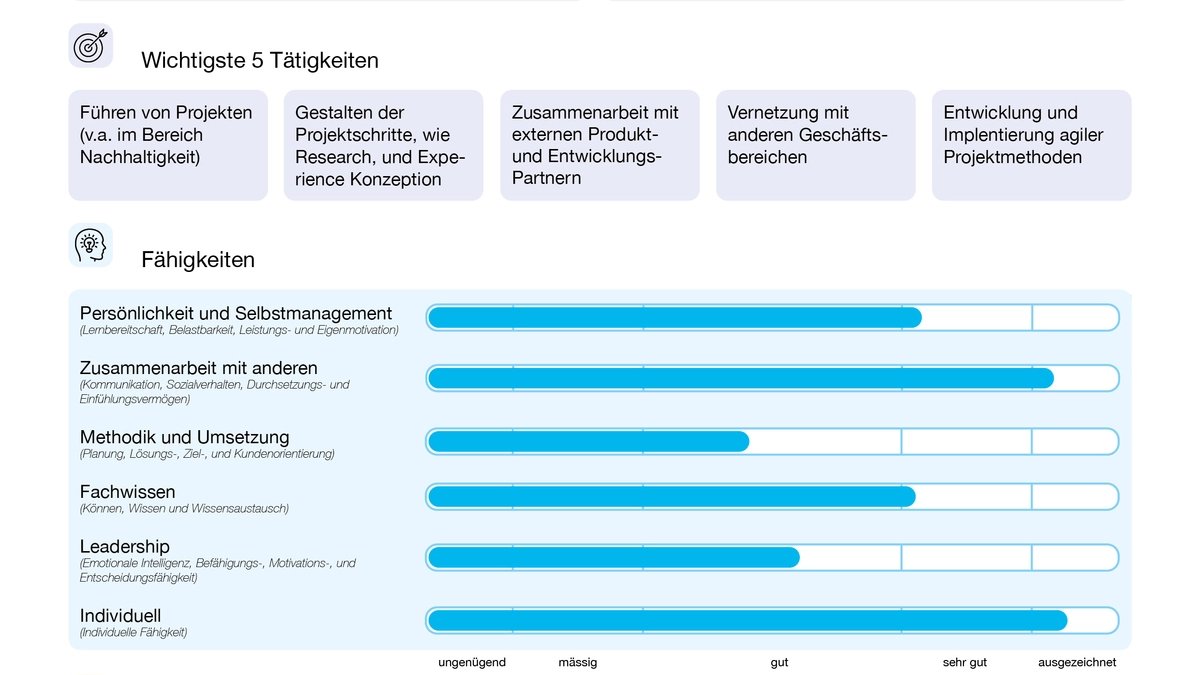
The “Employment Certificate 2.0”, as described by the Vision Arbeitszeugnis association, which has been founded in the meantime (work certificate.work), works with the “Rule of 5”: the person’s five most important activities, five central skills (personality and self-management, collaboration, implementation, specialist knowledge and leadership) and five points about strengths are mentioned.
In principle, a certificate of service based on this model is also permissible in Austria, says labor law expert Julia Englader, lawyer at the Körber-Risak law firm. With a few restrictions: There is no legal right to issue a “qualified service certificate” evaluating the services provided, as the template from Arbeitszeugnis.work is designed.
“If such a certificate is issued, it must not contain any detrimental wording. In particular, entries or assessments that are likely to make it more difficult to obtain a new position are not permitted,” says Englader. Against this background, an assessment in the “skills” category as “inadequate” or “moderate” appears legally problematic. “We therefore recommend limiting the rating scale to a range between “good” and “excellent.” (For further inadmissible formulations, see box.)
Secondly, it should be noted that “the type of termination of the employment relationship – especially in the event of dismissal or resignation – may not be stated in the reference,” says Englader. Therefore: leave out the termination type or reason.
In Austria, employers are obliged to issue their employees with a certificate of service upon request upon termination of the employment relationship. This is usually required when looking for a new job. It should at least contain the name of the employee, the name of the employer, the duration of the employment relationship and information about the activity(s) and be signed. An interim certificate may also be requested.
Prohibited codes in the service certificate
Codes that conceal a negative evaluation are not permitted in service references. Here are some examples:
• “XY tried to meet the requirements”: XY tried hard, but did not meet the requirements.
• “XY committed all his strength to project X”: But only for this one project.
• “XY had specialist knowledge and showed great self-confidence/XY always contributed to the team as an integrative, communicative personality”: Big mouth, little behind it.
• “XY was particularly committed to the interests of the workforce”: This means (to put it in a friendly way) that someone doesn’t put up with anything.
• “XY always behaved correctly towards his superiors and colleagues”: There was probably no sign of any particular commitment here.
Visually, the template from Arbeitszeugnis.work looks like a well-designed CV that tries to quickly highlight a person’s strengths and thus appeal to recruiters. As long as they are people. And that’s what Vision Arbeitszeugnis assumes: that (smaller) catering businesses are working even less with AI-based HR tools, at least at the moment.
Speaking of CV: The European template Europass (europass.europa.eu/de) ensures a high level of comparability because it standardizes the fields to be filled out, but is not necessarily popular in practice.
On the one hand, because it leaves little room for individual design, and on the other hand, because some candidates have problems integrating their qualifications. If you assume that the application will be viewed by people, you are better off with an individually designed CV.
Human resources specialists also recommend making your CV skill-based and highlighting the skills and abilities you have acquired and used when describing your professional and voluntary positions.
Templates: lebenslauf.at/vorlagen, karriere.at/lp/lebenslauf-vorlagen or bewerbung.net/ CV-sample-templates
Design tips: ams.at/arbeitsuchede/rechte-bewerben/anfragender- CV