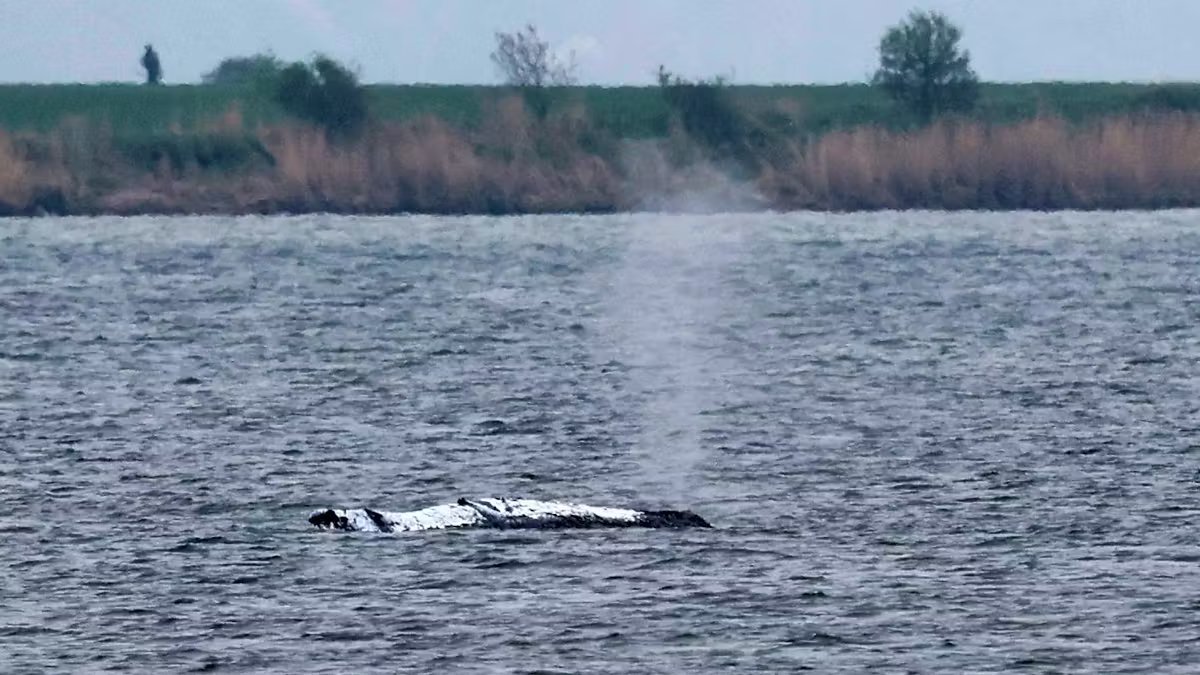
According to marine biologist and whale researcher Fabian Ritter, the humpback whale, which was rescued by helpers from a shallow Baltic Sea bay, goes beyond all scientific experience. “Yes, there is a will to live in him, no question about it,” Ritter told the German Press Agency.
“Large whales usually only survive repeated strandings for a few days.” This led to the recommendation that the whale should be allowed to die with dignity and that no rescue measures be undertaken. “No one could have known that it would turn out differently and into a drama like no other.”
First-of-its-kind rescue operation
From Ritter’s point of view, the outcome of the rescue operation, which is unique to date, is still completely open. Transport in unfamiliar and noisy surroundings is very stressful for the animal. “We don’t know what that does to the whale,” he said. There are no precedents.
In general, the whale’s health is not good. “Everyone says that, including the supporters of the rescue operation.” There is a long, traumatic history. The animal got caught in nets, wandered around for weeks and had five self-strandings. “These are clear signs that the whale is anything but fit.”
The moment of release is crucial
The moment of release will be crucial, Ritter continued. It must be ensured that the whale can eat and that it can swim and dive normally. The latter is questionable after lying in bed for such a long time, which affects the muscles and internal organs. The question of food intake arose because power supplies had been discovered in his mouth. “We can only speak of a rescue if the whale shows normal behavior for weeks after its release,” explained the marine biologist.
Think about your own behavior
Ritter pointed out that around 300,000 whales and dolphins die in fishing nets every year worldwide, many thousands of them in Europe. If there is a message from the campaign for the Poel whale, it is that it contributes to a change in people’s consciousness, “so that we think about our behavior towards the seas and its inhabitants and change it.”
This could start with banning gillnet fishing in protected areas. Mecklenburg-Western Pomerania’s Environment Minister Backhaus could also do this in his state, where it is his area of responsibility. But each and every individual can also make a contribution to protecting the oceans by restricting their personal fish consumption.
Sad about hate messages
He finds it regrettable that he and his colleagues have become the target of hostility and hate messages. It is part of normal, democratic discourse to accept opposing opinions and not attack each other. It cannot be the case that “we use our love for a single whale to stir up hatred among ourselves,” said Ritter. (DPA)