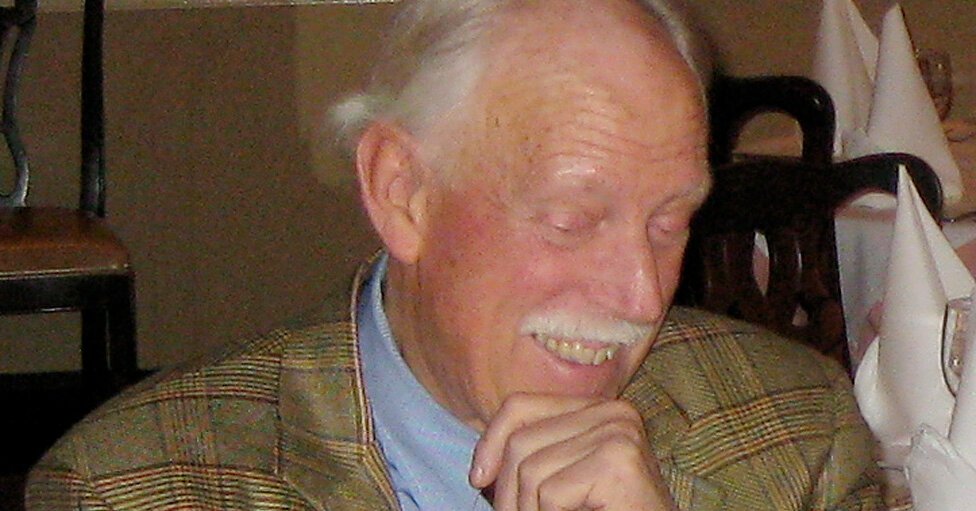
Kendall Myers, who in a double life as a State Department employee and a spy for Cuba — known as Agent 202 — passed sensitive intelligence to his handlers during foreign trips, through shortwave radio messages and in package drops in supermarket shopping carts, died on March 12 in Springfield, Mo. He was 88.
The cause of his death, in a prison medical center, was cancer, his daughter, Amanda Myers, said.
At the time of his death, which was not widely reported, Mr. Myers was serving a life sentence for his conviction for conspiracy to commit espionage and two counts of wire fraud. His wife, Gwendolyn (Steingraber) Myers, his partner in clandestine activities who died in 2015, was sentenced to 81 months — close to seven years — for conspiring to gather and transmit national defense information. She was known as both Agent 123 and E-634.
“We did not act out of anger toward the United States or from any thought of anti-Americanism,” Mr. Myers said, when he pleaded for leniency for his wife during their sentencing hearing in federal court in Washington in November 2009. “We did not intend to hurt any individual American. Our only objective was to help the Cuban people defend their revolution.”
They also forfeited $1.7 million in assets, the sum of the federal salary Mr. Myers had earned over the decades.
In a 30-year scheme that coincided with Mr. Myers’s rise at the State Department to positions that provided him with increasing access to sensitive national security intelligence, the couple helped Cuba amid Cold War tensions between the United States and Fidel Castro’s Communist government.
James Olson, a former C.I.A. counterintelligence chief, who was acquainted with but not involved in the Myerses case, said the damage caused by Mr. Myers to U.S. interests while at the State Department’s Bureau of Intelligence and Research would have been “devastating” because of his top-secret access — sensitive compartmented information — to reports, cables and other types of intelligence.
“He would have been in a position to give them hot-off-the-press information about what was going on within the intelligence community at the State Department,” Mr. Olson said in an interview.
Mr. Myers copied, memorized or stole State Department files, and Ms. Myers, a bank employee, prepared them to be handed over to their handlers. They met with Cuban agents in Cuba, Mexico, Argentina, Brazil, Ecuador and Trinidad and Tobago. In 1995, they traveled to Cuba under false names and met with Mr. Castro for four hours in the house where they were staying.
“Fidel is just wonderful, just wonderful,” Mr. Myers said in 2009 to an undercover F.B.I. agent involved in ending the couple’s clandestine activities. Ms. Myers called Castro “an incredible statesman.”
They were, according to a Times account in 2009, apparently motivated by political sympathy for Cuba, not money. They were reimbursed for a shortwave radio and other equipment but otherwise did not receive pay.
“I make the case that ideological spies are the toughest to catch,” Mr. Olson said, “because there are no flashy expenditures.”
In 1978, when Mr. Myers first traveled to Cuba — at the invitation of a Cuban government official he had met through the State Department — he visited the Museum of the Revolution in Havana.
“Cuba is so exciting!” he wrote in a diary that the F.B.I. found in the couple’s apartment in Washington. “Facing step by step the historic interventions of the U.S. into Cuban affairs, including the systematic and regular murdering of revolutionary leaders left me with a lump in my throat.”
He continued: “The revolution is moral without being moralistic. Fidel has lifted the Cuban people out of the degrading and oppressive conditions which characterized pre-revolutionary Cuba. He has helped the Cubans to save their own souls.”
Six months after the trip, while Mr. Myers was living briefly in South Dakota with Ms. Steingraber before their marriage, an agent of the Cuban Intelligence Service recruited him as a spy.
The quality — and sensitivity — of the information that he and his wife provided the Cubans improved as he moved up at the State Department. Starting in the late 1970s, he was an instructor in its Foreign Service Institute, the agency’s training arm in Arlington, Va., and he later had positions within the bureau of intelligence, eventually as senior intelligence analyst of European countries from 2001 to 2007.
Their scheme unraveled in 2009, when they were contacted by an undercover F.B.I. agent posing as a Cuban intelligence agent. Mr. Myers had retired from the State Department two years earlier and, while he and his wife were still in contact with Cuban intelligence, their espionage had slowed significantly.
Still, court documents say that the F.B.I. had, at some point, identified “high frequency messages” that were sent by Cuban intelligence to a handler of the Myerses. Nonetheless, the approach by the F.B.I. agent did not arouse the couple’s suspicious.
Asked if he had ever provided Cuban intelligence with information that had been classified more than Secret, Mr. Myers said, “Oh, yeah.”
After a few meetings with the undercover agent, the Myerses were arrested in early June 2009 and quickly indicted in federal court in Washington.
“They always understood that they might some day be called to account for that conduct and always have been prepared to accept full responsibility,” Bradford Berenson, the Myerses’ lawyer, said in a statement after the couple pleaded guilty.
Walter Kendall Myers Jr. was born on April 15, 1937, in Washington. His father, Walter Sr., was a physician, and his mother, Carol (Grosvenor) Myers, ran the home. He was also a great-grandson of Alexander Graham Bell, the inventor who received the first U.S. patent for the telephone, and a grandson of Gilbert H. Grosvenor, a former chairman of the National Geographic Society.
In 1958, he interrupted his studies in history at Brown University to begin a four-year stint in the Army, first in language school in Monterey, Calif., then as a Czech interpreter in Germany until 1962.
He graduated from Brown in 1963 with a bachelor’s degree, then earned a master’s degree in 1966 and a Ph.D. in 1972 from the Johns Hopkins School of Advanced International Studies.
Mr. Myers taught Western European studies at Johns Hopkins from 1971 to 1977, which overlapped with his job as a contract instructor with the Foreign Service Institute.
After two years, he and Ms. Steingraber moved to South Dakota for a year, where they promoted solar energy and grew marijuana in their basement. They married in 1982.
In addition to his daughter, Amanda, Mr. Myers is survived by a son, Michael, both from his first marriage, to Maureen Walsh, which ended in divorce; three stepchildren, Jill Liebler and Bob and Brad Trebilcock; a sister, Elsie Martin; three brothers, Gardiner, Martin and Aleck; and four grandchildren.
Mr. Myers, whose family said continued to teach part-time at Johns Hopkins until his arrest, retired from the State Department in October 2007, all but ending his adventure in espionage. But when he was contacted by the undercover F.B.I. agent in 2009, he was happy to re-establish his ties to Cuba.
“We really have missed you,” he told the agent. “You, speaking collectively, have been a really important part of our lives, and we have felt incomplete.”