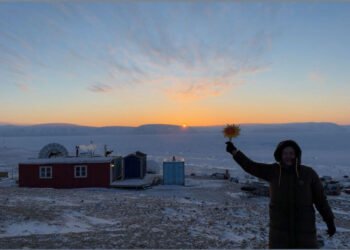
Biologists and trappers stand once again on opposite sides. NAMMCO again recommends that the capture of narwhals and beluga whales in East Greenland be stopped because the populations are threatened.
However, the prisoners completely disagree. A trapper from Ittoqqortoormiit has previously said that there are far more whales than the counts show. And if the capture of narwhals is stopped, it will mean the end of the trapping industry. Naalakkersuisoq for capture, Peter Borg, listens to the prisoners’ concerns.
Biologists and trappers stand once again on opposite sides. NAMMCO again recommends that the capture of narwhals and beluga whales in East Greenland be stopped because the populations are threatened.
However, the prisoners completely disagree. A trapper from Ittoqqortoormiit has previously said that there are far more whales than the counts show. And if the capture of narwhals is stopped, it will mean the end of the trapping industry. Naalakkersuisoq for capture, Peter Borg, listens to the prisoners’ concerns.
– It is of course thought-provoking to hear. I also think it is important to say that NAMMCO has scientifically recommended stopping the catch since 2019, so this year’s recommendation is not new, says Peter Borg.
They will probably get quotas
This year, a quota of 41 narwhals has been set in East Greenland. If NAMMCO’s and the Nature Institute’s recommendations are followed, the quota should be 0. However, it is naalakkersuisoq for catching that makes the decision on the quotas.
– Right now we are sticking to the line that Naalakkersuisut – also the former Naalakkersuisut – has laid down, with regard to security of supply, cultural traditions and catching methods, so that narwhals can continue to be caught in East Greenland, says Peter Borg and continues:
– No other decision has been made and this is Naalakkersuisut’s current position.

Even so, Peter Borg cannot already say how many quotas there will be for next year. Until the quota allocation, various information, including the catches made this year, will also be decisive and will be included in the evaluation.
Even so, Peter Borg cannot yet say how many quotas there will be next year. In the run-up to quota determination, various information – including the year’s catches – will be included in the evaluation.
Is scientific knowledge necessary?
Since 2019, NAMMCO has recommended that the hunting of narwhals in East Greenland be stopped. However, Naalakkersuisut has since then continued to allocate quotas.
If the recommendations are not followed, is it necessary to count the stocks?
– It is necessary to follow the development scientifically for all animal species – both in the sea and on land, whether it is fish or mammals. But the scientific figures must also be supplemented with local knowledge in the decision-making process, says Peter Borg.
If the collective knowledge of the captives and researchers points to a decline in the narwhal population, it will be considered whether quotas should continue to be given.
– Right now we find ourselves in a careful balance between the two. Time will tell if political decisions are made when both parties present their numbers.
Naalakkersuisoq will travel to Tasiilaq on Saturday, but the prisoners in Ittoqqortoormiit have also invited him to share their knowledge.
– My plans include a visit to Ittoqqortoormiit. It has not yet been decided, but I hope it can be done before the end of the year, as I will also be visiting other places on the coast, concludes Peter Borg.