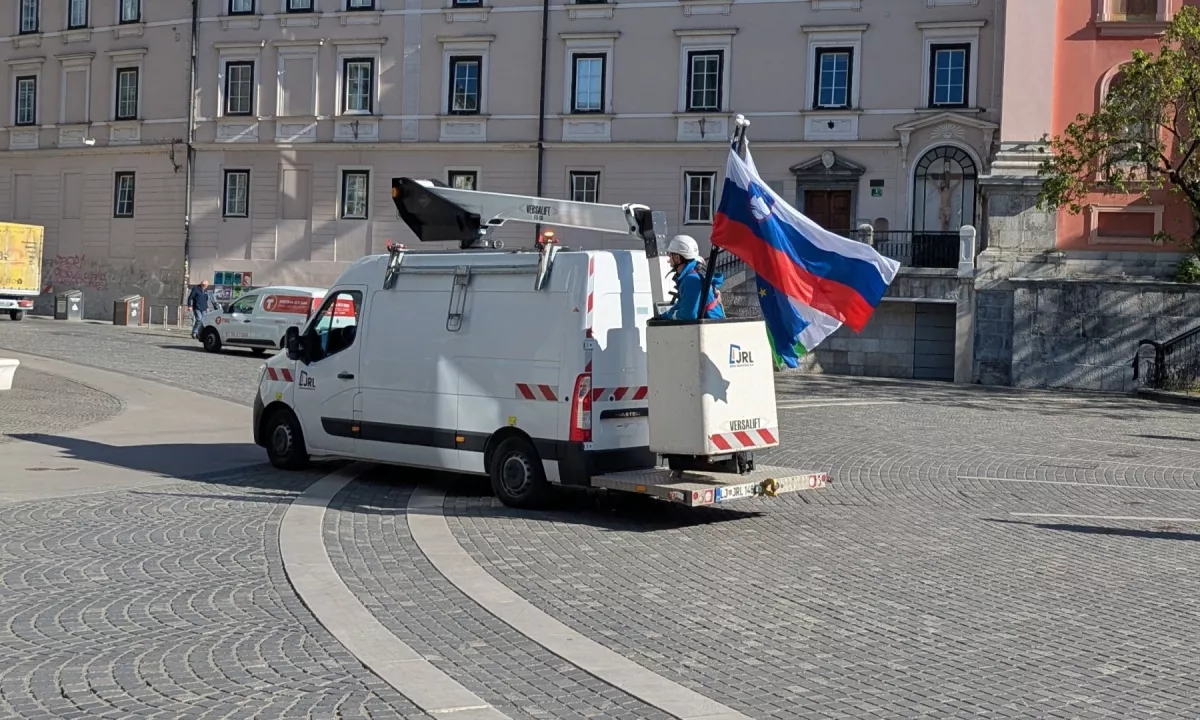
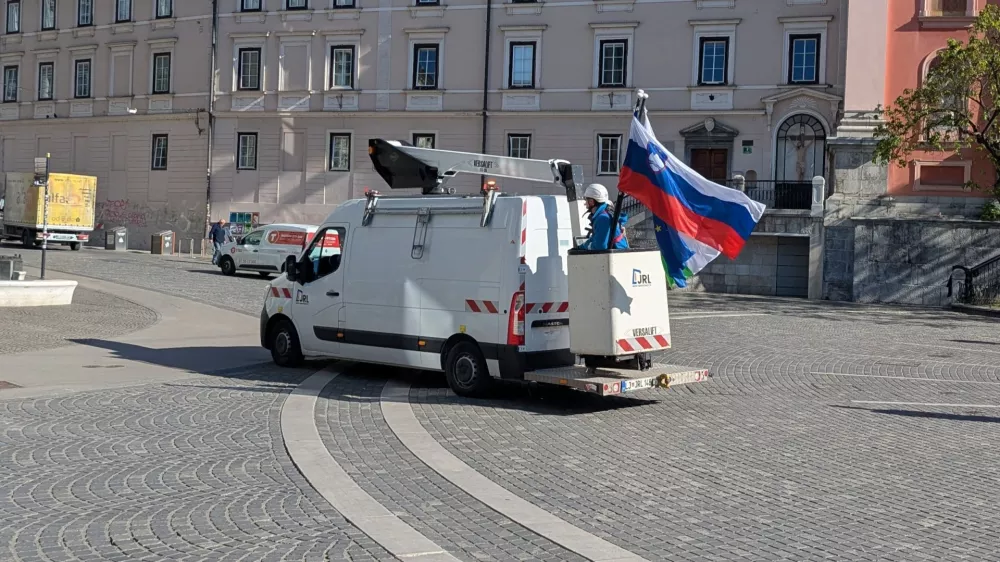
Public lighting vehicle on its way to the next pole. / Photo: Daf
The law is the law: why are the streets of Ljubljana flooded with 1,000 flags before the holidays?
Before most of the people go on their well-deserved May Day break, Public Lighting workers hang hundreds of flags on the street lamps and thus ensure a flawless festive scene.
As if watching communal workers in Paris preparing the Champs Elysées for July 14th with charm and a cigarette in the corner of their mouth, a similar, albeit distinctly Slovenian, spectacle is taking place on the streets of Ljubljana these days. The main actors? Workers of Public Lighting Ljubljana. Their stage? A small truck or van with a lift and basket. Their mission? Saving national pride ahead of the upcoming double holidays – 27th April and 1st and 2nd May.

FLAG DAY
On this day in 1848, our flag was hoisted for the first time. Where is the biggest feather?
Spring in Ljubljana does not only bring blooming chestnuts and full terraces along the Ljubljanica. It also brings that familiar, slightly noisy sound of hydraulics, when boys in blue or yellow jackets rise above confused cyclists and tourists to hang a Slovenian tricolor, a Ljubljana bicolor and a European monocolor on every street lamp. It’s a real heroic ballet that turns Ljubljana into a holiday capital, even before most of its inhabitants have even packed their bags for the traditional escape to the coast.
Watching Public Lighting workers at work is like watching a well-tuned orchestra, which is what we experienced these days in the city center. The truck stops (often where the traffic is the most disruptive, but that’s part of the charm), the elevator squeals, the flag sways in the spring breeze, and they’re already at the next light.
In order for the contrast between those who work (elevator workers) and those who will celebrate Labor Day to be perfect, the city must be impeccably decorated.
Slovenian flag-hanging culture is actually a fascinating mixture of legal obligation and folk folklore. If in Italy and France, for example, flags are proudly waved at every goal of the national football team or at a piece of good cheese, in Slovenia this culture is somewhat more structured.
Law is law here. State institutions and local communities must display the flag. That’s why the guys from Public Lighting don’t have a choice – the street lamps can’t be left bare.
However, if a precise statistical analysis were to be carried out, it would be immediately apparent that the rate of hanging flags on private houses grows exponentially with the distance from the center of the capital. In Ljubljana, flags mostly hang from the facades of state institutions and on street poles. In the countryside (I think especially in Gorenjska and Primorska), neighborhood prestige, who will have the higher pole and the prettier flag in front of the house, is still very much alive.
The culture of festive home decoration dates back to the times of the national awakening in the 19th century, but it was strongly consolidated during the former Yugoslavia, when it was an offense not to display the flag on May 1. Today it is an act of relaxed patriotism.
And how to hang the flag correctly? The flag must be attached to a pole that is placed vertically or at an angle. If the flag is displayed on a pole, the colors of the flag must be arranged from top to bottom in the following order: white, blue, red. The coat of arms must be, viewed from the front, on the left side of the flag in the upper left part.
So while you’re sipping your coffee for the holidays, escaping the rain at the bonfire, or waiting in queues at toll booths heading south, remember the guys from the little truck with the lift basket.
They are the ones who, from a height of a few meters, made sure that the city breathes with holidays. So the next time you have to cycle around their orange cone, don’t grumble. You’d better wave to them – after all, they are the real garages that allow us to rest in peace and aesthetically perfect surroundings on Labor Day.