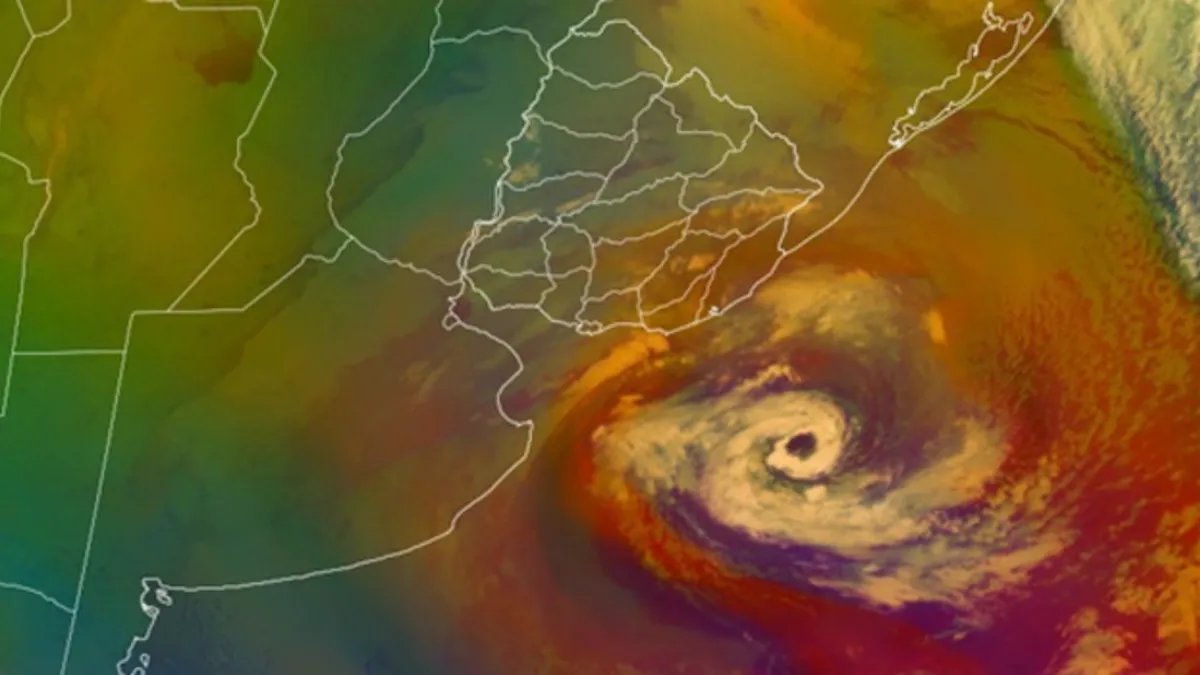
He Uruguayan Institute of Meteorology (INUMET) issued a new meteorological alert due to the beginning of a period of instability that will affect the country, with strong storms and punctually severe, rains of varying intensity and intense winds.
The phenomenon, classified as a extratropical cyclonewill implode in the afternoon and evening of Tuesday, with rainfall, some locally intense, mainly in the north and center of the territory.
“We are going to have winds of 60 to 80 km/h; they are dangerous winds and that will cause the thermal sensation to be around 0 °C and, at times, below”added the meteorologist Nubel Cisnerosby delving into the conditions expected for the next few hours.
The expert also commented that “Even in the east there can be some higher gusts. Very low thermal sensations: dress warmly”.
What is the difference between a cyclone, tropical cyclone and extratropical cyclone?
The glossary of INMUET difference to the cyclones, tropical and extratropical cyclones based on their degree of latitude of development and potential.
| Characteristics | |
| Cyclone | It is a system of closed concentric isobars in which the minimum pressure is located in the center. The circulation is clockwise. This phenomenon causes convergence and convection, which is why it is associated with the presence of great cloudiness and rain. |
| tropical cyclone |
It is a cyclone, which does not present fronts; It develops over tropical waters and has an organized and defined surface circulation in the counter-clockwise direction. A cyclone is classified, according to the intensity of its winds, into: tropical disturbance, light surface winds; tropical depression maximum surface winds of 61 km/hr; tropical storm maximum winds within the range of 62 to 87 km/hr; hurricane maximum surface winds greater than 116 km/hr. Hurricanes are in turn divided into 5 categories according to the speed of their winds, as seen in the table. Category Wind speed Cat. 1 118 at 153 km/h Cat. 2 154 to 177 km/h Cat. 3 178 to 209 km/h Cat. 4 210 to 249 km/h Cat. 5 250 km/h |
| Extratropical cyclone |
It is a cyclone that forms at latitudes greater than 30°, it is composed of two or more air masses, therefore it is associated with one or more fronts. |
The general terms, a cyclone configures, then any low atmospheric pressure system with wind circulation around a center, regardless of where it is formed or how it obtains its energy.
image
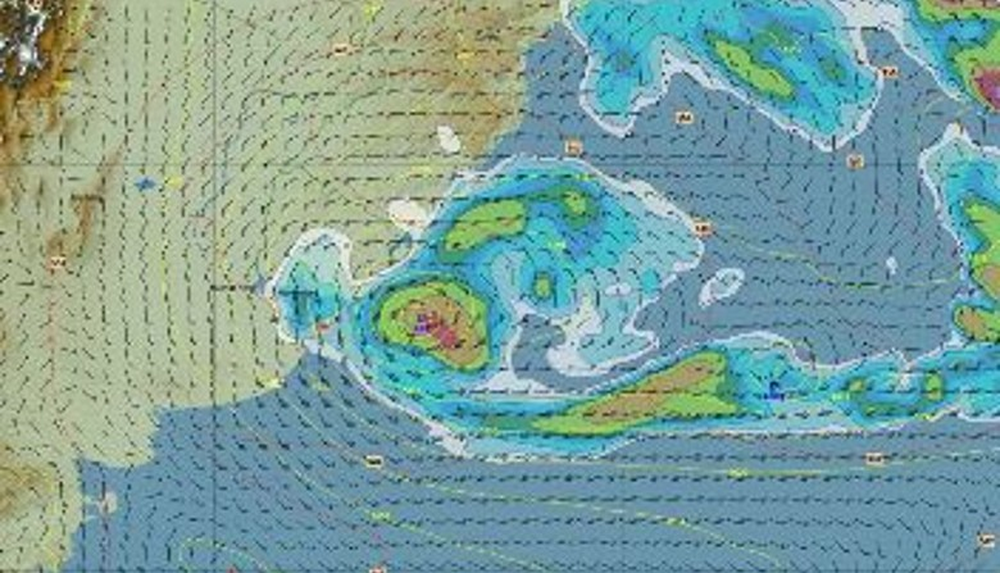
Within this category, tropical and extratropical cyclones are distinguished.
a) The former develop over warm waters of tropical or subtropical regions. They are characterized by having a “warm core”symmetrical structure and thunderstorms organized around a defined center and their energy comes mainly from the heat released by the ocean, allowing their intensification under favorable conditions.
b) On the other hand, the extratropical cyclones They form outside the tropics, in middle latitudes. Unlike the previous ones, they have a “cold core”are asymmetric and are associated with meteorological fronts. Its energy does not come from the warm ocean, but from temperature contrasts between air masses, a process known as baroclinic dynamics.